The first decision is whether you buy soap noodles or saponify palm oil, tallow or other fats yourself, because that sets the whole plant. CISH supplies, installs and commissions complete bar soap lines; for a small manual or liquid soap set, a local supplier is usually the better buy.
Soap making machine prices, 2026
| What you buy | Typical output | Indicative price (2026) | Fits |
|---|---|---|---|
| Manual or small-batch bar soap equipment | Small batches, hand cutting | Bought locally; a fraction of the sets below | Home and village soap makers |
| Liquid soap and detergent mixing and filling set | Batch tanks of a few hundred litres, small filler | About US$20,000–60,000 | Liquid hand soap, dishwashing liquid, detergents |
| Washing powder blending set | 50–500 kg batches | About US$3,000–45,000 | Blended (not spray-dried) powder |
| Soap noodle finishing line | 100–500 kg/h | About US$20,000–100,000 | Bar soap from bought-in noodles |
| Complete soap line from oils and fats | 300–1,000 kg/h | About US$150,000–400,000 | Laundry and toilet soap brands |
| Spray-dried washing powder tower | Tonnes per hour | Quoted per configuration | Large detergent makers |
Prices are for equipment in US dollars, before freight, clearance, installation and building work. Locally made small equipment is bought in shillings; we do not convert it.
Noodles or oil: the decision that sets the plant
| Finishing from soap noodles | Making soap from oils and fats | |
|---|---|---|
| Raw material | Bought-in soap noodles, perfume, colour | Palm oil, palm stearin, tallow or other fats, caustic soda |
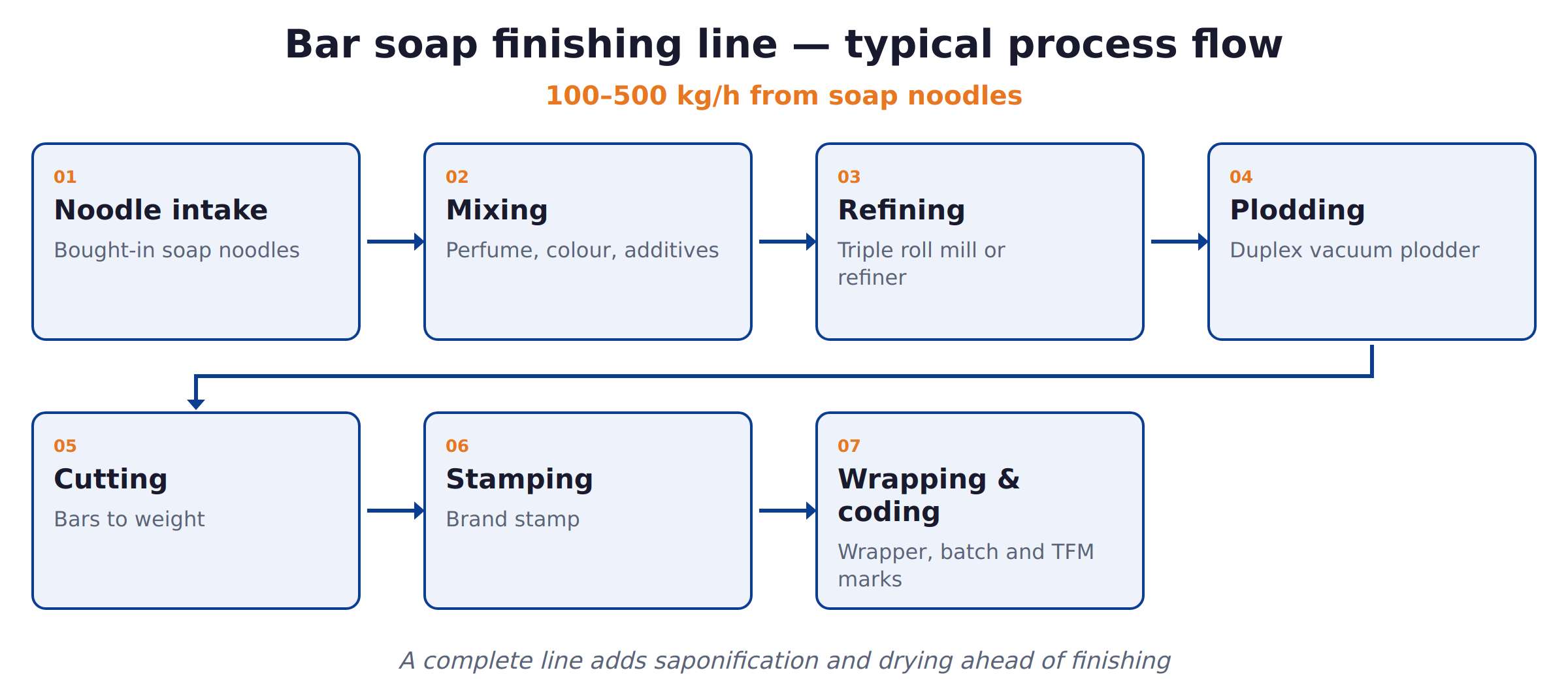
| Main equipment | Mixer (amalgamator), refiner, plodder, cutter, stamper, wrapper | Saponification, drying, plus everything in the finishing line |
| Capital | Lower | Several times higher |
| Margin | Thinner; noodles are someone else's value added | Higher, if you buy fats well |
| Skills | Mixing, perfuming, stamping | Chemistry, steam, process control |
| Utilities | Power, small compressor | Boiler or steam supply, more water and power |
Many new soap makers in Kenya start by finishing noodles and add saponification later. That works if the building leaves space for the kettle or continuous saponifier and its steam supply.
Laundry bars or toilet soap?
- Laundry bars sell on price per bar and washing power. Total fatty matter and hardness matter, and laundry soap has its own East African standard.
- Toilet (beauty) soap sells on perfume, feel and packaging. It is made to EAS 186-1:2021, Bathing soap, Part 1: Solid, adopted in Kenya as KS EAS 186-1:2021. In the text published for comment in 2020, toilet soap keeps the 76% minimum total fatty matter of the 2011 edition, free caustic alkali is limited to 0.1% as NaOH, and a new bathing bar category needs at least 50%. A further revision is in draft, so confirm the edition in force with KEBS.
- Antibacterial toilet soap and bathing bars sit in the same standard, with the antibacterial agent declared on the label; check carbolic and other medicated soaps separately.
Every wrapped cake of toilet soap must show the product and brand name, the maker's name and address, batch identification, the TFM, net mass and country of origin. Plan the stamp, wrapper and coding equipment around those marks.
Palm oil and tallow supply
Kenya depends heavily on imported palm oil. USDA projections reported by Food Business MEA put palm oil imports at about 1.05 million tonnes in the 2025/26 season, covering more than 90% of the country's oil and fat use, with crude palm oil making up most of the volume and Malaysia supplying most of it. For a soap maker, that means:
- Fat prices follow world palm oil prices and the shilling.
- Palm stearin and palm fatty acid distillate from local refineries are often cheaper soap fats than refined oil.
- Tallow from abattoirs is a local alternative, but quality and supply vary.
Ask any line supplier which fat blends their saponification section handles, because the plant must be set for your fats.
Who sells soap making machines in Kenya
- Jua kali and local fabricators make mixing tanks, cutters, moulds and stamping presses for small soap makers.
- Dealers sell imported plodders, mixers and stamping machines.
- Chinese factories selling direct offer finishing lines, saponification plants and complete lines by catalogue.
- Turnkey companies design the plant from fats to wrapped bars and commission it on your formula.
Soap machine sellers are not named or ranked on this page. Ask every seller for output in kg per hour at your bar size and TFM, and to show a line running on a formula like yours.
What a complete bar soap line includes
- Fat storage and melting: tanks with heating for palm oil, stearin or tallow.
- Saponification: batch kettles or a continuous saponifier, with caustic dosing.
- Drying: vacuum spray drier to bring neat soap to noodle moisture.
- Mixing (amalgamating): perfume, colour and additives.
- Refining and plodding: triple roll mill or refiner, then a duplex vacuum plodder.
- Cutting and stamping: bars to weight and shape, with the brand stamped on.
- Wrapping and coding: wrapper, batch code and TFM marking.
- Utilities: boiler or steam supply, compressed air, cooling water, power.
- Laboratory: TFM, free alkali and moisture testing.
Power and steam in Kenya
A finishing line mainly uses electricity for mixers, refiners and plodders. A saponification plant adds steam for heating and drying. Kenya's electricity bills include pass-through charges; the fuel energy cost charge on its own was about KES 3.5 for each unit of electricity in August 2026. Ask each seller for installed kW and steam demand in kg per hour, so you can size the boiler and the supply.
Importing a soap line into Kenya
| Cost or step | Notes |
|---|---|
| Duty | Soap making machinery normally comes in free of duty under the EAC tariff; check each HS code |
| VAT | 16% on the import value plus duty |
| IDF | 2.5% Import Declaration Fee on customs value |
| RDL | 2% Railway Development Levy on customs value |
| PVoC | KEBS verifies regulated items before they leave the exporting country |
| Port | Mombasa, with inland transport by rail or road |
Worked example: starting from noodles
An illustration only:
| Item | Assumption |
|---|---|
| Product | 200 g laundry bars and 100 g toilet soap |
| Line | Noodle finishing line at about 300 kg/h |
| Price | Within US$20,000–100,000, depending on refiner, plodder and stamper |
| Raw material | Bought-in soap noodles at the TFM you need |
| Later step | Add saponification when volume and fat buying justify it |
| Approvals | Product certification and labelling that meet the standard |
How to compare quotes
- Output in kg per hour at your bar size.
- Noodle finishing only, or saponification included.
- Fats the saponifier handles, and the TFM it reaches.
- Refiner and plodder size and vacuum.
- Stamper type and dies for your bar shape.
- Wrapping and coding equipment.
- Steam demand, installed power and water.
- Laboratory equipment for TFM and free alkali.
- Installation, commissioning on your formula, and training.
- Warranty and support.
Mistakes we see
- Buying a stamper before fixing the bar weight and shape. Dies are made for one design.
- No lab. Without TFM and free-alkali tests you cannot label correctly.
- Wrong fat blend for the plant. Bars crack, sweat or go soft.
- Ignoring steam. Saponification needs a boiler or steam supply sized for the plant.
- Skipping the label rules. Product category, batch, net content, origin, ingredients and dates must be on each package.
- Starting with saponification before having buyers.
What we see in Kenya
- Imported fat. Palm oil, mostly crude and mostly from Malaysia, covers the bulk of Kenya's oil and fat use, so fat prices drive soap prices.
- Forecast imports. About 1.05 million tonnes of palm oil were projected for the 2025/26 season.
- Clear labelling rules. The current standard asks each package to show the product category, maker's name and address, batch or lot number, net content, country of origin, ingredients and dates of manufacture and best before. The 2011 edition also required the TFM on each wrapped cake, and many buyers still expect it.
- A minimum TFM. 76% total fatty matter for toilet soap, unchanged from the 2011 edition; 50% for a bathing bar.
- Separate standards by soap type. Laundry bars and bathing soaps are covered by different East African standards.
- No duty on most machinery. Soap machines usually enter without EAC duty, with VAT, IDF and RDL on top.
- Power pass-throughs. The fuel energy cost charge adds to every kWh, which matters for refiners and plodders.
- Local fabrication. Jua kali workshops supply tanks, cutters and moulds for small soap makers.
Where CISH fits
CISH supplies, installs and commissions complete bar soap lines from audited factories in China, from noodle finishing to full saponification, drying, plodding, stamping and wrapping, with the import into Kenya arranged and the line commissioned on your formula. For manual soap equipment or a small liquid soap set, a local supplier is usually the better choice, and we will say so.