Products sold in shops are expected to meet KEBS standards and carry the Standardization Mark. The East African standard for toilet soap, now EAS 186-1:2021, keeps a minimum total fatty matter of 76% and limits free caustic alkali to 0.1%, and asks each package to show the product category, batch, net content, origin, ingredients and dates. Palm oil, Kenya's main soap oil, is mostly imported: USDA forecast about 1.05 million tonnes of palm oil imports for 2025/26. Imported machines usually enter at 0% EAC duty, with 16% VAT, the 2.5% IDF and the 2% RDL. CISH supplies, installs and commissions complete soap and detergent lines.
Step 1: liquid or bar?
| Liquid soap and detergents | Bar soap | |
|---|---|---|
| Products | Multipurpose liquid soap, dishwashing liquid, hand wash | Laundry bars, toilet soap |
| Raw materials | Surfactants (such as LABSA), caustic soda or neutralisers, salt, thickener, fragrance, colour, preservative | Soap noodles, or oils and caustic soda; fragrance, colour |
| Equipment | Mixing tanks, filling, capping, labelling | Noodle finishing line or full saponification and finishing |
| Investment | Lower | Higher |
| Customers | Households, schools, hotels, offices, cleaning companies | Shops, supermarkets, wholesalers, hotels |
Many businesses start with liquid products and add bars once they have buyers and capital.
Step 2: standards and permits
- Business registration and a KRA PIN; a county business permit.
- KEBS: soaps and detergents sold in shops are expected to meet Kenyan or East African standards and carry the KEBS Standardization Mark, which involves product testing and factory inspection.
- Toilet soap: EAS 186-1:2021, Bathing soap, Part 1: Solid (KS EAS 186-1 in Kenya), keeps the 2011 edition's 76.0% minimum total fatty matter and, in the text published for comment in 2020, limits free caustic alkali to 0.1% as NaOH; a bathing bar needs at least 50%. Each package shows the product category, maker, batch, net content, origin, ingredients and dates; the 2011 edition also required the TFM on each bar. A further revision is in draft, so confirm the edition in force with KEBS.
- Labels: product name, net quantity, directions, warnings where needed, batch and your details.
- Workplace safety: caustic soda and concentrated surfactants are hazardous; train staff and provide protective equipment.
Step 3: raw materials
Palm oil and palm kernel oil are the main oils for bar soap. Food Business MEA, citing USDA, reported Kenya's palm oil imports forecast at about 1.05 million tonnes for 2025/26, mostly crude palm oil, so prices follow world markets and the shilling. Many bar soap makers buy imported soap noodles rather than oils, which removes the saponification step. Liquid soap makers buy surfactants and chemicals from chemical distributors. Test each delivery and keep records.
Step 4: equipment and costs
| Purchase | Use | Indicative price (2026) |
|---|---|---|
| Liquid detergent mixing and filling set | Mixing tanks, filler, capper | About US$20,000–60,000 |
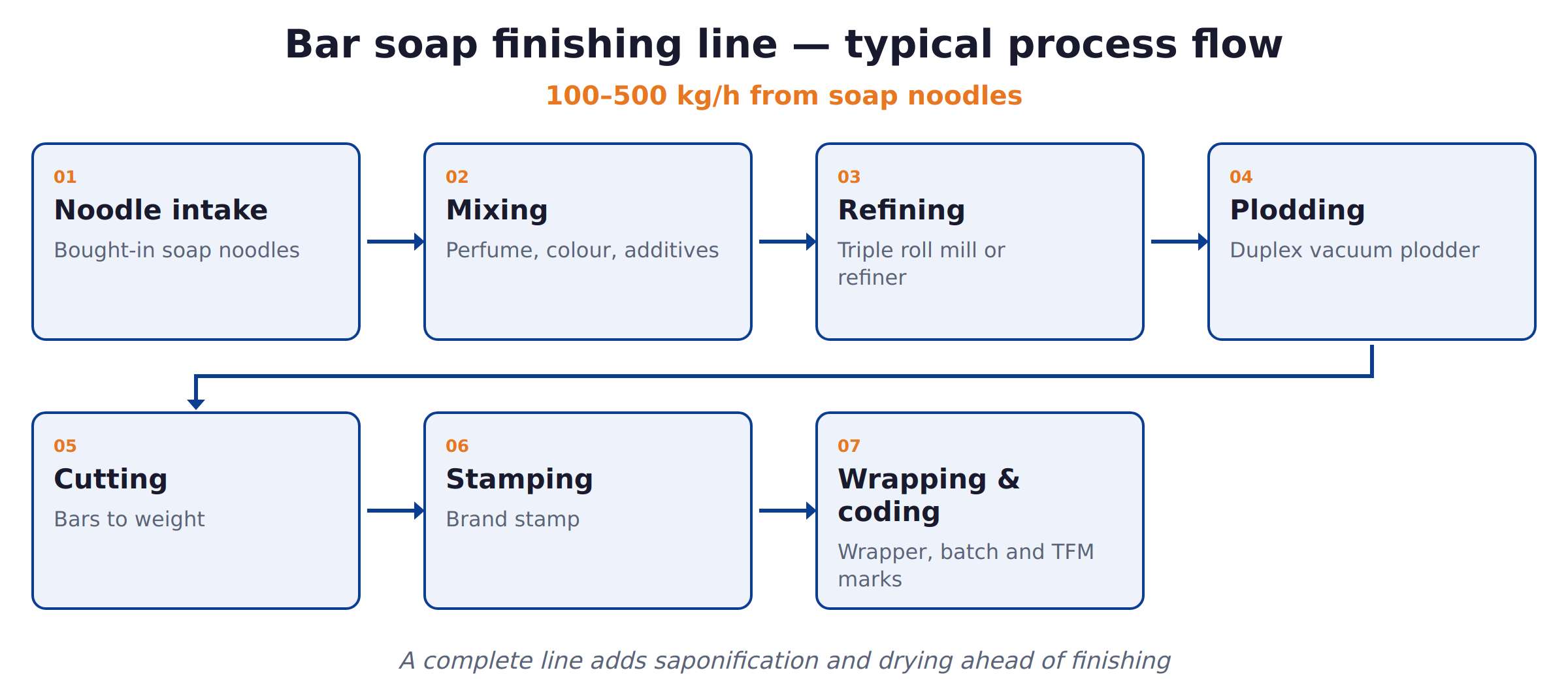
| Soap noodle finishing line | Mixing, refining, plodding, cutting, stamping | About US$20,000–100,000 for 100–500 kg/h |
| Complete bar soap line | Saponification from oils, drying, finishing | About US$150,000–400,000 for 300–1,000 kg/h |
Our soap making machine price guide breaks the lines down. Local jua kali workshops can make tanks, stands and simple mixers; our guide to machinery companies in Kenya explains where they fit.
Step 5: power and premises
A soap factory needs three-phase power for mixers, plodders and pumps, water, drainage, a chemical store, and space for finished stock. EPRA's fuel energy cost charge was about KES 3.5 per kWh in August 2026, on top of Kenya Power's tariff. Saponification also needs steam or heating.
Step 6: importing equipment
Capital goods usually enter Kenya at 0% under the EAC CET. Import VAT is 16%, the Import Declaration Fee 2.5% and the Railway Development Levy 2% of customs value, and regulated goods need KEBS pre-export verification before shipment.
Step 7: the numbers and the market
Cost per bar or bottle is raw materials, fragrance, packaging, labour, power, testing, rent, transport and finance. Bar weight and fill accuracy matter: small overfills on every unit add up. Sell to shops and wholesalers in your area, to schools, hospitals and hotels on supply contracts, and to cleaning companies in bulk. Supermarkets need the KEBS mark and steady supply.
Worked example: a liquid soap maker adds bars in Machakos
A business in Machakos makes multipurpose liquid soap in 20-litre jerrycans for schools and hotels. Shops ask for laundry bars. The owner gets KEBS certification for the liquid soap first, then installs a noodle finishing line of about 200 kg an hour with a mixer, refiner, plodder, cutter and stamper, and buys laundry noodles. Bars are marked with TFM, batch and net weight, and sold to shops and wholesalers in the county. The figures are illustrative.
Common mistakes
- Selling without KEBS certification.
- Bars below the TFM that buyers and inspectors check.
- Unsafe caustic soda handling.
- Underweight bars or short fills.
- Starting with saponification before having customers.
What we see in Kenya
- Liquid soap is the most common starting product.
- Laundry bars sell widely in shops.
- Palm oil is imported, so prices follow world markets.
- KEBS certification is expected for products in shops.
- Jua kali workshops make tanks and simple equipment.
- Capital goods usually enter duty-free under the EAC CET.
Packaging and brand
Liquid soap sells in bottles for households and in 5 and 20-litre jerrycans for schools, hotels and offices; bars sell wrapped or in multipacks. Choose bottles and jerrycans that do not leak, caps that seal, and labels that stay on when wet. Print the product name, net quantity, directions, batch and your details on every pack, and keep the design consistent so customers recognise you.
Quality checks
Check liquid soap for active content, thickness, pH and fragrance on every batch, and bars for weight, TFM and free alkali at a laboratory regularly. Keep retained samples and batch records, because buyers and KEBS inspectors will ask for them.
Safety first
Keep caustic soda and concentrated surfactants in a locked, labelled store, train staff in safe handling, and keep water and an eyewash close to mixing areas.
Where CISH fits
We supply complete soap and detergent lines, liquid mixing and filling, noodle finishing and full saponification, from audited factories in China, sized to your products and output. CISH ships to Mombasa, clears, installs and commissions the line on your materials, and trains your team. For simple tanks and mixers, a local jua kali workshop is usually the better buy.