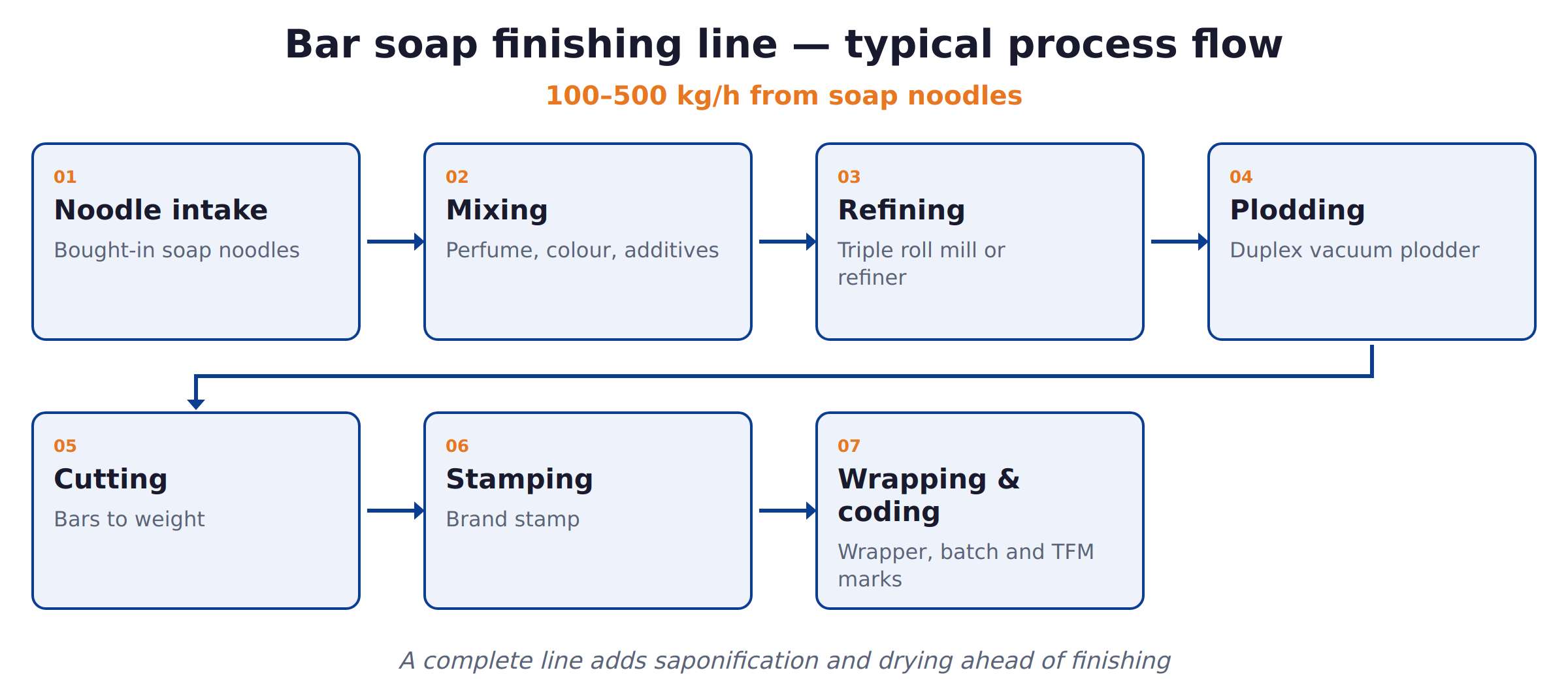
There are two ways to make bar soap. A finishing line buys soap noodles, the dried soap base made elsewhere, and mixes, plods, extrudes, cuts, stamps and packs them into bars; it is cheaper and simpler. A complete line saponifies oils and fats, usually palm oil, palm kernel oil or tallow, with caustic soda, then dries the soap into noodles and finishes them; it costs more but controls the raw material cost and quality. Equipment landed at Dar es Salaam typically costs about 1.25–1.45 times its ex-works price. Soap sold in Tanzania must meet the relevant TBS and East African standards, such as EAS 186-1:2021 for toilet soap and bathing bars, which set limits such as total fatty matter.
Soap machine prices, 2026
| What you buy | Capacity | Indicative price (2026) |
|---|---|---|
| Soap noodle finishing line | About 100–500 kg/h | About US$20,000–100,000 ex-works |
| Complete soap line (saponification to bars) | About 300–1,000 kg/h | About US$150,000–400,000 |
| Liquid detergent mixing and filling set | Batch tanks of a few hundred litres | About US$20,000–60,000 |
| Washing powder blending set | 50–500 kg batches | About US$3,000–45,000 |
| Landed at a coastal port | All | About 1.25–1.45 times the equipment price |
Finishing line or complete line?
| Finishing line (noodles to bars) | Complete line (oils to bars) | |
|---|---|---|
| Raw material | Imported or locally bought soap noodles | Palm oil, palm kernel oil, tallow, caustic soda |
| Equipment | Mixer, plodder, extruder, cutter, stamper, packer | Saponification, drying, plus finishing |
| Investment | Lower | Higher |
| Skill | Moderate | Chemical process skill and laboratory |
| Control of cost | Depends on noodle price | Controls fats and formulation |
Many new producers start with a finishing line and add saponification when volumes and raw material supply justify it.
What is in a bar soap finishing line
- Mixer (amalgamator): blends noodles with colour, perfume and additives.
- Roller mill (optional): refines the mix for toilet soap.
- Plodder: compacts and extrudes the soap into a continuous bar.
- Cutter: cuts the bar to length.
- Stamper: presses logos and shapes for toilet soap.
- Packing: wrapping or cartons.
Raw materials
Bar soap is made from fats and oils, palm oil, palm kernel oil, coconut oil or tallow, with caustic soda, fillers, colour and perfume. Laundry soap often uses more fillers; toilet soap needs higher fatty matter and refined ingredients. Price swings in palm oil and caustic soda drive your cost, so agree supply with more than one supplier and keep stock.
Standards and quality
Soap must meet the relevant TBS standard for its type. East African Standards such as EAS 186-1:2021 for toilet soap and bathing bars set requirements including total fatty matter (at least 76% for toilet soap) and free alkali. Test each batch, keep records, and label bars correctly. Supermarkets and public buyers ask for product certification.
What drives the price
- Capacity in kilograms an hour.
- Finishing only or saponification.
- Toilet soap equipment: roller mills and stampers add cost.
- Drying system for noodles in complete lines.
- Automation and packing.
- Materials: stainless steel where the soap touches equipment.
Landed cost in Tanzania
Soap plodders, mixers, cutters, stampers and saponification equipment are capital goods that generally enter duty-free under the EAC tariff, subject to their codes; dies, wrapping materials and spare parts may be classified separately. VAT of 18% applies at import unless the plant qualifies for TRA's deferment. Check whether electrical items or packaging materials appear on TBS's PVoC list before shipping. A complete soap plant also needs a building, drainage for wash water, a steam or heating system for saponification, caustic storage, installation and training. Our guide to importing a production line into Tanzania covers the route.
Liquid soap and detergents
Liquid hand soap, dishwashing liquid and liquid detergents are made by mixing surfactants, water and additives in tanks, then filling bottles or jerrycans. The equipment is simpler and cheaper than a bar soap line. Many soap makers add liquids to use the same distribution.
Site, power and safety
Soap plants need three-phase power, water, a dry store for raw materials and finished bars, and safe handling of caustic soda: protective equipment, eye wash and training. Complete lines with saponification need steam or heating.
How to compare quotes
Ask each supplier for output in kilograms an hour for your bar size, the soap type, which machines are included, power and heating needs, materials, moulds and dies for your bar shapes, installation, commissioning, training and spares. Our page on soap machine prices in Kenya shows how the market compares next door.
Common mistakes
- Saponification without a laboratory or chemical skills.
- Low fatty matter that fails standards.
- No dies for the bar shapes buyers want.
- Unsafe caustic handling.
- No plan for raw material price swings.
Who buys bar soap
Laundry bar soap is a daily household purchase across Tanzania, sold through wholesalers, distributors, shops, kiosks and markets, often cut into pieces for low-income buyers. Supermarkets stock branded laundry and toilet soaps. Institutions such as schools, hospitals and hotels buy in bulk, sometimes through tenders. A new brand competes on price, consistency of the bar, how long it lasts in washing, and availability in shops. Distribution, getting bars into thousands of small shops, is often harder than making them, so plan distributors and transport early.
Bar sizes, shapes and packing
Laundry bars are usually extruded and cut to standard lengths and weights; toilet soap is stamped into shapes with a logo and wrapped. Agree bar weights with your buyers and check them on the line, because underweight bars break trust and may break labelling rules. Choose wrapping and cartons that protect bars from moisture in transport and storage.
A laboratory for every batch
Even a finishing line needs a small laboratory to check moisture, total fatty matter and free alkali, because noodle quality varies between deliveries. A complete line needs more: checks on oils, caustic strength and the saponification reaction. Results go into batch records that TBS and buyers will ask to see.
Starting small and growing
A common path is to start with a finishing line for one laundry bar, build distribution, then add a toilet soap line or liquid soaps, and finally saponification when volumes justify buying oils in bulk. Each step should be paid for by sales from the last. Keep the first line simple and reliable, and add equipment only when orders are waiting.
Where CISH fits
We supply bar soap finishing lines, complete saponification lines and liquid soap sets, from audited factories in China, sized to your soap and tonnes. CISH ships the line, installs and commissions it on your raw materials, and trains your team. For a single small plodder or cutter, a local dealer is usually the better buy.