Nigeria has a large soap and detergent market, served by small hand-made producers, medium brands and large manufacturers. Soaps and detergents are regulated products under NAFDAC, so register each product before sale. Imports pay ECOWAS CET duty plus surcharge, CISS, ETLS and 7.5% VAT, and plodders and boilers need reliable power. CISH supplies, installs and commissions complete soap and detergent lines.
Soap and detergent machine prices in Nigeria, 2026
| Line | Capacity | Indicative price (2026) |
|---|---|---|
| Washing powder blending set | 50–500 kg batches | About US$3,000–45,000 |
| Liquid soap and detergent mixing and filling set | A few hundred litres a batch; small filler | About US$20,000–60,000 |
| Soap noodle finishing line | 100–500 kg/h | About US$20,000–100,000 |
| Complete bar soap line with saponification | 300–1,000 kg/h | About US$150,000–400,000 ex-works |
| Spray-dried washing powder tower | Tonnes per hour | Quoted per configuration |
Complete lines are priced in US dollars; landed and installed on a coastal route is typically 1.25–1.45 times.
Bar soap: saponify or finish noodles?
Full saponification reacts oils with caustic soda to make soap, which is dried into noodles and finished into bars. Nigeria has local palm kernel oil and palm oil, so saponification can lower raw material cost and give control of the recipe. It needs a reactor or kettle, caustic handling, a vacuum dryer, a boiler and trained operators.
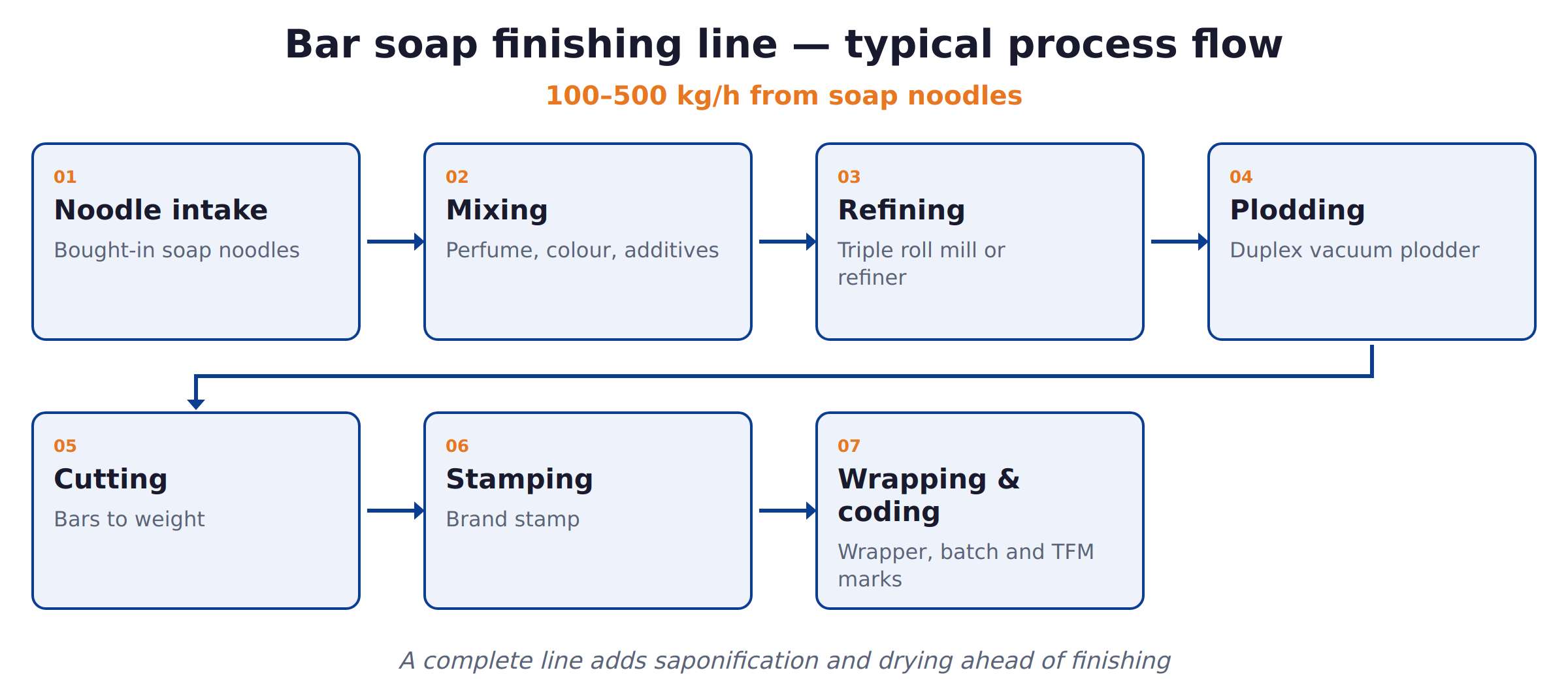
Noodle finishing starts from bought-in soap noodles. The line mixes them with fragrance and colour, mills them, plods them under vacuum into a solid bar, cuts and stamps them, and wraps them. It is smaller, simpler and safer, and is how many brands start.
Liquid soap and detergents
Liquid hand wash, dishwashing liquid, laundry liquid, bleach-based cleaners and disinfectants sell in sachets, bottles and jerrycans. A plant needs stainless mixing tanks, transfer pumps, a filler suited to foaming liquids, cappers and labellers, and good water. Preservatives and the right active content matter: watered-down products and spoiled batches lose customers fast.
NAFDAC registration
NAFDAC regulates the manufacture, importation, distribution, advertisement and sale of food, drugs, cosmetics, medical devices, packaged water, chemicals and detergents. Toilet soap and hand wash fall under cosmetics, and laundry soaps and detergents under detergents and chemicals. Register each product, meet NAFDAC's requirements for the factory and labelling, and keep batch records before you sell.
Power and safety
Plodders, mills and mixers draw heavy loads, and saponification plants need boilers and pumps. NERC's third-quarter 2025 report put national grid availability at about 5.4 GW, so most soap factories run generators; the Manufacturers Association estimated self-generation spending of around ₦1.4 trillion in 2025. Caustic soda burns skin and eyes, so provide protective equipment, eye-wash stations and training.
Landed cost in Nigeria
| Item | Basis |
|---|---|
| Duty | ECOWAS CET band for each machine |
| Surcharge | 7% of duty |
| CISS | 1% of FOB |
| ETLS | 0.5% of CIF |
| VAT | 7.5% on value plus duties |
| Form M | On the B'Odogwu portal |
| 4% FOB charge | Suspended; confirm before import |
Finance and sizing
With the maximum lending rate around 33% in mid-2026 according to the Central Bank, start with the products that sell fastest. A liquid soap set or a noodle finishing line often comes first; saponification and powder towers follow once volumes justify them.
Worked example: a regional laundry and toilet soap brand
A distributor in Aba sells imported soap and wants its own brand. It installs a noodle finishing line of about 300 kg an hour for toilet and laundry bars, with an amalgamator, three-roll mill, duplex vacuum plodder, cutter, stamper and wrapper, plus a liquid soap set for dishwashing liquid. It registers each product with NAFDAC, buys noodles in US dollars, and later adds a saponification section using palm kernel oil to cut costs. The figures are illustrative.
How to compare quotes
- Bars per minute at your bar weight, or litres per hour.
- Saponification included or noodle finishing only.
- Plodder type: single or duplex vacuum.
- Mill rolls and their hardness.
- Stamping dies for your shapes.
- Wrapping machine and speed.
- Boiler, chiller and air requirements.
- Installation, commissioning and training.
- Spares: screws, rolls, dies.
- References in West Africa.
Choose by situation
- Liquid soap and cleaners: a mixing and filling set.
- First bar soap brand: a noodle finishing line.
- Low-cost bars from local oils: full saponification.
- Washing powder: a blending set, or a tower at large scale.
Packaging and distribution
Soap in Nigeria moves through wholesale markets, distributors and supermarkets, often in bulk cartons of bars or jerrycans of liquid. Wrapped bars in branded cartons look more professional and survive transport better than hand-wrapped bars, so plan the wrapping machine with the line. For liquids, sachets and small bottles reach lower-income customers, while 4-litre and 25-litre containers serve cleaning companies and institutions. Price each pack size separately, because packaging can be a large share of the cost of small packs.
Quality checks
Test each batch of bar soap for moisture, total fatty matter and free alkali, and each batch of liquid for pH, viscosity and active content. Keep retained samples and batch records, which NAFDAC inspections and distributors may ask for.
Organising the soap plant floor
Keep raw materials, the production floor and finished goods apart, with caustic soda stored separately, dry and locked. Bar soap lines need room for noodles, the line itself and cartons; liquid plants need drains and a washable floor.
Mistakes we see
- Selling before NAFDAC registration.
- No vacuum plodder: air bubbles and cracks.
- Thin liquid products that customers notice.
- No caustic safety.
- Ignoring generator fuel in the cost per bar.
What we see in Nigeria
- A large, price-sensitive soap market with brands at every scale.
- Palm kernel oil is a local soap oil.
- NAFDAC regulates cosmetics, chemicals and detergents.
- Grid availability was about 5.4 GW in 2025; generators are normal.
- Self-generation cost manufacturers about ₦1.4 trillion in 2025.
- Credit costs around 33% at the maximum lending rate.
- Imports pay CET duty plus surcharge, CISS, ETLS and VAT.
- Form M runs on B'Odogwu.
Where CISH fits
We supply complete soap and detergent lines, saponification, noodle finishing, liquid and powder plants, from audited factories in China. CISH ships and clears the line, installs and commissions it, and trains your team. For a first small mixer, a local fabricator is usually the better buy.