A bar soap line either saponifies oils itself or buys soap noodles and finishes them by mixing, milling, plodding, cutting and stamping; liquid soap and detergent plants mix and fill; washing powder plants blend or, at large scale, spray-dry. Cosmetic soaps and household chemicals are registered with the FDA. Machinery usually pays 5% duty under the ECOWAS CET plus the merged 20% VAT, NHIL and GETFund charge since January 2026. CISH supplies, installs and commissions complete soap and detergent lines.
Soap and detergent machine prices in Ghana, 2026
| Line | Capacity | Indicative price (2026) | Fits |
|---|---|---|---|
| Washing powder blending set | 50–500 kg batches | About US$3,000–45,000 | Regional powder brands |
| Liquid soap and detergent mixing and filling | Tanks of a few hundred litres; small filler | About US$20,000–60,000 | Dishwashing liquid, hand wash, cleaners |
| Soap noodle finishing line | 100–500 kg/h | About US$20,000–100,000 | Bar soap from bought-in noodles |
| Complete bar soap line | 300–1,000 kg/h | About US$150,000–400,000 ex-works | Saponification to stamped bars |
| Spray-dried powder tower | Tonnes per hour | Quoted per configuration | Large detergent makers |
Prices are ex-works in US dollars; landed and installed on a coastal route is typically 1.25–1.45 times.
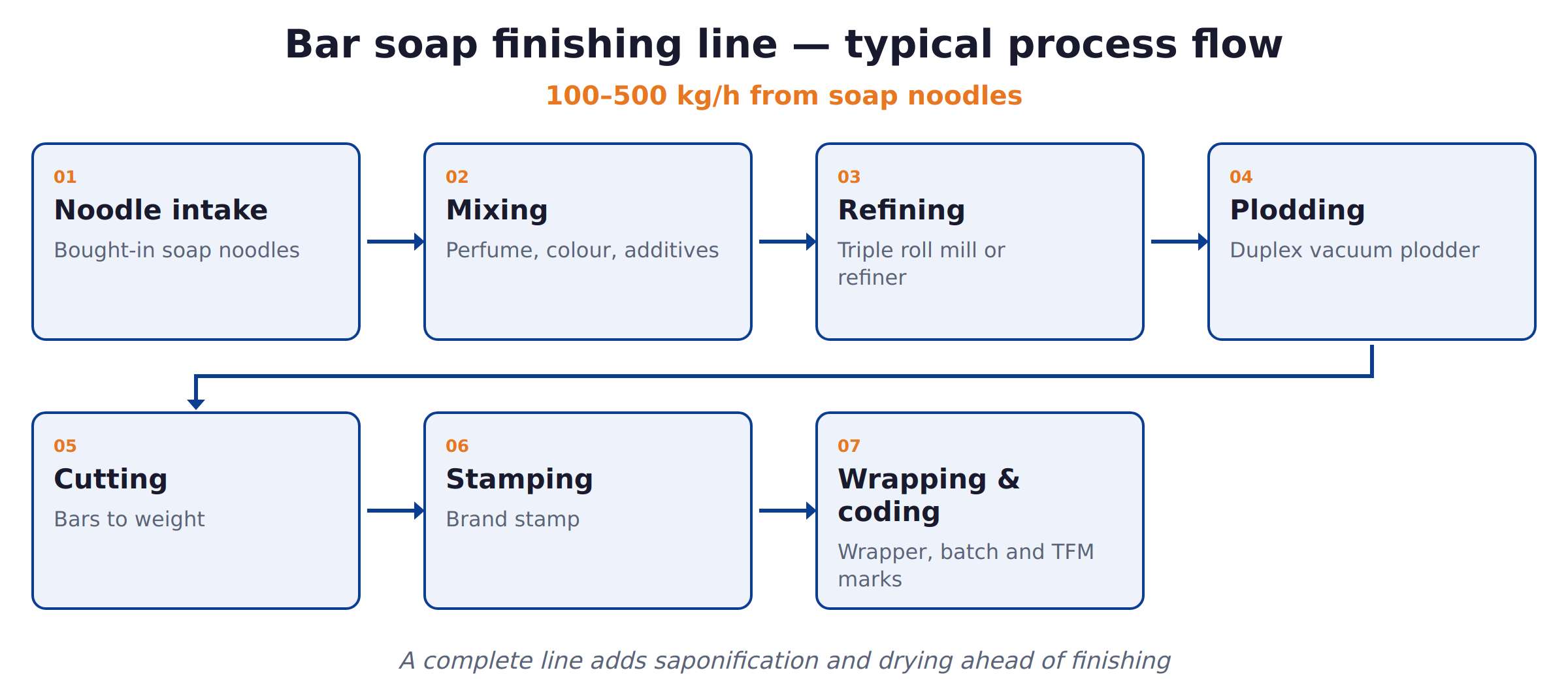
Noodles or full saponification?
- Buying soap noodles and finishing them is the most common way to start bar soap production. You mix noodles with fragrance, colour and additives, mill and plod them into a solid bar, cut and stamp it, and wrap it. The line is smaller and needs no caustic handling at scale.
- Full saponification turns oils and fats, such as palm oil, palm kernel oil or tallow, into soap with caustic soda, then dries it into noodles. It gives control over cost and recipe but needs boilers, caustic handling, more space and skilled operators.
Ghana has a long tradition of soap made from palm kernel oil and plantain or cocoa pod ash, including black soap. Commercial lines build on the same oils with modern processing.
Liquid soap and detergents
Liquid hand wash, dishwashing liquid, laundry liquid and household cleaners are mixed in stainless tanks and filled into bottles and jerrycans. A good start is two or three mixing tanks, a transfer pump, a filler suited to foaming liquids, a capper and a labeller. Control dilution and preservatives: thin or spoiled products lose customers quickly.
FDA registration
The Food and Drugs Authority registers products in categories that include cosmetics and household chemicals. Toilet soap and hand wash are generally treated as cosmetics; laundry soap, dishwashing liquid and household cleaners as household chemicals. Register each product, meet the FDA's labelling and premises requirements, and keep batch records before you sell. Check the current requirements with the FDA for your products.
Power and safety
Plodders, mills and mixers draw heavy loads, and saponification plants run boilers and pumps. ECG said in April 2026 that much of its distribution network was overloaded beyond its thermal limits, with frequent faults and low voltage. Plan supply, voltage protection and a generator. Caustic soda burns skin and eyes: provide protective equipment, eye-wash stations and training.
Landed cost in Ghana
| Item | 2026 basis |
|---|---|
| Duty on machinery | Usually 5% under the ECOWAS CET |
| VAT, NHIL, GETFund | 20% combined since 1 January 2026 |
| ECOWAS and AU levies, processing fee | Added on top |
| Clearance | ICUMS at Tema |
| Port buffer | GPHA congestion measures from August 2026 |
Worked example: a noodle-based toilet soap line
A cosmetics distributor in Accra wants its own toilet soap brand. It installs a soap noodle finishing line of about 300 kg an hour: an amalgamator for mixing noodles with fragrance and colour, a three-roll mill, a duplex vacuum plodder, a cutter, a stamper and a flow-wrapping machine, plus a small chiller. It registers the soap with the FDA, buys noodles in US dollars, and adds a liquid hand wash line later on the same site. The figures are illustrative.
How to compare quotes
- Bars per minute at your bar weight, or litres per hour.
- Plodder type: single or duplex vacuum.
- Mill rolls and their material.
- Stamping dies included for your shapes.
- Wrapping included and its speed.
- Utilities: chiller, steam, compressed air, power.
- Installation, commissioning and training.
- Spares: screws, rolls, dies, blades.
- Delivery to Tema.
- References in West Africa.
Choose by situation
- Liquid soap and cleaners: mixing and filling set.
- First bar soap brand: noodle finishing line.
- Using local oils at scale: full saponification plant.
- Washing powder: blending set, or a spray-dried tower at large scale.
Raw materials and cost per bar
Soap noodles, fragrance, colour and packaging make up most of the cost of a bar, and imported noodles are priced in US dollars. Calculate the cost of each bar at your target weight, including wrapping and cartons, and compare it with what wholesalers pay, not the shelf price. If you saponify, palm kernel oil and other local oils can lower cost, but you take on caustic handling, drying and more quality control.
Packaging
Bars sell on appearance as well as quality. Flow-wrapped or carton-packed bars with clear labels meeting FDA requirements look more professional than hand-wrapped bars, and protect the soap from moisture. Plan the wrapping machine with the line, because hand wrapping soon becomes the bottleneck.
Quality checks for bar soap
Check every batch for moisture, hardness and fragrance, and make sure bars do not crack, sweat or lose their stamp. Keep a retained sample from each batch with its date, so complaints can be traced. Train operators to read the plodder temperature and vacuum gauges, because most bar defects start there.
Mistakes we see
- Buying a plodder without a mill: bars crack.
- No vacuum plodder: air bubbles in bars.
- Selling before FDA registration.
- Weak caustic safety.
- Ignoring power quality.
What we see in Ghana
- A strong soap tradition, including black soap from palm kernel oil.
- Noodle finishing is the common entry to bar soap.
- FDA registration covers cosmetics and household chemicals.
- Machinery duty is usually 5%.
- One 20% charge for VAT, NHIL and GETFund since 1 January 2026.
- ICUMS is the customs single window.
- Tema congestion needs a buffer.
- ECG's network is overloaded in places; generators are common.
Where CISH fits
We supply complete soap and detergent lines, from saponification or noodle finishing to stamping and wrapping, and liquid and powder plants, from audited factories in China. CISH ships to Tema, clears, installs and commissions the line, and trains your team. For a first small mixer, a local fabricator is usually the better buy.