Plan on about 1.25–1.45 times the equipment price for freight, duties, clearance and installation landed at a coastal port such as Dar es Salaam, plus inland transport to the site. Pressing yields roughly a third of the seed weight as oil, depending on seed quality and the press, with the rest as cake sold for animal feed. Policy is supportive: the National Edible Oil Strategy 2026–2035 targets self-sufficiency and singles out sunflower for Singida, Dodoma and Simiyu, and the 2026/27 budget added tax incentives for local processing and a customs duty on crude oil imports. CISH supplies, installs and commissions sunflower pressing and refining lines.
Sunflower oil machine prices, 2026
| What you buy | Capacity | Indicative price (2026) |
|---|---|---|
| Entry-level screw press | Small batches | Under about US$10,000 ex-works |
| Pressing and refining line | About 20 t of seed a day | About US$150,000–400,000 |
| Plant with fuller refining section | About 50 t a day | About US$400,000–900,000 |
| Larger plant | About 100 t a day | About US$700,000–1.5 million and more |
| Landed and installed at a coastal port | All | About 1.25–1.45 times the equipment price |
Bands are for equipment from China; what each covers is set out in our refining line sizing guide.
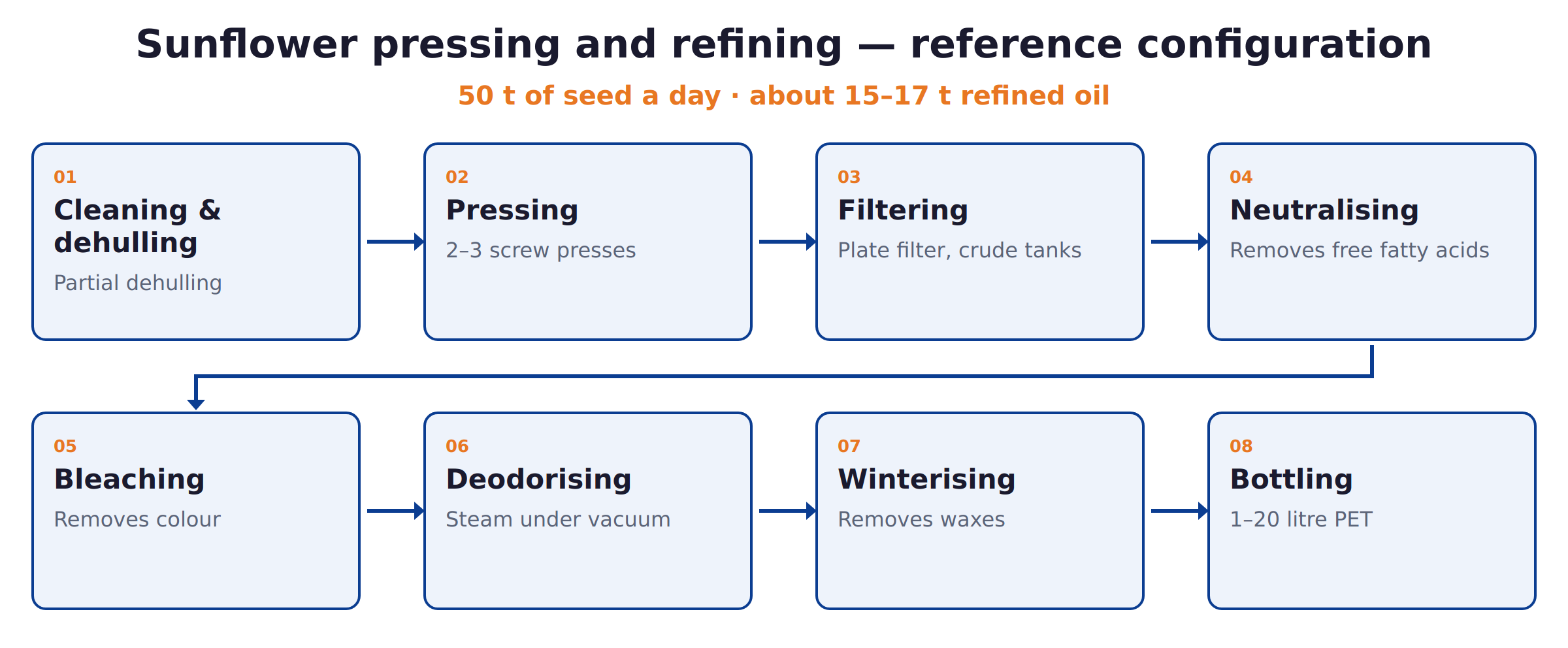
What is in a sunflower oil line
- Seed cleaning: removing stones, dust and stalks.
- Dehulling (optional): removing part of the hulls for better oil and cake.
- Conditioning: heating the seed for better pressing in hot-press lines.
- Pressing: one or more screw presses; larger plants use pre-press and solvent extraction, a different scale.
- Filtering: settling tanks and filter presses to clear crude oil.
- Refining (optional): degumming, neutralising, bleaching, deodorising and, for sunflower, dewaxing (winterisation) for clear oil.
- Filling and packing: bottles, jerrycans or pouches, with labels and coding.
Crude, semi-refined or fully refined?
| Product | Equipment | Buyers |
|---|---|---|
| Crude filtered oil | Press and filter | Local markets, other refiners |
| Semi-refined | Press, filter, partial refining | Wholesalers, institutions |
| Fully refined, winterised | Complete refinery | Supermarkets, branded retail |
Refining adds cost and skill but opens supermarkets and better prices. Many mills start with crude filtered oil and add refining when they have steady seed and buyers.
What drives the price
- Seed capacity in tonnes a day.
- Number and size of presses.
- Refining steps and whether dewaxing is included.
- Automation and controls.
- Materials: stainless steel in refining and filling.
- Steam and utilities: a boiler for refining and conditioning.
- Filling and packing level.
Landed cost in Tanzania
Oil presses, filter presses, refining vessels and filling machines are capital goods that generally enter duty-free under the EAC tariff, subject to their codes; stainless tanks, pipework and spares may be classified separately. Import VAT is 18%, but qualifying capital goods may benefit from TRA's VAT deferment, which the Finance Act, 2026 retained. Items on TBS's PVoC list need a Certificate of Conformity before shipment. Add freight, clearance at Dar es Salaam, inland transport to the central regions, civil works, a boiler house if you refine, installation and training. Our guide to TBS PVoC for machinery imports explains the conformity step.
Seed, season and working capital
Sunflower is harvested once a year, and most mills buy seed in the months after harvest. A plant must either buy and store enough seed to run for months or run seasonally. Working capital for seed and dry storage often costs as much as the equipment. Size the plant on the seed you can buy and store, not on the press's nameplate.
Power and site
Presses and refining need reliable three-phase power; refining also needs steam. Check your connection with the utility, plan backup for critical equipment, and choose a site with space for seed storage, cake storage and loading.
Standards and market
Packaged edible oil sold in Tanzania must meet the relevant TBS standards; refiners supplying supermarkets need product certification and labelling. Imported crude oil now faces a customs duty under the 2026/27 budget, aimed at supporting local processors, while the edible oil strategy targets self-sufficiency by 2035. Demand estimates vary; one estimate puts annual demand at about 732,000 tonnes.
How to compare quotes
Ask each supplier for: seed capacity per day; expected oil yield on your seed; residual oil in cake; the refining steps included; steam and power requirements; materials; installation and commissioning on your seed; training; and spares. Compare total landed cost, not machine price.
Common mistakes
- Buying presses without filtering and storage.
- No dewaxing for oil meant for clear bottles.
- A plant larger than the seed you can buy.
- No working capital for the seed season.
- Ignoring PVoC for regulated items.
Press yield and cake quality
Two presses with the same nameplate capacity can leave very different amounts of oil in the cake. A press that leaves a few extra percent of oil in the cake loses that oil on every tonne of seed, every day of the season. Ask suppliers for the expected residual oil in cake on your seed, test it on a trial, and check it during commissioning. Dehulling part of the seed can raise cake protein and improve press performance, but changes the cake's market; decide with your feed buyers.
Filling and packs
Sunflower oil in Tanzania sells in jerrycans, bottles and small pouches. Jerrycans suit wholesalers and institutions; bottles suit supermarkets; small pouches suit low-income buyers in shops and markets. Each pack needs its own filling and sealing equipment. Accurate filling matters, because underfilled packs breach labelling rules and lose customers.
Utilities for refining
A refinery needs steam for heating and deodorising, a vacuum system, cooling water and a supply of bleaching earth and other processing aids. Size the boiler for the refining section and any seed conditioning, and plan fuel: many mills burn sunflower hulls or other biomass, which cuts fuel cost. Dewaxing needs chilling and filtration to stop oil clouding in cool weather. These utilities are often missing from cheap quotes and can add a large share to the project; ask for them by name.
Spares and wear parts
Screw presses wear: the press screws, cage bars and bearings need replacement after a number of tonnes. Ask suppliers for wear part life on your seed and their prices, and keep a set in stock before the season.
Where CISH fits
We supply sunflower pressing and refining lines, cleaning, dehulling, pressing, filtering, refining with dewaxing, and filling, from audited factories in China, sized to your seed and buyers. CISH ships the line, installs and commissions it on your seed, and trains your team. For a single small press, a local dealer is usually the better buy.