The central regions, Singida, Dodoma, Manyara and Simiyu, grow most of the seed and host hundreds of mills. The government's National Edible Oil Strategy 2026–2035 aims for self-sufficiency, singles out sunflower for Singida, Dodoma and Simiyu, and the 2026/27 budget added tax incentives for local processing and a duty on imported crude oil, so the policy wind is behind local processors. The business depends on three things more than on the press: buying enough good seed in season, having the cash and dry storage to hold it, and selling both oil and cake well. Many small processors sell crude filtered oil; refining to clear, winterised oil opens supermarkets but needs more capital and skill.
Step 1: decide what you will sell
| Model | What you make | Who buys | Notes |
|---|---|---|---|
| Crude filtered oil | Pressed, settled, filtered oil | Households, local shops, markets, refiners | Lowest capital; common in rural mills |
| Semi-refined oil | Partly refined | Wholesalers, institutions | Better shelf life and look |
| Refined branded oil | Fully refined, winterised, bottled | Supermarkets, retail chains | Needs a refinery, standards and a brand |
| Toll pressing | Pressing farmers' seed for a fee | Farmers and traders | Low risk; small margin |
| Cake | Pressed cake | Feed millers, poultry and dairy farmers | Large share of revenue |
Step 2: plan the seed
Sunflower is harvested once a year. Most processors buy seed in the months after harvest, when prices are lower, and store it to run as long as possible. Plan:
- Where you buy: from farmers, aggregators and farmer groups in your area, by weight and moisture.
- How much: enough to run your plant for the months you plan; the plant's capacity means little without seed.
- Storage: dry, ventilated, rodent-proof stores; wet seed spoils and gives poor oil.
- Cash: buying seed for months of production ties up working capital, often more than the equipment.
Some processors support farmers with seed and buy back the harvest to secure supply.
Step 3: crude or refined
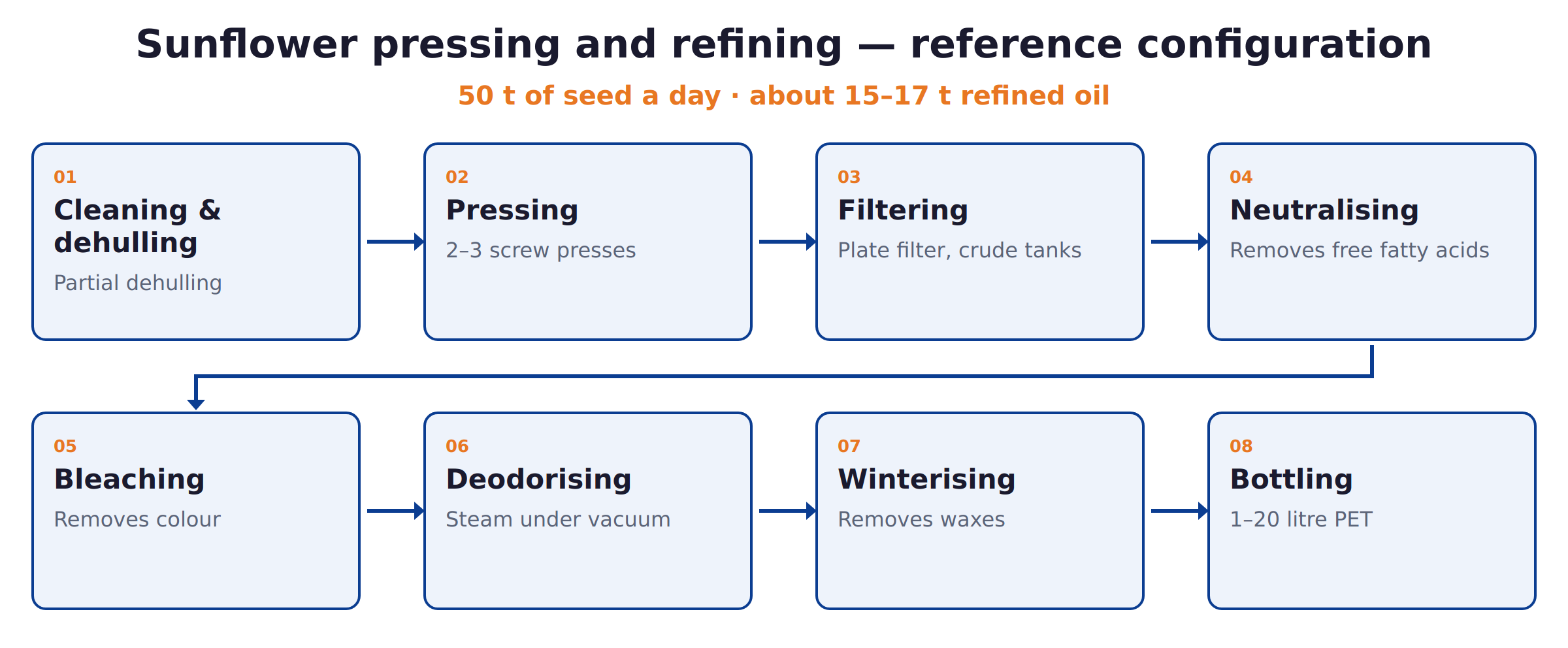
Crude filtered oil needs presses, settling tanks and filter presses. Refined oil needs a refinery: degumming, neutralising, bleaching, deodorising and dewaxing, with a boiler and a laboratory. Refining improves shelf life, clarity and price, and is needed for supermarket shelves. Start with crude oil if your capital is limited and buyers accept it; add refining when seed supply and sales are steady. Our sunflower oil machine price guide sets out the bands.
Step 4: sell the cake
Pressing gives roughly a third of the seed weight as oil and about two thirds as cake. Sunflower cake is a protein feed for poultry, dairy and pigs. Feed millers and livestock farmers buy it, sometimes under contract. Cake revenue can make the difference between profit and loss, so plan buyers before you press, and store cake dry to prevent mould.
Step 5: standards, labels and registration
Packaged edible oil must meet the relevant TBS standards and labelling rules. Supermarkets and institutions usually ask for product certification, batch codes and consistent quality. Register your business and premises with the local authorities, and keep records of seed lots, batches and tests.
Step 6: the plant and the site
A practical plant has seed cleaning, optional dehulling, presses, filtering, storage tanks, optional refining, and filling. The site needs three-phase power, space for seed and cake storage, a boiler house if you refine, and truck access. Import the line through Dar es Salaam: capital goods generally pay 0% duty under the EAC tariff, VAT at 18% may be deferred for qualifying capital goods, and regulated items need a TBS Certificate of Conformity before shipping. Our guide to importing a production line into Tanzania covers the route.
Step 7: the numbers
Revenue = oil sold × oil price + cake sold × cake price. Costs = seed (by far the largest), energy, labour, packaging, refining chemicals and bleaching earth if you refine, maintenance, transport, storage losses and the cost of holding seed stock. Margin depends on the spread between seed and oil prices in your season, and on yield: a press that leaves too much oil in the cake throws away money every day.
Challenges reported by processors
The Tanzania Sunflower Processors Association has said that many rural processors lack land titles to use as bank collateral, which keeps them on older equipment with lower yields. Imports of cheaper refined oil have also squeezed local mills at times. Plan conservatively, build buyer relationships for both oil and cake, and invest in yield and quality, which raise margin regardless of price swings.
Worked example: a mill in Singida
A trader in Singida buys seed from farmer groups after the harvest and stores it in a dry warehouse. She installs a line that cleans, presses and filters about 20 tonnes of seed a day, sells crude oil in jerrycans to wholesalers and shops in Dodoma and Dar es Salaam, and sells cake to poultry farmers under monthly contracts. After two seasons, with steady seed supply and buyers, she adds a small refining and dewaxing section and starts bottling branded oil for supermarkets. The figures and names are illustrative.
Common mistakes
- Not enough seed or cash to run beyond a few months.
- Damp storage that spoils seed and cake.
- No buyers for cake.
- Refining too early, before supply and sales are steady.
- Old presses that leave oil in the cake.
Building a brand
Most crude oil is sold unbranded in jerrycans, but branded bottled oil earns more and builds loyalty. A brand needs a consistent product, a clear label with the TBS mark where required, a name buyers remember, and reliable supply to shops. Start in one region where you can serve shops well, then expand. Supermarkets also need barcodes, steady supply and payment terms you can carry.
Seasonal staffing and maintenance
The busy season runs from harvest for as long as your seed lasts. Train operators before the season, service presses and replace worn screws and cages before seed arrives, and keep critical spares. A press that breaks down at the height of the season costs far more than its repair.
Working with farmers
Some processors build loyal supply by working with farmer groups: providing quality seed at planting, advising on harvesting and drying, and buying the crop at a fair, transparent price. The edible oil strategy promotes higher seed production, and processors who help farmers improve yields can secure more and better seed.
Where CISH fits
We supply sunflower pressing and refining lines, cleaning, dehulling, pressing, filtering, refining with dewaxing, and filling, from audited factories in China, sized to your seed and buyers. CISH ships the line, installs and commissions it on your seed, and trains your team. For a single small press, a local dealer is usually the better buy.