Your margin depends on the price and quality of jumbo reels, and your wrapping must follow the East African standard: rolls individually wrapped, or group-wrapped packs of no more than ten labelled not to be sold individually. CISH supplies, installs and commissions complete tissue converting lines; for a single small rewinder, a local dealer is usually the better buy.
Toilet paper machine prices, 2026
| What you buy | What it does | Indicative price (2026) | Fits |
|---|---|---|---|
| Small manual or semi-automatic rewinder with band saw | Rewinds jumbo reels into logs, cuts rolls | Within the entry range below | First toilet roll workshop |
| Entry or semi-automatic converting line | Unwind, emboss, perforate, rewind, cut, wrap | About US$10,000–50,000 | Small brands selling to shops |
| Serviette or facial tissue machine | Folds and cuts napkins or facial tissue | Quoted per configuration | Adding products for hotels and retail |
| Fully automatic high-speed line | Continuous log rewinding, log saw, automatic packing | Up to about US$1 million | Regional brands |
| Tissue paper mill | Makes jumbo reels from pulp or waste paper | A different order of magnitude | Paper makers, not converters |
Equipment prices are in US dollars, before freight, clearance, installation and the building.
Converting line or paper mill?
| Converting line | Tissue paper mill | |
|---|---|---|
| Raw material | Jumbo reels bought from mills | Pulp or waste paper |
| Process | Unwind, emboss, perforate, rewind, cut, wrap | Pulping, cleaning, paper machine, drying, reeling |
| Utilities | Power and compressed air | Large power, steam, water and effluent treatment |
| Capital | Tens of thousands to around a million US dollars | Many millions |
| Main risk | Jumbo reel price and supply | Fibre supply, energy and effluent |
Nearly everyone searching for a toilet paper making machine in Kenya needs a converting line. Be wary of any offer that calls a rewinder a "toilet paper making machine" and suggests it makes paper.
Jumbo reels: where the margin is decided
A converting business buys jumbo reels, often more than a metre wide and weighing hundreds of kilograms, and sells rolls. The reel price is most of the cost of a finished roll. Before buying any machine:
- Find two or three reel sources, from local mills, regional mills or imports, and compare price per tonne delivered.
- Check ply, grammage and width. The line must match the reel width and the ply you will sell.
- Virgin or recycled fibre. Recycled reels are cheaper but less white and soft; buyers notice.
- Storage. Reels must stay dry; damp reels tear on the rewinder.
Ask any machine seller what reel width and diameter the unwind stand takes. A cheap line that only takes narrow reels can lock you into a more expensive supply.
Wrapping rules in the EAC
Tissue paper in East Africa is covered by the East African Standard EAS 355:2017. Packaging was disputed between partner states for years, and in September 2024 the EAC's standards technical management board settled it: toilet paper should be individually wrapped, and group-wrapped packs of rolls that are not individually wrapped are allowed up to a maximum of ten pieces, clearly labelled "NOT TO BE SOLD INDIVIDUALLY". The 2017 standard stays applicable while it is revised.
For your line, that decides the packing equipment:
- Single-roll wrapper if you sell individually wrapped rolls through kiosks and shops.
- Bundle packer for packs of up to ten unwrapped rolls, with the required label.
- Both, if you sell to retail and institutions.
If you plan to export to neighbouring countries, check each market's current rules, because national standards were applied in some partner states during the dispute.
Who sells toilet paper machines in Kenya
- Local dealers sell imported rewinders, band saws and wrappers from stock.
- Jua kali and local fabricators make reel stands, tables and simple cutters, and repair machines.
- Chinese factories selling direct offer converting lines, serviette and facial tissue machines by catalogue.
- Turnkey companies lay out the converting room, supply the line and commission it on your reels.
We do not publish names of tissue machine sellers. Ask every seller to run the line on jumbo reels like the ones you will buy, and to show roll weight, sheet count and wrapping at the stated speed.
What a complete converting line includes
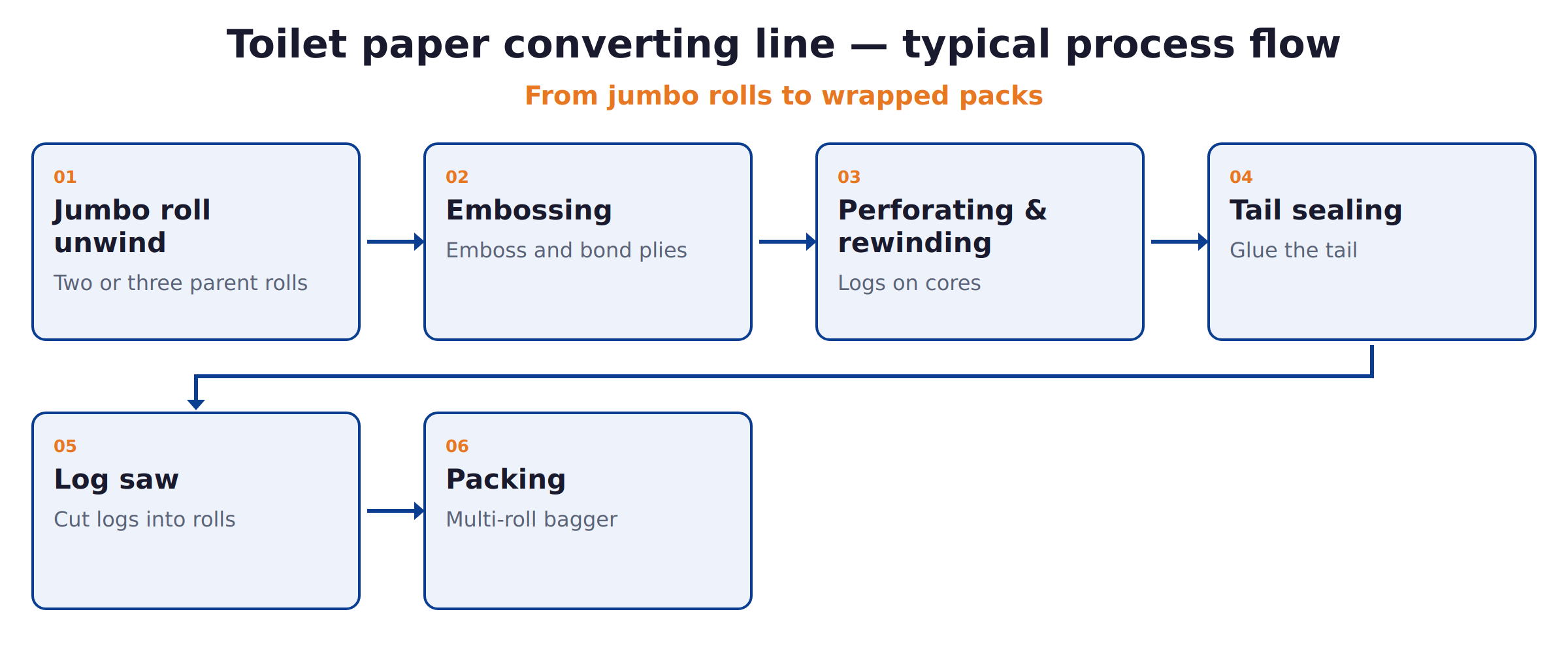
- Unwind stand: sized for your reel width, diameter and ply.
- Embossing unit: pattern rollers for softness and ply bonding.
- Perforating unit: sheet length set for your product.
- Rewinder: winds logs at the set diameter and sheet count.
- Tail sealer: glues the loose end of each log.
- Log saw: cuts logs into rolls; a band saw on small lines, an automatic saw on larger ones.
- Wrapping: single-roll wrapper or bundle packer, with labelling.
- Core making: a core machine if you make your own cardboard cores.
- Utilities: three-phase power, compressed air, dust extraction.
Adding a serviette folder or facial tissue line later is common; leave space in the room.
Power and running costs
A converting line is a moderate electrical load compared with a mill. In Kenya, the per-unit energy charge on electricity bills is topped up by pass-through items; one of them, the fuel energy cost charge, was about KES 3.5 a kWh in August 2026. Dust extraction and compressed air run all day, so include them when you ask sellers for installed power.
Importing a converting line into Kenya
| Item | What applies |
|---|---|
| Duty | Converting machinery is generally duty-free under the EAC Common External Tariff; check each HS code |
| VAT | 16% of the import value plus duty |
| IDF | 2.5% of customs value |
| RDL | 2% of customs value |
| PVoC | For regulated items, KEBS verification in the country of export |
| Transport | Through Mombasa, then by rail or truck |
Jumbo reels themselves are an import if you buy abroad; ask your clearing agent about the duty on paper, which differs from machinery.
Worked example: a small brand moving to wrapped rolls
An illustration only:
| Item | Assumption |
|---|---|
| Today | Buying finished rolls to resell |
| Plan | Semi-automatic converting line with embossing, rewinding, band saw and single-roll wrapper |
| Price | Within US$10,000–50,000 |
| Reels | Two-ply jumbo reels from a regional supplier |
| Output | Several thousand rolls a shift, depending on roll size |
| Running costs | Reels, cores, wrapping film, labour, power |
Compare the cost per roll with the price you pay today. If the reel price is not well below the finished roll price, the line will not pay.
How to compare quotes
- Reel width and diameter the unwind stand takes.
- Line speed in metres per minute and rolls per shift.
- Embossing pattern and ply bonding.
- Log saw type and cutting accuracy.
- Wrapping: single-roll, bundle or both.
- Core making included or not.
- Installed power, compressed air and dust extraction.
- Spare blades, rollers and belts supplied.
- Installation, commissioning on your reels, and operator training.
- Warranty and support.
Mistakes we see
- Buying the machine before finding reels. Reel price decides margin.
- Unwind stand too narrow. You pay more for narrow reels.
- Wrong packing for the market. Unwrapped packs over ten rolls break the EAC rule.
- No dust extraction. Tissue dust is a fire and health risk.
- Damp storage. Reels absorb moisture and tear.
- Believing a rewinder makes paper. It converts reels; it does not make tissue.
What we see in Kenya
- An East African tissue standard. EAS 355:2017 covers tissue paper and remains applicable while it is reviewed.
- Wrapping settled in 2024. The EAC decided rolls should be individually wrapped, or group-wrapped up to ten with a "not to be sold individually" label.
- Past cross-border disputes. During the review, at least one partner state applied its own national toilet paper standard, so exporters should check rules market by market.
- Converting is the common business. Kenyan toilet roll makers mostly buy jumbo reels and convert them.
- Machines usually duty-free. Converting machines generally enter at 0% EAC duty, while VAT, the IDF and the RDL still apply.
- PVoC sequencing. Build pre-shipment verification into the factory schedule.
- Electricity surcharges. Pass-through charges make efficient drives and correct compressor sizing worthwhile.
- Local fabrication. Reel stands, tables and repairs are often handled by local workshops.
Where CISH fits
CISH supplies, installs and commissions complete tissue converting lines from audited factories in China: unwinding, embossing, perforating, rewinding, log sawing and wrapping, plus serviette and facial tissue machines, with the import into Kenya arranged and the line commissioned on your reels. For a single small rewinder, a local dealer is usually the better choice, and we will say so.