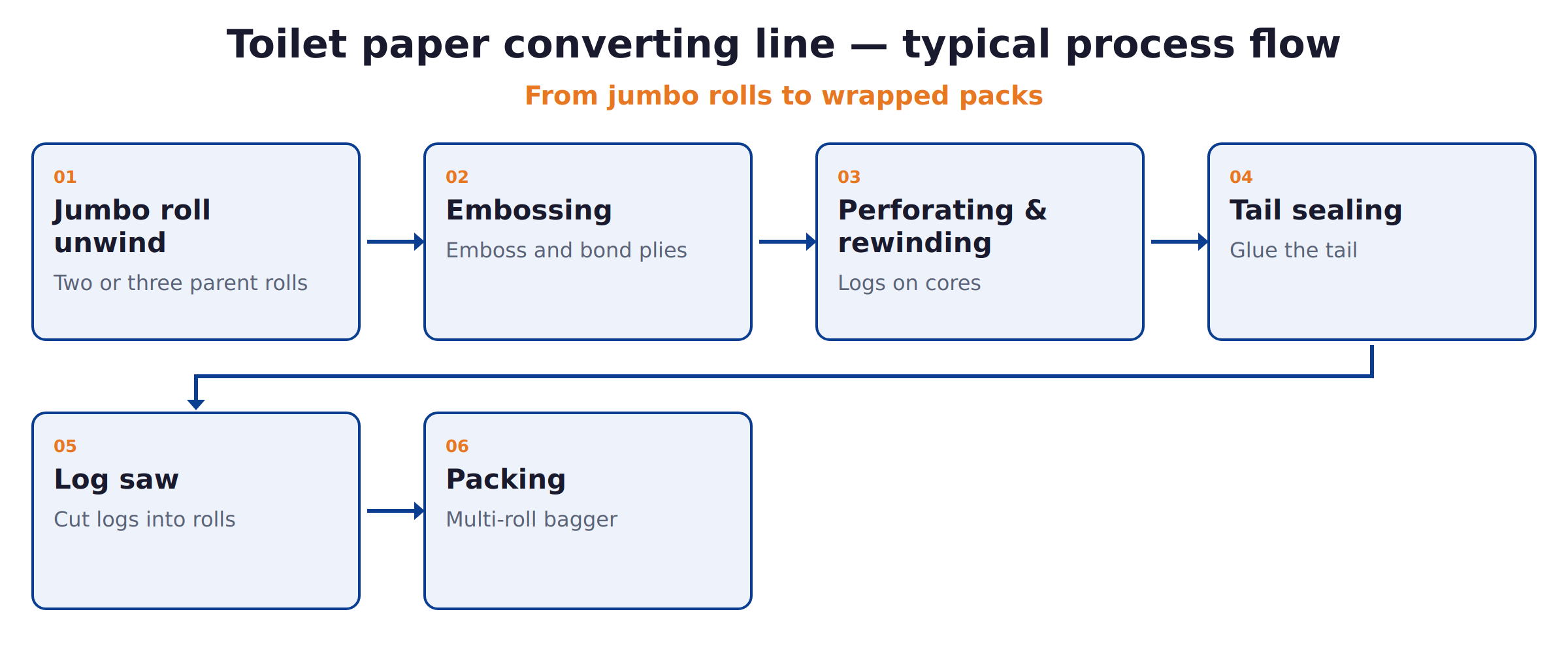
A line unwinds two or three parent rolls, embosses and perforates the paper, rewinds it onto cores as logs, seals the tail, cuts the logs on a saw and packs the rolls. The business depends on a steady supply of parent rolls, often priced in US dollars, and on power: national grid availability was about 5.4 GW in 2025, so generators are normal. Imports pay ECOWAS CET duty plus surcharge, CISS, ETLS and 7.5% VAT. CISH supplies, installs and commissions complete tissue converting lines.
Tissue converting machine prices in Nigeria, 2026
| What you buy | What it includes | Indicative price (2026) |
|---|---|---|
| Small converting line | Unwind stands, embossing, perforation, rewinder, manual tail sealing, band saw | About US$10,000–50,000 ex-works (often about US$25,000) |
| Automatic converting line | Faster rewinder, core maker, automatic tail sealer, log saw, accumulator | Up to about US$1 million with packing |
| Serviette and napkin machines | Folding, embossing, cutting | Within the small line range, by speed |
| Tissue paper mill | Pulping, tissue machine, dryer, utilities | Quoted per configuration |
Landed and installed costs on a coastal route are typically about 1.25–1.45 times the ex-works price.
Converting or making paper?
| Converting line | Tissue paper mill | |
|---|---|---|
| Starts from | Bought-in parent rolls | Pulp or waste paper |
| Machines | Rewinder, log saw, packing | Pulper, tissue machine, Yankee dryer, boiler |
| Water and effluent | Little | Large volumes, treatment needed |
| Power | Moderate | Very high, continuous |
| Investment | Tens of thousands to hundreds of thousands of dollars | Millions |
| Fits | New and growing tissue brands | Large integrated producers |
Almost every new tissue business in Nigeria starts with converting.
Parent rolls: the real business decision
Your margin depends on the price and supply of parent rolls. Many are imported and priced with the US dollar, so plan for currency movements, keep several weeks of stock in a dry warehouse, and agree supply with more than one source if you can. Match the width of your rewinder to the parent rolls you can buy.
As an example, a two-ply roll of 200 sheets of 10 × 10 cm, at about 17 g/m² per ply, contains roughly 68 grams of tissue, so a tonne of parent roll gives in the region of 14,000 rolls before trim. Ask suppliers to calculate for your own specification.
What a converting line needs
- Space: a dry, clean floor with room for parent roll storage, the line and finished goods.
- Power: a three-phase supply for the rewinder, saw and packing machines.
- Compressed air for pneumatic units.
- Cores: bought-in or made on an inline core maker from board strips.
- Packaging: film, bags and cartons for packs of 4, 6, 10 or more rolls.
Power in Nigeria
NERC's third-quarter 2025 report put national grid availability at about 5.4 GW, and manufacturers spent around ₦1.4 trillion generating their own power in 2025, according to the Manufacturers Association. A converting line does not need the continuous heavy power of a paper mill, but rewinders and saws stop on low voltage. Plan a generator sized for the line and voltage protection.
Landed cost in Nigeria
| Item | Basis |
|---|---|
| Duty | ECOWAS CET band for each machine's HS code |
| Surcharge | 7% of duty |
| CISS | 1% of FOB |
| ETLS | 0.5% of CIF |
| VAT | 7.5% on value plus duties |
| Form M | On the B'Odogwu portal |
| 4% FOB charge | Suspended; confirm before import |
Standards and labelling
Tissue products should meet the relevant Nigerian Industrial Standards; check with the Standards Organisation of Nigeria which standards and product certification apply to your products, and declare sheet count or roll size correctly on the pack.
Worked example: a regional tissue brand
A distributor in Onitsha buys imported toilet rolls and wants its own brand. It installs a semi-automatic converting line of about 150–200 m a minute with two unwind stands, embossing, perforation, a rewinder, a log saw and semi-automatic bagging, plus a generator. Parent rolls arrive every month and are stored on racks off the floor. With credit at a maximum lending rate around 33% in mid-2026, the distributor starts with one shift and adds an automatic packing machine once sales grow. The figures are illustrative.
How to compare quotes
- Rolls per minute at your sheet count and diameter.
- Parent roll width the line accepts.
- Ply: number of unwind stands.
- Embossing pattern and ply bonding.
- Tail sealing: manual or automatic.
- Log saw type and blade life.
- Packing: manual, semi-automatic or automatic.
- Power and air requirements.
- Installation, commissioning on your parent rolls, and training.
- References in West Africa.
Choose by situation
- New tissue brand: a small converting line with semi-automatic packing.
- Growing brand: an automatic rewinder and log saw with automatic packing.
- Serviettes and kitchen towels: separate folding or towel lines.
- Large integrated producer: a tissue mill, quoted per configuration.
Running costs to plan
Beyond parent rolls, a converting plant spends on cores or core board, glue for tail sealing and lamination, packaging film and cartons, saw blades, embossing roll maintenance, diesel or gas for the generator, and labour for packing. Packaging is often underestimated: wrapping film and printed bags for multi-packs add up quickly. Track trim waste from the saw and from roll ends, and sell it to recyclers or paper mills rather than discarding it. A daily record of parent roll used against rolls packed shows quickly whether waste is creeping up.
Staffing the line
A small converting line typically needs an operator for the rewinder, one or two people at the saw and several packers per shift. Train at least two people to change parent rolls and set the rewinder, so the line does not stop when one is absent.
Mistakes we see
- Buying a line before securing parent rolls.
- Rewinder width that does not match available parent rolls.
- Damp storage that spoils tissue.
- Hand packing as the bottleneck.
- No generator.
What we see in Nigeria
- Converting dominates new tissue businesses.
- Parent rolls are often imported and priced with the dollar.
- Grid availability was about 5.4 GW in 2025.
- Self-generation is a major factory cost.
- Credit costs around 33% at the maximum lending rate.
- Imports pay CET duty plus surcharge, CISS, ETLS and VAT.
- Form M runs on B'Odogwu.
- Standards are set by the Standards Organisation of Nigeria.
Where CISH fits
We supply complete tissue converting lines, unwinding to packing, from audited factories in China, sized to your rolls a day. CISH ships and clears the line, installs and commissions it on your parent rolls, and trains your operators. We do not build tissue mills.