It is a volume business with a small margin per bag, so water quality, machine uptime and distribution decide whether it pays. Every product must be registered with the Food and Drugs Authority, and GSA certification is expected for packaged water. Imported equipment pays the ECOWAS CET, mostly 5% on machinery, plus the combined 20% VAT, NHIL and GETFund from January 2026, clearing through ICUMS at Tema. Ghana imported about US$17.5 million of filling and packaging machinery in 2024, up 59.2%, much of it for water. CISH supplies, installs and commissions complete water treatment and packing plants.
Step 1: secure and test your water
Most sachet factories use borehole water; some use treated mains water. Test the source at an accredited laboratory for chemistry and microbiology before you design treatment. Borehole water can be hard, iron-rich or salty in places, which changes the treatment you need. Check whether your borehole needs a water use permit from the Water Resources Commission. Plan storage tanks so production does not stop when the pump does.
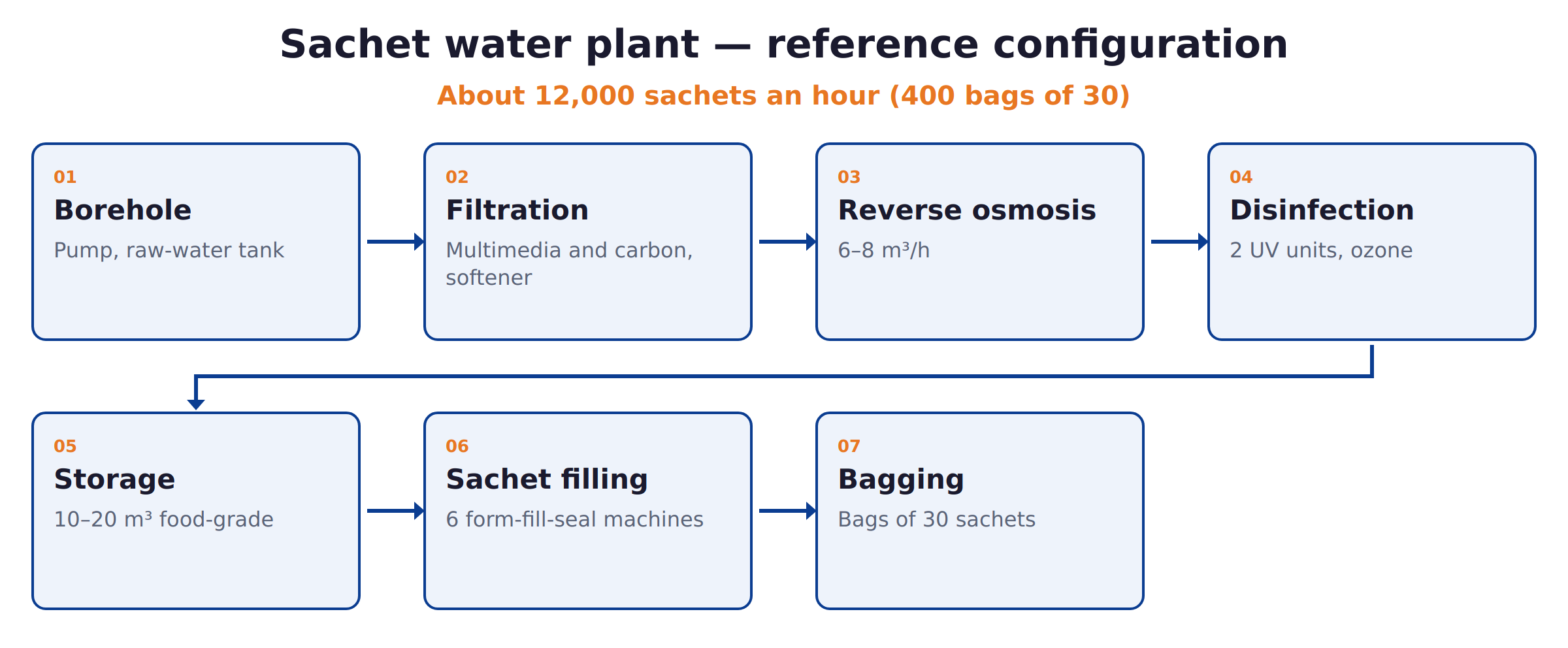
Step 2: treatment and the filling room
| Stage | Purpose |
|---|---|
| Sand and carbon filters | Remove particles, colour, smell |
| Softener or reverse osmosis | Reduce hardness or dissolved salts where needed |
| Micron filters | Final particle removal |
| UV or ozone | Kill micro-organisms before filling |
| Stainless storage tank | Holds treated water |
| Enclosed filling room | Washable walls and floor, controlled access, hand-wash point |
Inspectors look at the treatment records, the filling room and staff hygiene as much as the machines.
Step 3: approvals
- Business registration and tax registration.
- FDA registration of each product, with factory inspection and laboratory results.
- GSA certification for packaged water, which buyers and inspectors expect.
- District assembly permits for the premises.
- Water use permit for borehole abstraction where required.
Keep records of water tests, filter changes, UV lamp hours and cleaning; inspectors ask for them.
Step 4: equipment and costs
| What you buy | Indicative price (2026) | Notes |
|---|---|---|
| Single sachet form-fill-seal machine | Sold locally, a few hundred to a few thousand dollars | Most factories run several |
| Treatment system | Priced by flow and source water | The part that decides quality |
| Automated treatment and packing plant with bottle line | From about US$150,000–400,000 | For growing brands adding bottled water |
Our sachet water machine guide explains the machines, and our installation guide covers getting a plant from Tema to production.
Step 5: power
Sachet machines, pumps, RO and UV all need power. ECG's managing director said in April 2026 that much of the distribution network was overloaded, and announced investment including about 2,500 distribution transformers. Plan a generator sized for your machines and pumps, and include fuel in your cost per bag.
Step 6: the cost per bag
Add treated water (including RO reject), printed sachet film, the outer bag, power and fuel, labour, filters and consumables, laboratory tests, FDA and GSA costs, rent, delivery and loan repayments. Divide by the bags you sell each month. Because the margin per bag is small, a few hours of downtime or a day of unsold stock make a big difference.
Step 7: distribution
Most sachet water is sold through distributors with trucks, vans and tricycles (aboboyaa), and through shops, kiosks and hawkers. Plan delivery routes, a loading area, and credit terms for distributors. A factory that cannot deliver every day loses its distributors to the next one.
Step 8: when to automate and add bottles
Many sachet businesses add bottled water for shops, offices and events once they have approvals and distribution. That needs a blower or bought-in bottles, a rinse-fill-cap monoblock, labelling and shrink wrapping, and the treatment system sized for both lines.
Importing equipment
| Charge | 2026 basis |
|---|---|
| Import duty | ECOWAS CET; most machinery at 5% |
| VAT, NHIL and GETFund | Combined 20% from 1 January 2026 (Act 1151) |
| ECOWAS and AU levies | Small percentages on CIF value |
| Clearing | ICUMS at Tema |
Worked example: a pure water factory in Tamale
A business in Tamale starts with two local sachet machines, a borehole and a simple filter, selling to shops nearby. The FDA inspection asks for better treatment and records. The owner adds a softener, micron filters, UV, a stainless storage tank and an enclosed filling room, then four more sachet machines and a generator. With FDA registration and GSA certification, she signs three distributors with tricycles and a van. Two years later she plans a bottled water line. The figures are illustrative.
Common mistakes
- Skipping the water test.
- Filling in an open room.
- No treatment records.
- No generator: production stops with the power.
- Too few distributors for the output.
What we see in Ghana
- Sachet water is a daily essential sold everywhere.
- FDA and GSA approvals are expected.
- Distributors with tricycles and vans move most bags.
- Generators back up most factories.
- Filling machinery imports grew strongly in 2024.
- Many factories add bottled water as they grow.
Staff and hygiene
A sachet factory needs machine operators, packers, a person responsible for water treatment and records, loaders and drivers. Train everyone in hand washing, protective clothing and hairnets, and keep a cleaning schedule for the filling room, machines and tanks. Staff health checks protect both customers and the factory's registration.
Sachet film
Printed sachet film is one of the largest costs after power. Buy film that runs well on your machines, store it clean and dry, and check seal strength every shift. Leaking sachets lose distributors quickly.
Pricing and margins
Sachet water is sold at well-known prices, so margins come from cost control rather than price. Track cost per bag every month, especially film, fuel and power, and agree distributor margins in writing. Factories that keep machines running and deliver every day earn more than those with cheaper machines that stop.
Choosing a site
Choose a site with a good borehole or mains supply, three-phase power, space for storage and loading, and roads that distributors can reach easily. A factory close to dense neighbourhoods and markets saves transport on a product that is cheap and heavy.
Where CISH fits
We supply complete water treatment and packing plants, from treatment and storage to sachet and bottle lines, from audited factories in China, sized to your water and output. CISH ships to Tema, clears, installs and commissions the plant on your water, and trains your team. For a single sachet machine, a local dealer is usually the better buy.