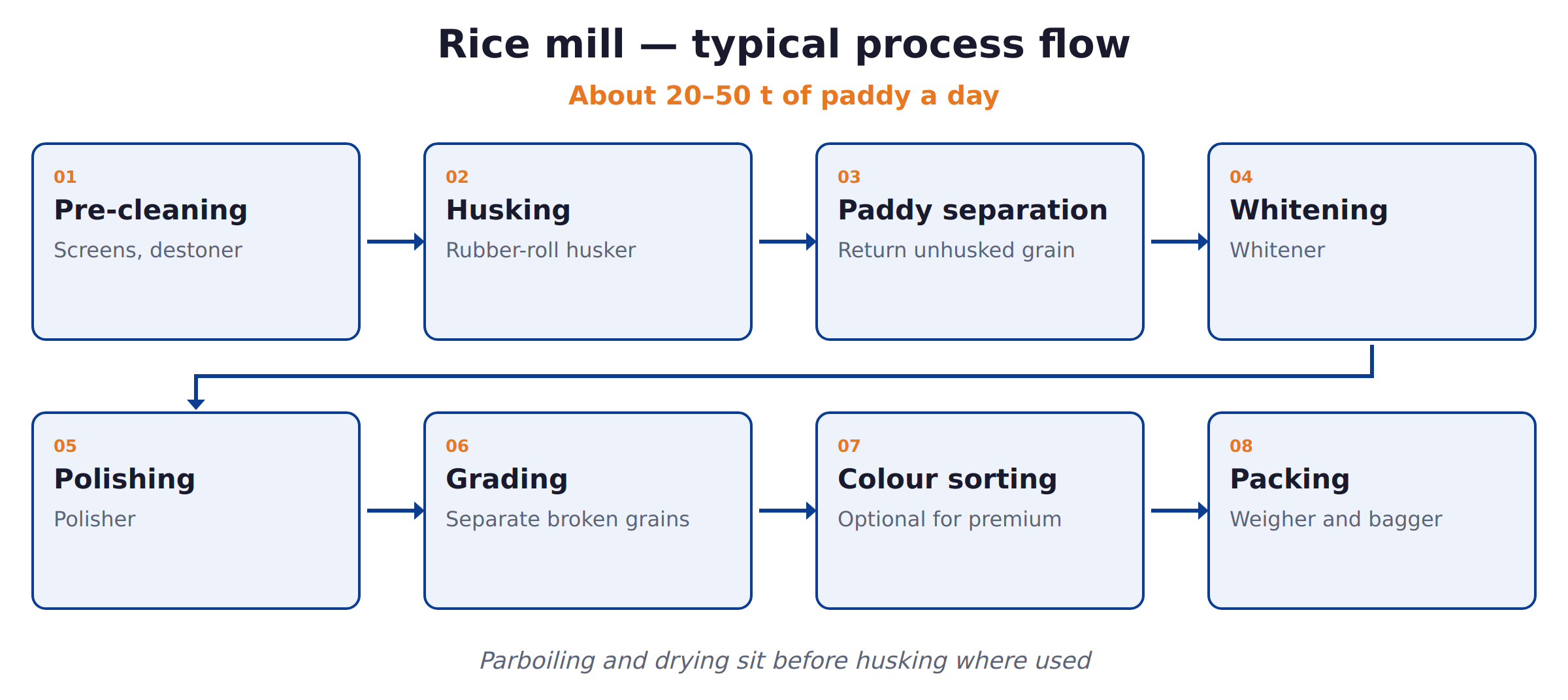
That gap is the opportunity for local mills, but only if the rice is clean, stone-free and consistent, because shoppers compare it with imported rice. A rice mill business buys paddy at harvest, often parboils it (soaking, steaming and drying), then cleans, destones, hulls, whitens, polishes, grades, sorts and bags it. Milled rice comes to roughly 60–65% of paddy weight, depending on variety and mill. Paddy buying, storage and working capital, at a maximum lending rate around 33% in mid-2026, decide the business more than the machines. Packaged rice should be registered with NAFDAC. CISH supplies, installs and commissions complete rice processing plants.
Step 1: choose your model
| Service milling | Own rice brand | |
|---|---|---|
| What you do | Mill farmers' paddy for a fee | Buy paddy, parboil, mill, pack and sell |
| Equipment | Small mill set | Parboiling, drying, full mill, colour sorter, packing |
| Working capital | Low | High: paddy stock |
| Customers | Farmers, local traders | Markets, supermarkets, wholesalers, institutions |
| Margin | Fee per bag | Price difference between paddy and branded rice |
Step 2: buy paddy at the right time
Paddy prices are lowest just after harvest and rise through the year. Mills that buy and store paddy at harvest secure supply for the lean months. That needs:
- Storage: dry, ventilated warehouses or silos, with pest control.
- Moisture control: paddy must be dry enough to store safely; a dryer helps in wet seasons.
- Quality checks: variety, moisture, immature and broken grains, stones and dirt.
- Working capital: months of paddy paid for in advance. At current lending rates, the cost of holding stock on credit can be high, so plan finance carefully.
Out-grower schemes with farmers, where the mill supplies seed or inputs and buys back paddy, help secure supply.
Step 3: parboiling and destoning decide quality
Much Nigerian rice is parboiled: paddy is soaked, steamed and dried before milling. Good parboiling hardens the grain, reduces breakage and gives the firm texture many buyers prefer. Poor parboiling gives uneven colour, smell and breakage. The most common complaint about local rice is stones; a destoner and good cleaning in front of the mill are essential, and an optical colour sorter removes discoloured and damaged grains.
Step 4: equipment and costs
| What you buy | Capacity | Indicative price (2026) |
|---|---|---|
| Rice mill set: cleaning, hulling, whitening, polishing, grading | About 20–30 t of paddy a day | About US$5,000–30,000 ex-works |
| Complete plant with parboiling, drying, colour sorting and packing | About 20–50 t a day | Quoted per configuration |
Our rice milling machine price guide breaks the options down. Imported equipment pays the ECOWAS tariff, a 7% surcharge on the duty, the 1% CISS, 0.5% ETLS and 7.5% VAT, after Form M on the B'Odogwu portal.
Step 5: power and steam
Parboiling needs steam from a boiler, which can burn rice husk, a by-product of the mill. Mill motors, sorters and dryers need electricity; NERC's third-quarter 2025 report put national available grid capacity at about 5.4 GW, so most mills run generators or a mix of grid and generator.
Step 6: by-products
Husk fuels the boiler or sells as fuel; bran sells to feed mills and farmers; broken rice sells at a discount for food and brewing. Plan how you will use or sell each.
Step 7: compete with imported rice
Local rice wins when it is clean, stone-free, evenly coloured, well packed and priced right. Bag it in attractive 5, 10, 25 and 50 kg bags, keep quality the same from bag to bag, and build relationships with wholesalers and market traders. Institutional buyers and supermarkets need consistent supply and registration of packaged products with NAFDAC.
Worked example: a mill in Niger State
A rice trader in Niger State buys milled rice from small mills and resells it in Lagos. Customers complain about stones. The trader builds a mill for about 30 tonnes of paddy a day with a parboiling unit, a husk-fired boiler, a dryer, a destoner, a hulling and whitening section, a polisher, a colour sorter and a bagging scale. The trader buys paddy at harvest from out-grower farmers, stores it in a warehouse, sells bran to feed mills, and registers branded 5 kg and 25 kg bags with NAFDAC. The figures are illustrative.
Common mistakes
- No destoner: stones in the rice lose customers for good.
- Poor parboiling: smell, colour and breakage.
- No paddy storage plan.
- Borrowing expensively to hold stock without working out the cost.
- Ignoring by-products.
What we see in Nigeria
- Imports still fill a large gap between production and consumption.
- Parboiled rice is the common local product.
- Stones and uneven grain are the main complaints about local rice.
- Rice husk fuels many mills' boilers.
- Generators power most mills.
- Packaged rice should be registered with NAFDAC.
Packaging and brand
Local rice competes on looks as well as taste. Use strong woven or laminated bags with clear printing, show the weight, variety and batch, and keep bag sizes consistent. Many buyers judge rice by the bag before they open it. A simple brand that stays the same from season to season builds trust with market traders.
People and skills
A mill needs an experienced miller who can set hullers, whiteners and polishers for each variety, a parboiling supervisor who controls soaking and steaming times, and operators for drying, sorting and bagging. Train them during commissioning, write down the settings that give the best yield for each variety, and track head rice and broken rice every shift.
Working with farmers
Out-grower schemes, where a mill supplies seed, fertiliser or advice and agrees to buy paddy at harvest, give farmers a market and the mill a steady supply. Keep agreements simple, weigh paddy fairly, test moisture on delivery, and pay on time; farmers return to mills they trust.
Quality checks every day
Check paddy moisture on every delivery, measure the share of whole grains and brokens after milling, and look for stones and discoloured grains in a sample from every bag lot before it leaves the mill. Keep a record for each day, so that when a trader complains you can see what changed. Mills that publish a simple quality promise, such as stone-free rice, and keep it, win repeat orders from traders who used to buy imported rice.
Where CISH fits
We supply complete rice processing plants, cleaning, parboiling, drying, destoning, hulling, whitening, polishing, grading, colour sorting and packing, from audited factories in China, sized to your paddy and output. CISH ships to Lagos, clears, installs and commissions the plant on your paddy, and trains your miller. For a small service mill, a local supplier is often the better buy.