Nigeria grows about 8–9 million tonnes of paddy a year but still imports about 3 million tonnes of rice, because much local rice is not cleaned, parboiled and sorted well enough to compete. CISH supplies, installs and commissions complete rice milling plants.
Rice milling equipment prices, 2026
| What you buy | Capacity | Indicative price (USD, 2026) | Note |
|---|---|---|---|
| Small rice huller or mini mill | Village scale | Low; a few thousand dollars or less | Produces broken, unsorted rice |
| Rice milling set | About 20–30 t paddy per day | US$5,000–30,000 ex-works China | Cleaner, destoner, husker, separator, whitener, polisher |
| Mill set with grading and packing | 20–30 t/day | Upper end of the band and above | Adds length grading and bagging |
| Complete plant with parboiling, drying and colour sorting | 20–50 t/day | Quoted per configuration | Boiler, soaking tanks, dryer, optical sorter, packing |
The machinery is priced in US dollars; paddy, labour and power are in naira.
Why parboiling and sorting decide the price you get
Most rice eaten in Nigeria is parboiled. Paddy is soaked, steamed and dried before milling, which hardens the grain, reduces breakage and gives the familiar colour. Buyers judge local rice by stones, broken grains and colour; imported rice sets the standard. A mill set without destoning, grading and colour sorting produces rice that sells at a discount in local markets, while a plant that cleans, parboils and sorts can compete with imports on quality.
What a complete rice plant contains
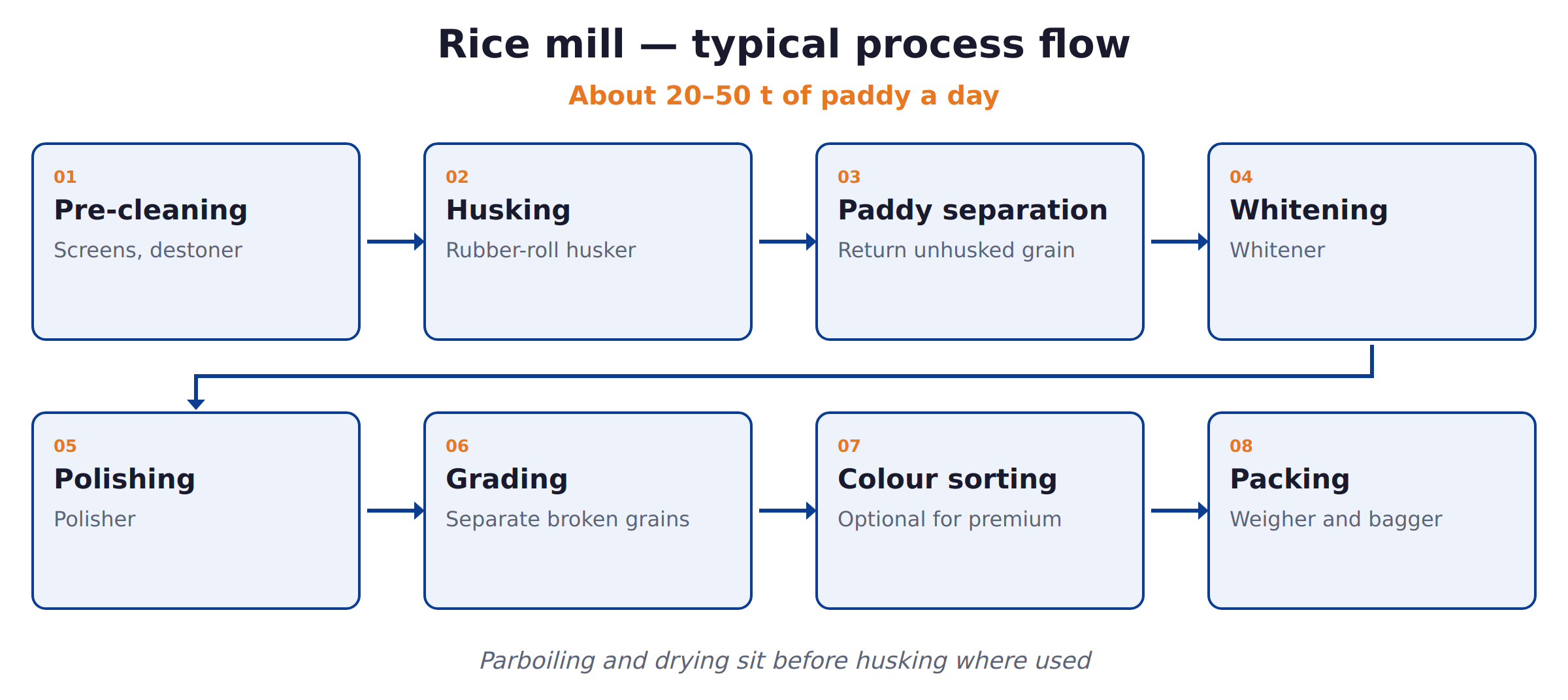
- Paddy cleaning and destoning.
- Parboiling: soaking tanks, steaming vessel and a boiler.
- Drying to milling moisture, in dryers rather than on the ground.
- Husking (dehulling) and paddy separation.
- Whitening and polishing.
- Grading by length, and colour sorting to remove discoloured grains and stones.
- Weighing and bagging.
- Husk handling, often burned to fire the boiler.
Who sells rice mills in Nigeria
- Local fabricators build parboiling vessels and small hullers; useful for village-scale milling.
- Importers and dealers sell imported mill sets and spare rubber rolls and screens.
- Chinese factories sell mill sets and complete plants direct; you handle Form M, freight, clearance and installation.
- Turnkey companies design and commission plants with parboiling, drying, sorting and packing.
Ask every seller for a test milling of your paddy and the head rice yield it achieves.
Head rice yield: the number that pays for the mill
Head rice yield, the share of whole grains after milling, decides the value of every tonne. It depends on paddy variety, moisture, parboiling quality and the husker and whitener. A mill that breaks more grains loses money on every bag. Ask for the guaranteed head rice and total milled yield on your paddy, measured at commissioning.
Worked example: what a 30 t/day plant needs
An illustration only:
| Item | Example |
|---|---|
| Paddy intake | 30 t per day |
| Milled rice out (assuming about 60–65% total milling yield) | About 18–20 t per day |
| Paddy stock for three months of running | About 2,000 t, purchased around harvest |
| Husk produced | Roughly a fifth of the paddy weight, usable as boiler fuel |
| Working capital | Paddy stock is usually larger than the cost of the mill |
The paddy purchase, not the machine, is the largest cash need. Plan storage and finance for it before you order.
Landed cost in Nigeria
| Item | How to plan |
|---|---|
| Mill set or plant | Ex-works or FOB |
| Freight and insurance | To the nearest port |
| Duty | ECOWAS CET band for the machinery |
| Surcharge, CISS and ETLS | 7% of duty, 1% of FOB, 0.5% of CIF |
| VAT | 7.5% on value plus duties |
| Boiler, dryer and building | Often the largest local costs |
| Installation and commissioning | Trial milling on your paddy |
How to compare rice mill quotes
- Paddy capacity per day and running hours.
- Cleaning and destoning steps.
- Parboiling included or not, and boiler size.
- Dryer type and capacity.
- Husker, whitener and polisher models.
- Grading and colour sorter.
- Packing and bag sizes.
- Electrical load and generator.
- Guaranteed head rice and milled yield.
- Installation, training and a plant you can visit.
Mistakes rice mill buyers make
- Buying the mill before securing paddy. A mill that runs three months a year cannot pay back.
- Drying on the ground. Stones and dirt enter the rice and the destoner works overtime.
- Skipping the colour sorter. It is often what separates supermarket rice from market rice.
- Undersized parboiling. The mill waits for steamed, dried paddy.
- Ignoring husk. Burned in the boiler, husk cuts fuel cost; dumped, it is a nuisance.
Choose by situation
| Situation | Usual choice |
|---|---|
| Farmer group milling for local market | Mill set with good destoning and parboiling vessels |
| Aggregator selling to supermarkets | Complete plant with dryer, colour sorter and branded packing |
| Existing mill upgrading quality | Add destoner, grader and colour sorter to the current mill |
| Processor expanding capacity | Second mill line and larger parboiling, sharing the boiler and packing |
What we see in Nigeria
- A large gap to fill. USDA's 2026 Grain and Feed Annual forecasts Nigerian paddy output at about 8.3 million tonnes in 2026/27, down about 6%, with consumption around 9.1 million tonnes and imports rising to about 3.1 million tonnes.
- Quality is the market. Imports set the benchmark for clean, sorted rice; plants that destone and colour-sort compete, others sell at a discount.
- Power. Grid capacity available nationally is about 5.4 GW according to NERC, so most mills run generators; husk-fired boilers help with steam for parboiling.
- Capital cost. The Central Bank's maximum lending rate was about 33.16% in mid-2026; paddy stock needs as much financing as the mill.
- Import process. Form M processing has moved to the B'Odogwu portal; plan the timing.
- Food registration. Packaged rice sold under a brand needs NAFDAC registration; check current requirements.
Where CISH fits
CISH supplies, installs and commissions complete rice milling plants from audited factories in China: cleaning, parboiling, drying, milling, grading, colour sorting and bagging, sized to your paddy supply, with trial milling on your paddy and the import into Nigeria handled. For a single small huller, a local fabricator is often the quicker route.