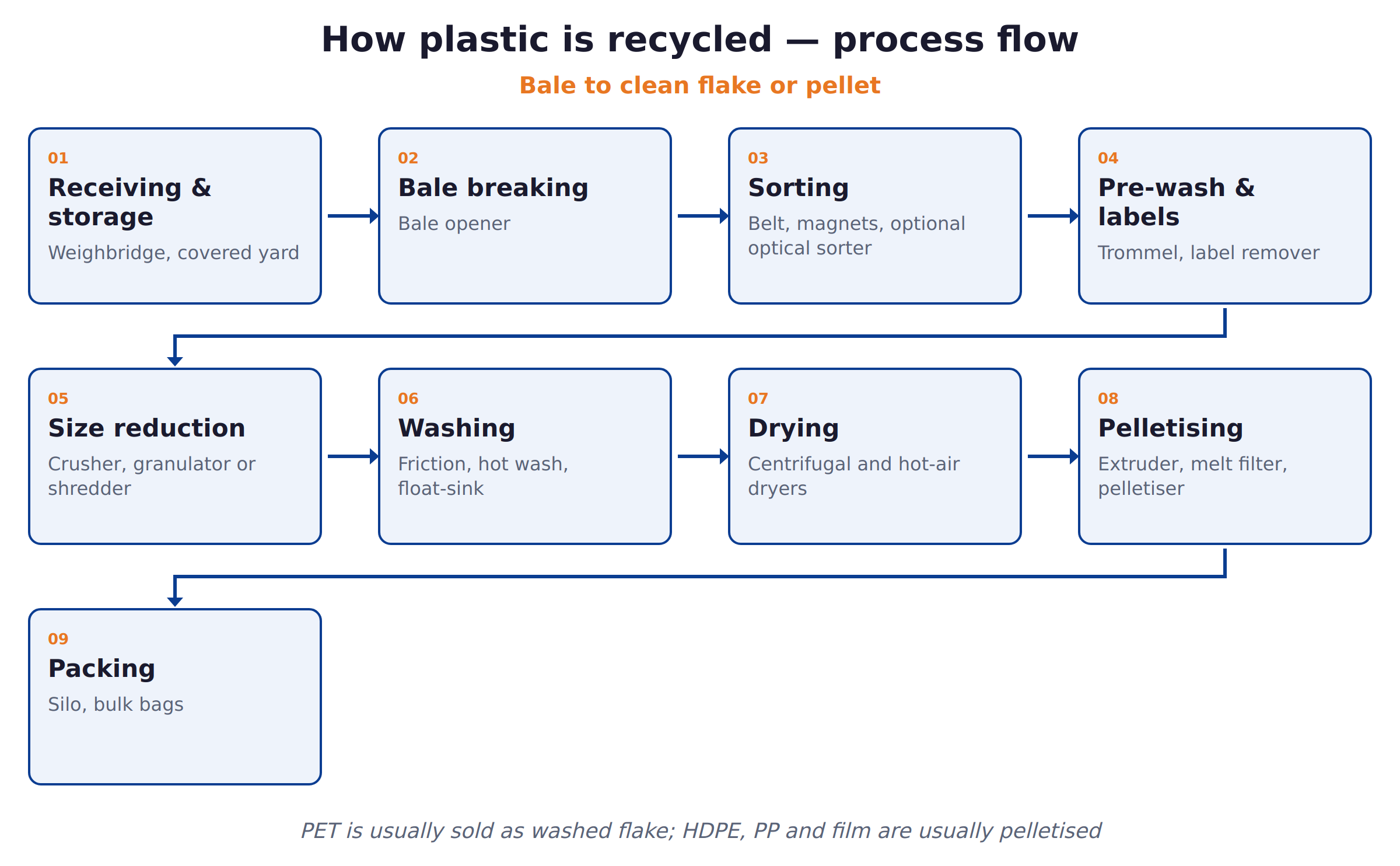
Stage one is collection and baling: buying PET bottles, HDPE containers and other plastics from pickers and collectors, sorting them by type and colour, and pressing them into bales for sale; it needs a yard, scales, a baler and working capital. Stage two is washing: shredding bales into flakes, washing, separating and drying them; a washing line of about 300–1,000 kg an hour costs about US$120,000–350,000 ex-works, and a PET flake line of about 500 kg an hour about US$150,000–200,000, as an indication for 2026. Stage three is pelletising: melting clean flakes or film into pellets that bag, film and moulding factories can use directly, for about US$80,000–120,000 more. Landed and installed, add roughly 25–45%. Clean sorted bottle bales often yield in the region of 70–85% clean flakes. Power is a major running cost, with national grid capacity of about 5.4 GW in 2025.
The three stages
| Stage | What you do | Equipment | Indicative investment (2026) | Who buys |
|---|---|---|---|---|
| 1. Collection and baling | Buy, sort and bale plastics | Yard, scales, baler, sorting tables | Mostly working capital; balers sold locally | Washers, exporters, larger recyclers |
| 2. Washing | Shred, wash, separate, dry into flakes | Washing line | About US$120,000–350,000 for 300–1,000 kg/h; PET about US$150,000–200,000 for 500 kg/h | Converters, exporters |
| 3. Pelletising | Melt and filter flakes or film into pellets | Pelletiser | About US$80,000–120,000 more | Bag, film, pipe and moulding factories |
Most successful recyclers start at stage one, learn the material and the buyers, then move to washing for one stream.
Stage 1: collection and baling
Collection depends on pickers, scavengers and small collectors who bring plastics to buy-back points. Pay fairly and quickly, weigh honestly, and keep a steady price policy; collectors bring material where they trust the scale. Sort by polymer (PET, HDPE, PP, LDPE film) and by colour, because clear PET and natural HDPE earn more. Bales must be clean and dry; buyers deduct for dirt, caps and wrong polymers.
Stage 2: washing into flakes
A washing line removes labels, caps, glue, dirt and food residue: shredding or crushing, pre-washing, hot or friction washing, float-sink separation (PET sinks, PE and PP float), and drying. Clean sorted bottle bales often yield in the region of 70–85% clean flakes, depending on contamination. Washing needs a reliable water supply, effluent treatment so wash water can be reused, and steady power. Our plastic recycling machine price guide breaks the lines down.
Stage 3: pelletising
Pelletisers melt flakes or washed film, filter out contamination, and cut pellets. Many Nigerian nylon bag and film makers prefer pellets because they feed consistently. Pelletising adds value but uses more power and needs skilled operators. Our recycling and bag machine guide shows how pellets become products.
Who buys recycled plastic
- Washers and larger recyclers buy bales.
- Exporters buy bales and PET flakes for overseas buyers.
- Local converters buy flakes and pellets for nylon bags, film, crates, buckets and pipes.
- Your own factory: some recyclers add a bag or film line to use their own pellets.
Agree specifications and prices in writing: moisture, contamination, colour, bulk density and packing.
Power and water
NERC's third-quarter 2025 report put available grid capacity at about 5.4 GW nationally, and manufacturers spent around ₦1.4 trillion on their own power in 2025. Shredders, friction washers, dryers and extruders are heavy loads, so plan a generator or dedicated supply sized for starting current, and include fuel in your cost per tonne. Water must be treated and recycled to keep costs and complaints down.
Importing a line
| Charge | 2026 basis |
|---|---|
| Import duty | ECOWAS CET band for each HS code |
| Surcharge | 7% of the duty |
| CISS | 1% of FOB |
| ETLS | 0.5% of CIF |
| VAT | 7.5% |
| Form M | On the B'Odogwu portal before shipment |
The 4% FOB charge was suspended after stakeholder engagement.
The numbers
At each stage, the margin is the price of what you sell minus what you pay for material, losses, labour, power, water, transport and finance. Washing and pelletising raise the price per tonne but also costs and losses. With the maximum lending rate around 33% in mid-2026, size each stage to the material you can collect and the buyers you have.
Worked example: a buy-back centre in Lagos
A buy-back centre in Lagos collects about 150 tonnes a month of mixed plastics and sells PET bales. It separates clear PET, about 80 tonnes a month, and installs a 500 kg/h PET washing line with hot washing, float-sink separation and drying, plus a water treatment unit and a generator. It sells clean flakes to a converter, and plans an HDPE line and a pelletiser in year two, once a nylon bag maker agrees to buy pellets. The figures are illustrative.
Common mistakes
- Buying a washing line before collection is steady.
- Mixed, dirty material that no buyer wants.
- No water treatment.
- Undersized generator for shredders and dryers.
- No signed buyer for flakes or pellets.
What we see in Nigeria
- Pickers and buy-back points drive collection.
- PET bottles are the most traded stream.
- Nylon bag makers buy pellets.
- Generators run most lines.
- Credit is expensive, so each stage must pay its way.
- Clean material earns far more than mixed waste.
Safety in the yard
Recycling yards handle sharp shredder blades, moving belts, hot extruders and heavy bales. Guard machines, train operators, provide gloves, boots and eye protection, and keep fire extinguishers close: plastic bales burn fiercely. Store bales in rows with space between them and away from the generator and fuel.
Grading and pricing
Buyers pay more for material that is sorted well. Grade PET by colour (clear, blue, green), remove caps and labels where buyers ask, and keep HDPE natural and coloured apart. Publish your buying prices to collectors, pay a premium for clean material, and deduct fairly for dirt and moisture so collectors learn what you need.
Working with collectors
Collectors are the start of the supply chain, and many are informal workers. Treat them as partners: pay on the spot, keep the yard safe and clean, explain what earns a better price, and consider supplying bags or carts to regular collectors. A yard that collectors trust receives more and cleaner material, which is the cheapest way to raise output and quality.
Where CISH fits
We supply complete washing and pelletising lines, shredding, washing, separation, drying, water treatment and extrusion, from audited factories in China, sized to your stream. CISH ships to Lagos, clears, installs and commissions the line on your material, and trains your team. For a baler or a single shredder, a local supplier is usually the better buy.