Landed and installed costs are typically 25–45% more. What decides profit is the quality of the bales you buy and the yield you get: clean, sorted bottle bales often yield in the region of 70–85% clean flake. Washing lines need water and treatment, and power is mostly self-generated: grid availability was about 5.4 GW nationally in 2025. CISH supplies, installs and commissions complete recycling lines.
Plastic recycling machine prices in Nigeria, 2026
| What you buy | Capacity | Indicative price (2026) |
|---|---|---|
| Single shredder or crusher | Per machine | Low tens of thousands of US dollars |
| Complete washing line | 300–1,000 kg/h | About US$120,000–350,000 ex-works |
| PET bottle flake washing line | About 500 kg/h | About US$150,000–200,000 ex-works |
| Pelletising line added | Per line | About US$80,000–120,000 more |
| Landed and installed | Any of the above | Typically 25–45% more than ex-works |
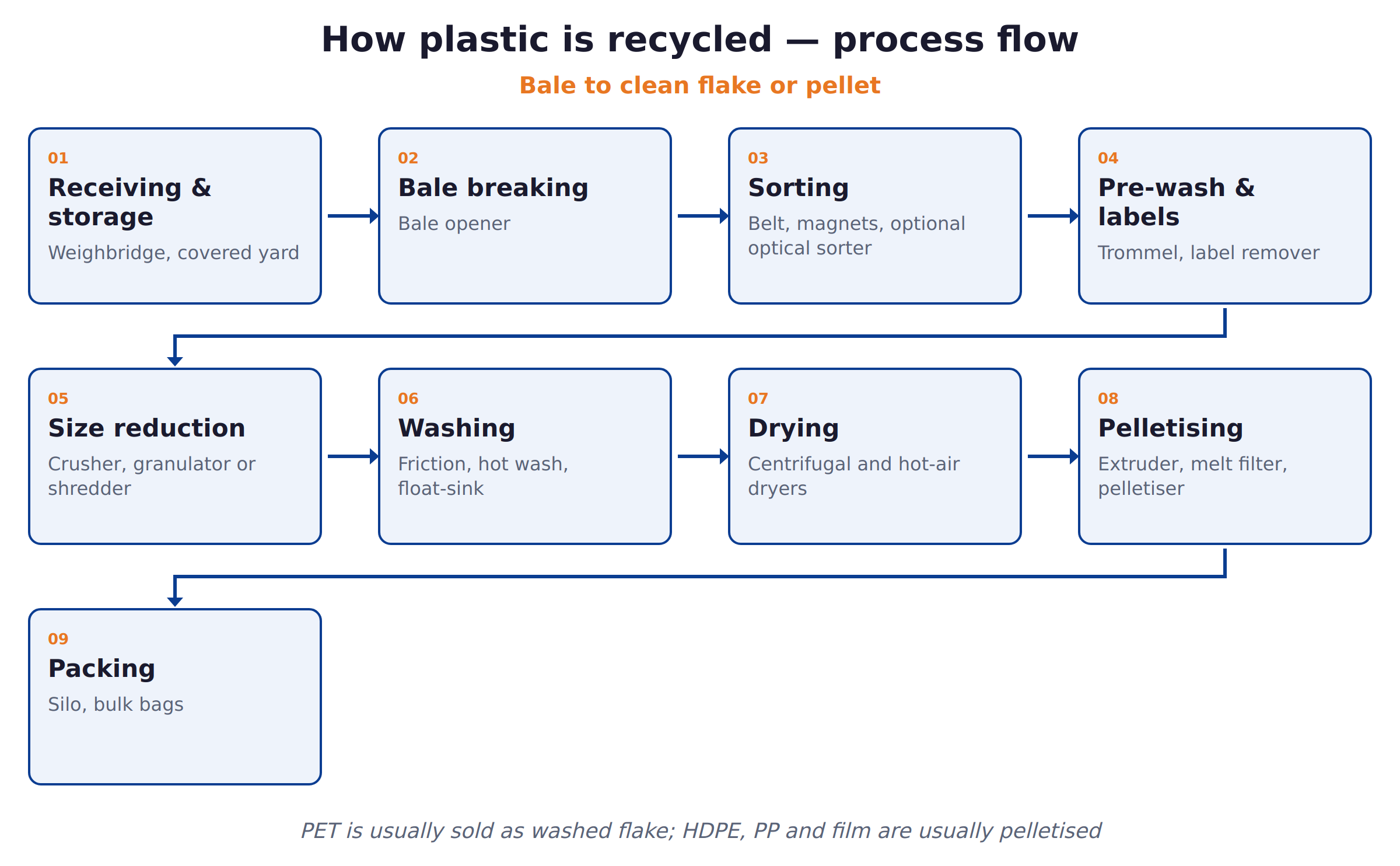
Flakes or pellets?
| Washed PET flakes | Pellets | |
|---|---|---|
| Plastics | PET bottles | HDPE, PP, LDPE film, sometimes PET |
| Machines | Sorting, label removal, crushing, hot wash, float-sink, drying | Washing line plus extruder, melt filter, pelletiser |
| Buyers | Fibre makers, sheet and strap makers, exporters | Local converters making buckets, crates, pipes, bags |
| Price | Depends on cleanliness, colour, PVC content | Depends on melt quality and contamination |
Many Nigerian recyclers start with flakes and add pelletising once they have steady buyers among local converters.
Collection and sorting
Most post-consumer plastic in Nigeria is collected by informal pickers and sold through aggregators and buy-back points. Your supply depends on paying fairly and promptly, and on telling suppliers what you will and will not buy. At the plant, sort bales by polymer and colour, remove caps, labels, PVC bottles and rubbish, and weigh everything in and out. Yield, clean product sold divided by bales bought, is the number that decides the business; test a few tonnes before agreeing large supply contracts.
Water, power and waste
Washing lines use water continuously and produce dirty water with sand, labels and residues. A borehole, settling tanks and filters for recirculation are usual. Hot washing and pelletising use a lot of power: NERC's third-quarter 2025 report put national grid availability at about 5.4 GW, and manufacturers spent around ₦1.4 trillion on self-generation in 2025. Size the generator for the whole line, including extruder heaters. Labels, caps and sludge must be disposed of legally.
Landed cost in Nigeria
| Item | Basis |
|---|---|
| Duty | ECOWAS CET band for each machine |
| Surcharge | 7% of duty |
| CISS | 1% of FOB |
| ETLS | 0.5% of CIF |
| VAT | 7.5% on value plus duties |
| Form M | Through B'Odogwu |
| 4% FOB charge | Suspended; confirm before import |
Finance
The Central Bank's figures put the maximum lending rate at around 33% in mid-2026. Many recyclers start with a sorting area, a crusher and a smaller washing line, sell flakes, and add pelletising from cash flow.
Worked example: a PET bottle washing plant
A recycler in Lagos buys PET bottles from aggregators and sells them baled to traders. To capture more value, it installs a 500 kg an hour PET washing line: bale breaker, sorting belt, label remover, wet crusher, friction washers, hot wash, float-sink tank and dryer, with a borehole, water treatment and a generator. Its first lesson is sorting: a few PVC bottles in a batch spoil the flake, so it adds a second sorting station. Clean flake sells at a better price to fibre and strap makers. The figures are illustrative.
How to compare quotes
- Output in kg/h of clean flake or pellets.
- Yield on a sample of your bales.
- Label removal and sorting stations.
- Hot wash for PET.
- Float-sink and drying.
- Melt filter on the pelletiser.
- Water use and treatment.
- Power: connected load and generator size.
- Installation, commissioning on your bales, and training.
- Spares: blades, screens, filters.
Choose by situation
- Aggregator adding value: sorting and a crusher, selling unwashed flakes.
- Flake producer: a complete PET washing line.
- Supplier to converters: a washing line with pelletising for HDPE and PP.
- Large recycler: several lines with optical sorting.
Space, water and permits
A recycling plant needs a covered yard for bales, a sorting area, the washing line, settling ponds or tanks for water, a store for finished flakes or pellets, and space for trucks to load and unload. Washing lines can use large volumes of water, so a borehole with treatment is common, and the dirty water must not be discharged untreated. Check with your state environmental agency and local authority which permits apply to a recycling plant at your site before you buy. Plan dust and noise control too, because crushers are loud.
Buyers and specifications
Before you install a line, agree specifications with your buyers: colour, flake size, moisture, PVC and label content for PET flakes, or melt flow and contamination for pellets. Buyers pay more for consistent material, and many will test a sample from each batch.
Staffing and safety
Sorting is labour-intensive, so plan enough sorters per shift and good lighting at the belt. Crushers and granulators need guards, emergency stops, hearing protection and training, and blades must be changed by trained staff with the machine locked off. Keep first aid and fire extinguishers near the line and the bale store, since plastic bales burn fiercely. Store bales in stacks with fire breaks between them, away from the generator and fuel, and keep the yard free of loose plastic that can carry a fire from one stack to the next.
Mistakes we see
- Buying a line before testing bales.
- No label removal on PET.
- No melt filter on pellets.
- Weak water treatment.
- No buyer agreed for flakes or pellets.
What we see in Nigeria
- Collection is mostly informal, through pickers and aggregators.
- PET bottles are the usual starting material.
- Local converters buy pellets for buckets, crates and bags.
- Grid availability was about 5.4 GW nationally in 2025.
- Self-generation cost manufacturers about ₦1.4 trillion in 2025.
- Credit costs around 33% at the maximum lending rate.
- Imports pay CET duty plus surcharge, CISS, ETLS and VAT.
- Form M runs on B'Odogwu.
Where CISH fits
We supply complete recycling lines, sorting, washing, drying and pelletising, from audited factories in China, sized to your plastics and output. CISH ships and clears the line, installs and commissions it on your bales with yield measured, and trains your team. For a single shredder, a local dealer is usually the better buy.