Processing means buying fresh fruit bunches from farmers and plantations, sterilising, threshing, digesting and pressing them, and clarifying the oil; trading means buying crude palm oil in the peak season, when fruit is plentiful and prices fall, storing it in drums or tanks, and selling in the lean months when prices rise. Small mills start with single machines made locally or imported, at roughly US$950–29,000 each, with small presses and threshers around US$1,500; a complete mill of about 1–5 tonnes of fresh fruit bunches an hour costs about US$100,000–390,000, and industrial mills of 10 tonnes an hour and up from about US$1.7 million. Oil comes to roughly a fifth of bunch weight, depending on the fruit and the mill, and kernels are a second product. Fruit supply and storage decide the business; with the maximum lending rate around 33% in mid-2026, the cost of holding stock matters too. Packaged palm oil sold to shops should be registered with NAFDAC. CISH supplies, installs and commissions complete palm oil mills.
Step 1: choose your model
| Processing (mill) | Trading (buy and store) | Both | |
|---|---|---|---|
| What you buy | Fresh fruit bunches | Crude palm oil | Bunches in season, oil when needed |
| Equipment | Sterilisers, thresher, digester, press, clarification | Drums or tanks, filters | Mill plus storage |
| Income | Oil and kernels from fruit | Price difference between seasons | Both |
| Main risk | Fruit supply, mill downtime | Price falls, poor storage | Capital tied up |
| Capital | Equipment and working capital | Mostly working capital | High |
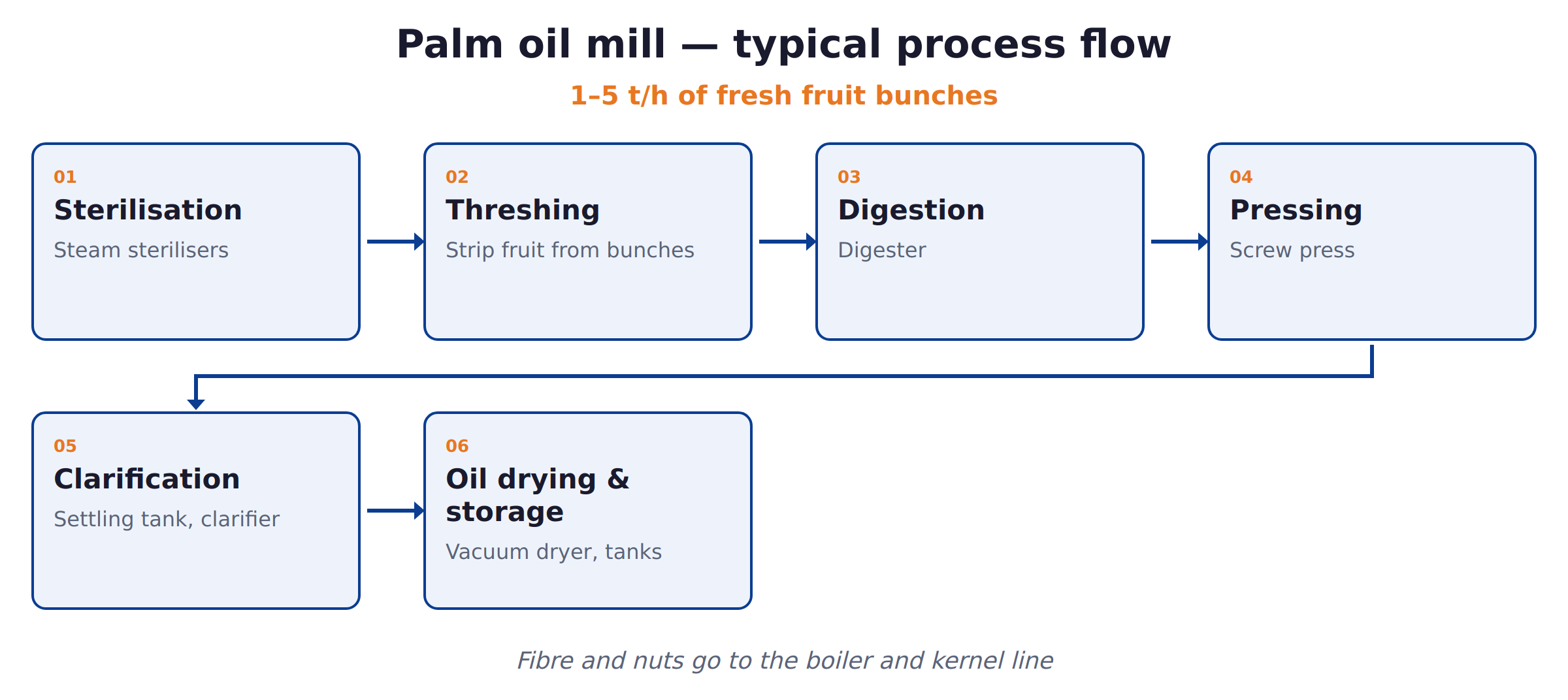
Step 2: secure fruit supply
Palm fruit comes from smallholder farms, wild groves and plantations across southern Nigeria. A mill needs a steady flow of fresh bunches, ideally processed within a day of harvest because fruit that waits develops free fatty acids and poorer oil. Agree supply with farmer groups, pay fairly and on time, and plan collection trucks. In the peak months, fruit is plentiful; in the lean months, mills compete for it.
Step 3: equipment and costs
| What you buy | Capacity | Indicative price (2026) |
|---|---|---|
| Single machines (thresher, digester, press, clarifier) | Small | About US$950–29,000 each; small machines around US$1,500 |
| Complete small mill | About 1–5 t of fresh fruit bunches an hour | About US$100,000–390,000 |
| Industrial mill | 10 t/h and up | From about US$1.7 million |
A complete mill includes bunch reception, sterilisers (steam), a thresher to strip fruit, a digester, a screw press, oil clarification and settling tanks, a nut and fibre separator, a boiler fired with fibre and shells, and kernel recovery. Our palm oil machine price guide breaks down each stage. Local fabricators make many small machines; our guide to Nigerian fabricators and imported lines explains where each fits.
Step 4: storage and quality
Crude palm oil keeps well if it is clean, dry and stored in closed, clean drums or tanks away from sun and heat. Water and dirt raise free fatty acids and spoil the oil. Buyers, especially food processors and refiners, test for free fatty acids and moisture; good oil earns a better price. For trading, plan secure storage and a way to check oil before you buy.
Step 5: power and fuel
NERC's third-quarter 2025 report put available grid capacity at about 5.4 GW nationally, so most mills generate their own power. The boiler can burn fibre and shells from the mill, which cuts fuel costs; presses, digesters and pumps run on electricity or diesel engines.
Step 6: importing a mill
| Charge | 2026 basis |
|---|---|
| Import duty | ECOWAS CET band for each machine's HS code |
| Surcharge | 7% of the duty |
| CISS | 1% of FOB |
| ETLS | 0.5% of CIF |
| VAT | 7.5% |
| Form M | On the B'Odogwu portal before shipment |
Step 7: register and sell
Crude oil sold in drums to traders, soap makers and refiners is a bulk trade. Bottled or jerrycan palm oil sold to shops and supermarkets is a packaged food and should be registered with NAFDAC, with labels showing the product, net volume, batch, dates and your address. Kernels sell to kernel crushers for palm kernel oil and cake.
Step 8: the numbers
For a mill, the margin is oil and kernel value minus fruit, transport, labour, fuel, maintenance and finance. For trading, the margin is the seasonal price difference minus storage, losses and the cost of money. With the maximum lending rate around 33% in mid-2026, holding stock on borrowed money for several months can eat the price gain, so work out the finance cost before you store.
Worked example: a farmer group mill in Imo
A farmer group in Imo State sells fresh bunches to traders at low prices and processes some by hand. It installs a small mill of about 2 tonnes of bunches an hour with sterilisers, a thresher, a digester, a screw press, clarification tanks, a boiler fired with fibre and shells, and a nut cracker. Members deliver bunches within a day of harvest. In peak season the group stores part of its oil in drums to sell in the lean months, and sells kernels to a crusher. The figures are illustrative.
Common mistakes
- Fruit that waits too long before processing.
- Dirty or wet storage that raises free fatty acids.
- Storing oil on expensive credit without working out the cost.
- No boiler plan: buying fuel when fibre and shells could fire it.
- A mill larger than the fruit supply.
What we see in Nigeria
- Smallholders and wild groves supply much of the fruit.
- Local fabricators make many small machines.
- Seasonal prices reward good storage.
- Generators and fibre-fired boilers power most mills.
- Credit is expensive, so working capital planning matters.
- Packaged oil needs NAFDAC registration.
Kernels: the second product
Every tonne of fruit bunches leaves palm kernels after pressing. Many small mills sell kernels in bags to kernel crushers, who extract palm kernel oil for soap, cosmetics and food and sell the cake to feed mills. A nut cracker and a separator recover kernels cleanly; dry them well before storage. Kernel income can make the difference between a mill that pays and one that does not.
Hygiene and buyers
Food processors, refiners and supermarkets prefer clean, low-acid oil from mills that keep sterilisers, presses and tanks clean. Drain water from settling tanks properly, keep drums sealed, and record the free fatty acid and moisture of each batch. Mills that can show records often sell at better prices and keep buyers through the lean season.
Effluent
Palm oil mills produce effluent from sterilisation and clarification. Plan settling ponds or treatment, away from streams and homes, before the mill starts.
Where CISH fits
We supply complete palm oil mills, from bunch reception and sterilisation to pressing, clarification, kernel recovery and boilers, from audited factories in China, sized to your fruit supply. CISH ships to Lagos or Onne, clears, installs and commissions the mill on your fruit, and trains your team. For single small machines, a local fabricator is usually the better buy.