Local hammer mills are made and sold in Uganda and cost a small part of a plant budget; branded grade 1 flour for supermarkets and large institutions needs a roller plant, about US$250,000–400,000 for 30 tonnes a day as an indication for 2026, landed and commissioned in Uganda. Schools are a large market: many buy maize flour in bulk for learners' meals each term. Power is a major cost: approved first-quarter 2026 tariffs after UEDCL took over distribution were about UGX 203.6 per unit for extra-large and UGX 300.4 for large industrial users, with higher rates for small users. The 2026/27 budget gave agro-industrialisation about UGX 2.2 trillion, its largest allocation.
Two business models
| Service milling | Selling your own flour | |
|---|---|---|
| Income | Fee per kilogram or per basin | Margin between maize price and flour price, plus bran |
| Equipment | Hammer mill, sometimes a dehuller | Cleaning, dehulling or degerming, milling, sifting, packing |
| Working capital | Very little | Maize stock and credit to buyers |
| Customers | Households, farmers | Shops, schools, institutions, traders |
| Seasonality | Busy after harvests | Steady if you store maize |
Many mills do both: service milling every day, and own flour when maize is cheap after harvest.
Buying maize
Many parts of Uganda harvest maize twice a year, which helps supply. Prices fall after harvests and rise in between. Buy dry maize, test moisture at intake, and store it in a ventilated store with pest control. Working capital for maize stock grows quickly with volume; plan finance before you scale.
Supplying schools and institutions
Boarding and day schools buy maize flour in bulk for meals, usually each term, as do hospitals, prisons and relief food buyers. They want consistent quality, correct weights, reliable delivery and invoices; larger buyers may require UNBS certification. Tender and supply schedules follow the school calendar, so build stock before each term.
Power
Hammer mills are heavy electricity users. Small users pay higher tariffs than large industrial users, so a mill's power bill depends on its connection and category. Keep hammers and screens in good condition, use the right motor size, mill full loads, and consider a three-phase connection. Diesel mills work where grid power is weak.
Mill sizes and costs
| Mill | Typical output | Indicative cost (2026) | Fits |
|---|---|---|---|
| Hammer mill for service milling | Service volumes | Sold locally; a small part of a plant budget | Trading-centre mills |
| Dehuller and hammer mill set | A few tonnes a day | Priced per set | Mills selling whiter posho |
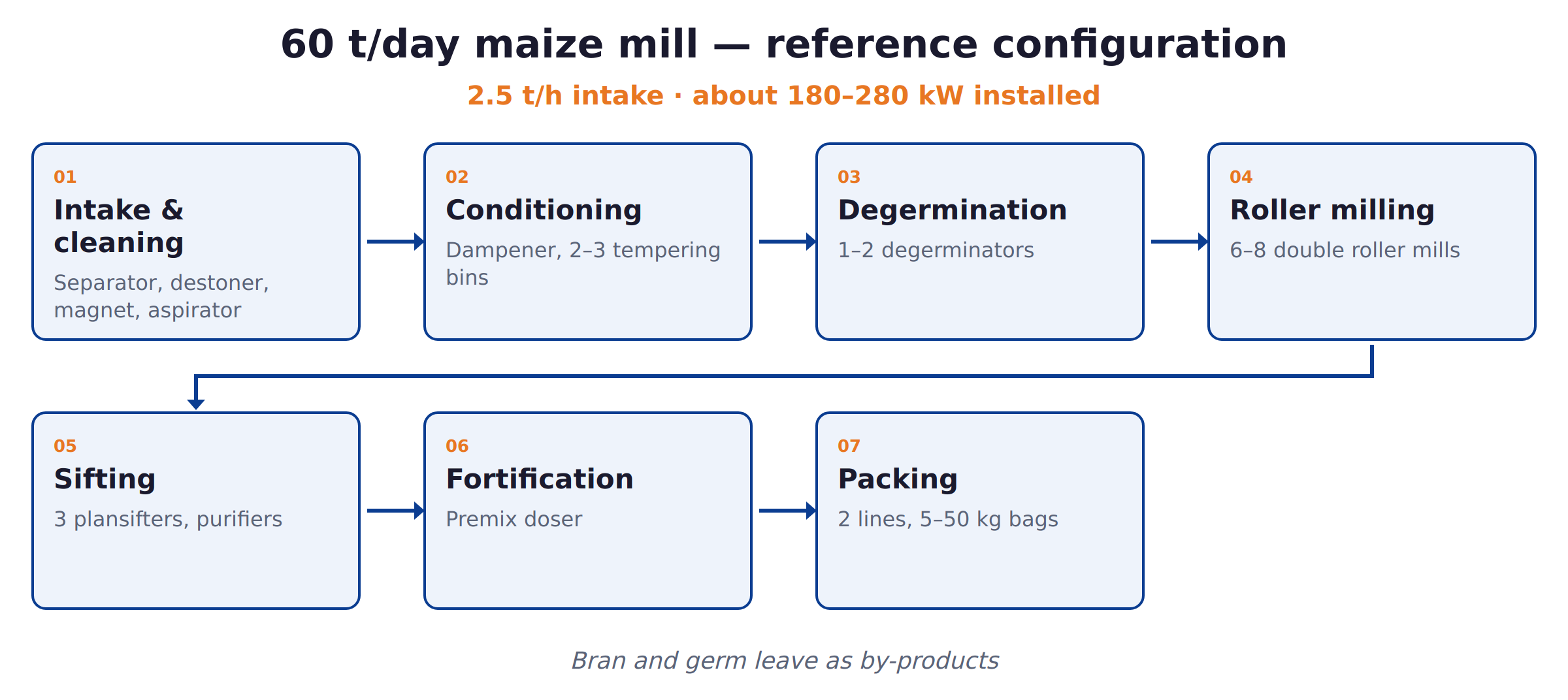
| Roller plant | About 30 t/day | About US$250,000–400,000 landed and commissioned | Branded grade 1 flour |
| Larger roller plant | About 60 t/day | About US$700,000–1.1 million | Regional and export millers |
Our maize milling machine price guide covers the options.
Standards and licences
Register the business and get local trading licences. Packed maize flour sold to supermarkets and large buyers is expected to meet UNBS standards, and many buyers ask for the UNBS Q-Mark. Keep the mill and store clean and dry; buyers and inspectors look at hygiene as much as the flour.
Importing a plant
Capital goods usually enter Uganda duty-free under the EAC CET; VAT is 18%, and regulated goods need UNBS pre-shipment verification. Equipment travels by sea to Mombasa or Dar es Salaam, then inland by road or rail, which is why landed costs are higher than at the coast. The Uganda Trade Portal sets out the import procedure.
The numbers
For service milling: fees × kilograms milled − (power + labour + hammers and screens + rent). For own flour: (flour price − maize cost per kilogram of flour) × kilograms sold + bran income − (power + labour + packing + transport + rent + finance). Work out both for your mill and location, using your own fees and prices.
Finance
The 2026/27 national budget put about UGX 2.2 trillion behind agro-industrialisation, and development finance institutions lend to agro-processors. Lenders want a clear plan: buyers, maize supply, a landed budget for the plant and realistic volumes.
Worked example: a mill in Masaka grows into school supply
A miller in Masaka runs two hammer mills for service milling and sells some posho to shops. Three boarding schools offer to buy 15 tonnes of flour a month each term if the flour is consistent and certified. The miller adds a dehuller and sifter, a packing scale and 25 kg bags, applies for UNBS certification and builds a maize store. As volumes grow, he plans a 30 t/day roller plant with a development finance loan. The figures are illustrative.
From a delivered project: On a delivered 60 t/day super-fine maize mill more than six hours from the nearest engineering hub, the mill itself was the easy part: extra pre-cleaning for maize at 11–16% moisture, an on-site critical-spares buffer and a year of support took the plant to about 85% of nameplate by month four. Read the maize mill case study.
Common mistakes
- No maize storage for the months between harvests.
- Worn hammers that waste power.
- Supplying schools on credit without a contract.
- Uncertified flour for large buyers.
- A roller plant before having buyers.
What we see in Uganda
- Hammer mills serve most households.
- Schools and institutions buy flour in bulk each term.
- Two maize seasons in many areas help supply.
- Power costs depend on the connection category.
- UNBS certification is asked for by larger buyers.
- Agro-industrialisation has record budget support.
Choosing a location
A service mill earns on footfall: trading centres, markets and dense residential areas bring customers with maize. A flour business earns on access to maize and buyers: near farming areas for supply, and on a good road for deliveries to shops and schools. Check the power connection before you sign a lease, because a three-phase supply changes your running costs, and look at how many mills are already nearby.
Staff and record keeping
A small mill needs an operator who can run and maintain the mill, someone to weigh and collect fees, and, for flour sales, packers and a driver. Keep daily records of kilograms milled, fees collected, flour sold, maize bought and power used. Records show which months are busy, when to buy maize, and whether the mill is making money, and they are what lenders ask for when you apply for finance to grow.
Bran and germ
Dehulling and degerming produce bran and germ, which feed makers and farmers buy for poultry, pig and dairy feeds. Bag them separately, keep them dry and sell them regularly; in a roller plant they are a meaningful share of income.
Where CISH fits
For a hammer mill for service milling, a Ugandan workshop is usually the better buy. When the business grows into branded flour, CISH supplies complete maize milling plants, cleaning, degerming, roller milling, sifting and packing, from audited factories in China, ships them through Mombasa or Dar es Salaam, clears, installs and commissions them, and trains your miller.