These mills are made and sold locally, run on electricity or diesel, and cost a small part of what a flour plant costs. Those prices are landed and commissioned; because Uganda is landlocked and equipment travels from Mombasa or Dar es Salaam, the inland leg pushes a project towards the top of the band. Capital goods usually enter duty-free under the EAC Common External Tariff, but VAT is 18%, and regulated goods need UNBS pre-shipment verification. Power costs fell after UEDCL took over distribution in 2025, with approved first-quarter 2026 tariffs of about UGX 203.6 per unit for extra-large and UGX 300.4 for large industrial users. CISH supplies, installs and commissions complete maize milling plants in Uganda.
Maize milling machine prices in Uganda, 2026
| What you buy | Capacity | Indicative price (2026) | Fits |
|---|---|---|---|
| Local hammer mill, electric or diesel | Service milling | Sold locally; a small part of a plant budget | Trading-centre maize mills |
| Dehuller and hammer mill set | A few tonnes a day | Priced per set | Mills making whiter flour |
| Complete grade 1 flour plant | About 30 t/day | About US$250,000–400,000 | Branded flour for shops and schools |
| Larger plant | About 60 t/day | About US$700,000–1.1 million | Regional and export millers |
Plant prices above are landed and commissioned. For single machines bought at the factory gate, landed and installed through Mombasa or Dar es Salaam is typically about 1.45–1.60 times ex-works.
Hammer mill or roller plant?
| Local hammer mill | Roller plant | |
|---|---|---|
| Product | Whole-grain or dehulled posho flour | Grade 1 and grade 2 flour, bran and germ |
| Separation | Little; with a dehuller, some bran removed | Degerming, sifting, controlled grades |
| Consistency | Varies | Even fineness and colour |
| Investment | Low | High |
| Customers | Households, small shops | Supermarkets, schools, institutions, exporters |
Electric or diesel?
Electric mills cost less to run per bag where three-phase supply is steady; diesel mills keep running in areas without grid power and during outages. Tariffs approved for the first quarter of 2026, after UEDCL took over distribution in 2025, were about UGX 203.6 per unit for extra-large industrial users and about UGX 300.4 for large industrial users; small commercial users pay other rates. Check the supply at your site before choosing.
Importing a plant into Uganda
| Item | 2026 basis |
|---|---|
| Duty | 0% for capital goods under the EAC CET; the 8-digit code decides |
| VAT | 18% |
| UNBS PVoC | Pre-shipment verification for regulated goods |
| Route | Sea to Mombasa or Dar es Salaam, then road or rail |
| Landed factor | About 1.45–1.60 times ex-works for equipment priced at the factory; our plant prices already include it |
The Uganda Trade Portal sets out the import procedure. Our Uganda import guide covers the sequence and documents.
Standards and markets
Packed maize flour sold to supermarkets and institutions is expected to meet UNBS standards, and many buyers ask for the UNBS Q-Mark. Schools, prisons and relief food suppliers buy large volumes on contract and test for quality. Regional buyers in neighbouring countries buy Ugandan maize flour when harvests elsewhere are poor.
Finance and policy
Uganda's 2026/27 budget allocated about UGX 2.2 trillion to the agro-industrialisation pillar, its largest allocation, and development finance is available for agro-processing. A well-specified plant with a clear landed budget is easier to finance.
Worked example: a trading-centre mill in Mbale
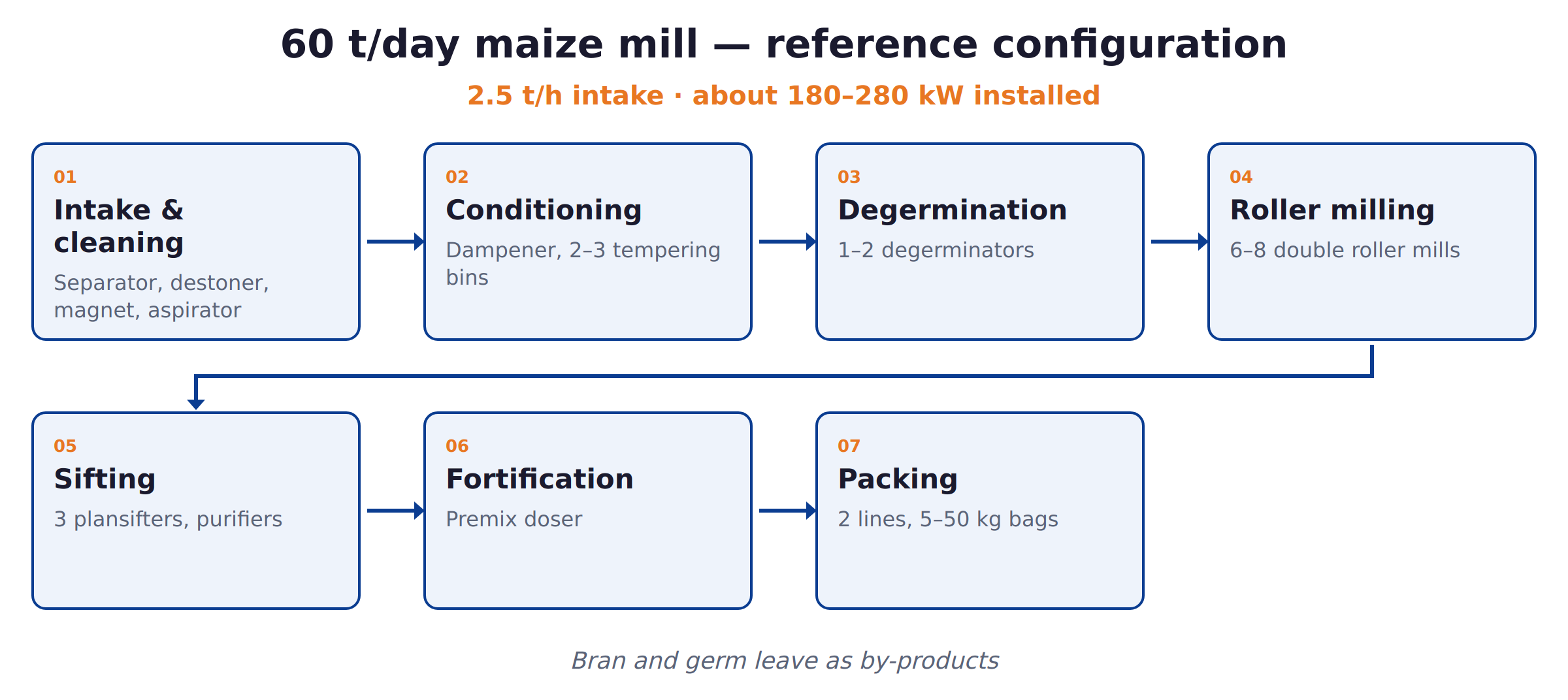
A miller in Mbale runs two electric hammer mills for service milling and sells some posho flour to local shops. A school supplier asks for 20 tonnes a month of grade 1 flour in 25 kg bags. The miller plans a 30 t/day plant with cleaning, degerming, roller milling, sifting and bagging, and keeps the hammer mills for service milling. Bran and germ are sold to feed makers. The figures are illustrative.
How to compare quotes
- Tonnes a day of finished flour, by grade.
- Cleaning and degerming sections.
- Roller mills and sifters.
- Fortification doser if buyers require it.
- Packing: bag sizes and speed.
- Connected load and backup plan.
- Installation, commissioning on your maize, and training.
- Spares: rolls, screens, belts, bearings.
- References of plants in East Africa.
Maize supply and storage
Uganda grows maize in two seasons in many areas, which helps supply. Buy dry maize, test moisture at intake, and store it in a dry, ventilated store with pest control. Working capital for maize stock usually exceeds the cost of a small mill within a year.
What we see in Uganda
- Hammer mills do most maize milling.
- Grade 1 flour sells to supermarkets, schools and institutions.
- Landed costs are higher because of the corridor from the coast.
- Milling plants usually pay 0% duty and 18% VAT at import.
- Industrial power tariffs fell after UEDCL took over in 2025.
- Agro-industrialisation has record budget support.
Grade 1, grade 2 and what buyers check
Ugandan buyers talk about grade 1 and grade 2 maize flour. Grade 1 is the finer, whiter flour made after the bran and much of the germ have been removed; grade 2 keeps more of the grain and is coarser and cheaper. A hammer mill with a dehuller can make a whiter flour than whole-grain posho, but consistent grade 1 for supermarkets and institutions comes from degerming and roller milling with sifting. Buyers check colour, fineness, moisture, the absence of grit and insects, and the weight of each bag. Large buyers test samples and reject lots that fail, so a laboratory corner with a moisture meter and sieves pays for itself quickly.
Keeping a mill running
Most lost output in Ugandan mills comes from small things: worn hammers, torn screens, slipping belts and damp maize that blocks screens. Keep a stock of hammers, screens, belts and bearings, check them every week, and train one person to change them quickly. On a roller plant, rolls must be kept sharp and correctly gapped, and sifter cloths clean and tight. A miller who records output, power use and stoppages every shift sees problems before they become breakdowns.
Space and building for a plant
A 30 t/day plant needs a building of roughly 150–250 m² plus maize storage and a bagging and dispatch area, a three-phase supply sized for the motors, and access for trucks. Taller buildings allow gravity flow between machines; lower buildings need more conveyors. Plan the building with the plant supplier before construction starts.
From a delivered project: On a delivered 60 t/day super-fine maize mill more than six hours from the nearest engineering hub, the mill itself was the easy part: extra pre-cleaning for maize at 11–16% moisture, an on-site critical-spares buffer and a year of support took the plant to about 85% of nameplate by month four. Read the maize mill case study.
Where CISH fits
For a hammer mill for service milling, a Ugandan workshop is usually the better buy, and we will say so. For grade 1 flour at scale, CISH supplies complete maize milling plants, cleaning, degerming, roller milling, sifting and packing, from audited factories in China, ships them through Mombasa or Dar es Salaam, clears, installs and commissions them, and trains your miller.