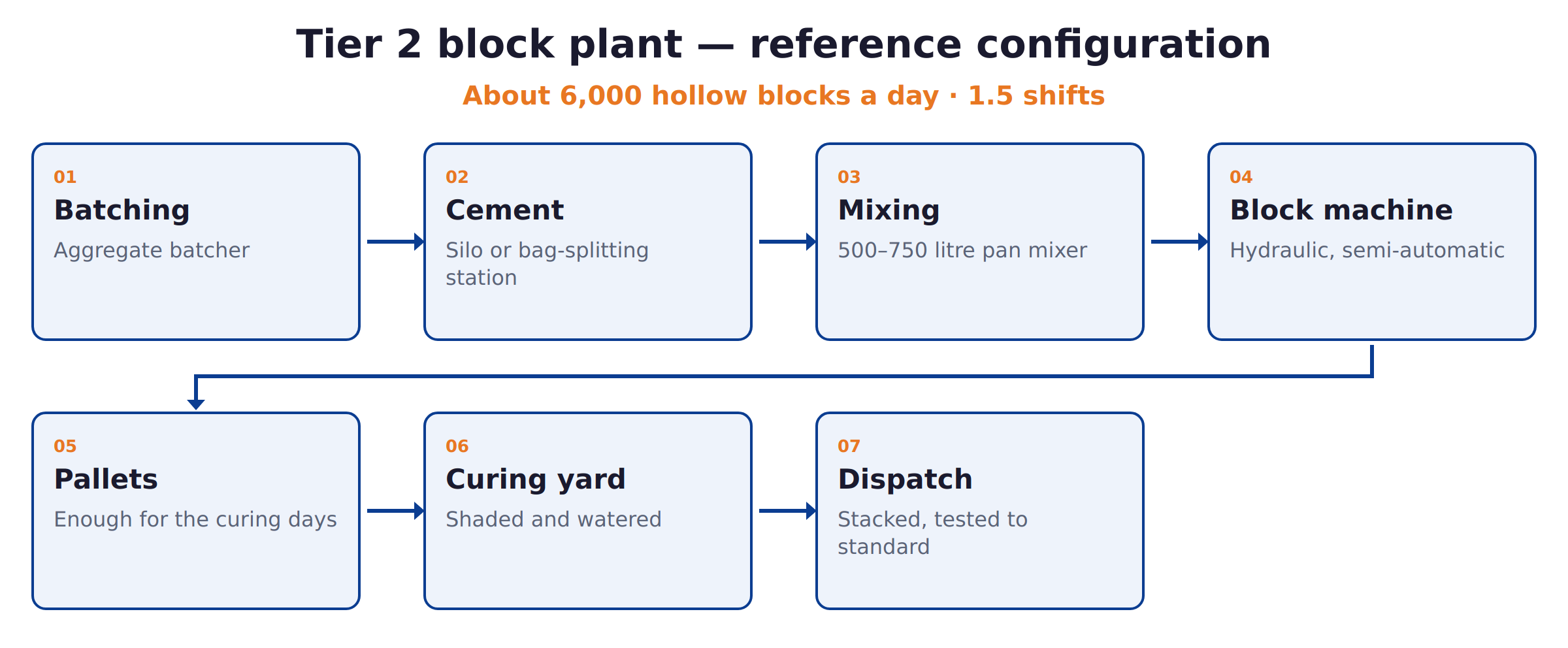
It can be a good business because Ghanaians build in stages for years, but the margin per block is small, so success depends on how many sound blocks you get from each bag of cement, how many you sell and deliver each day, and how well you cure them. As an example, a 6-inch hollow block weighs roughly 18 kg and a 5-inch about 14 kg; at one part cement to eight to ten parts sand, a 50 kg bag makes roughly 25–35 six-inch or 30–40 five-inch blocks, and leaner mixes make weak blocks that builders reject. Machines range from manual and egg-laying (mobile) machines at about US$8,000–40,000, with a whole small yard under about US$80,000, to semi-automatic static plants at about US$120,000–450,000 landed and commissioned. You need a level yard, a reliable water supply for mixing and curing, shade, and a truck for delivery. Rainy seasons slow building and curing, so plan stock and cash flow. Imported plants pay the ECOWAS CET, mostly 5%, plus the combined 20% VAT and levies, through ICUMS at Tema. CISH supplies, installs and commissions semi-automatic and automatic block plants.
What makes a block factory profitable
| Factor | Why it matters |
|---|---|
| Blocks per bag of cement | Cement is the largest cost; more good blocks per bag adds margin, but too lean a mix makes weak blocks |
| Daily sales and delivery | Fixed costs are spread over every block sold; most buyers want delivery |
| Curing | Well-cured blocks are strong and win repeat buyers |
| Location | Near building activity and good sand |
| Water | Needed every day for mixing and curing |
| Seasons | Building slows in heavy rains; plan stock and cash |
Blocks per bag of cement: an example
A 6-inch hollow block of about 450 × 150 × 225 mm contains roughly 0.009 m³ of concrete once the cavities are taken out, weighing about 18 kg; a 5-inch block of about 450 × 125 × 225 mm about 14 kg. If cement is about one-ninth of the dry mix by weight, a 6-inch block uses about 2 kg of cement, giving about 25 blocks per 50 kg bag; at one-tenth, about 28. A 5-inch block uses less, so a bag gives more. These figures are an example only: your sand, the machine's compaction and the strength buyers need decide the right mix. Test blocks rather than stretching the mix.
Machines
| Class | Typical output | Indicative price (2026) | Fits |
|---|---|---|---|
| Manual | A few hundred blocks a day | Low end of the US$8,000–40,000 band, or local machines | Small yards, site production |
| Egg-laying (mobile), vibrated | Thousands of blocks a day | US$8,000–40,000; whole yard under about US$80,000 | Most block factories |
| Semi-automatic static plant | Consistent blocks at volume, pavers | About US$120,000–450,000 landed and commissioned | Contractors, estates, supply contracts |
| Fully automatic | Large volumes | From about US$600,000 (civils extra) | Large suppliers |
Our block machine price guide and block plant sizing guide give more detail.
The site
- A level concrete slab for egg-laying machines and curing.
- Good sand close by, kept clean of soil and rubbish.
- Water: a borehole, mains supply or water tanker contract.
- Shade and covers to stop blocks drying too fast.
- Space for cement storage, stock and truck turning.
- Security for cement, machines and blocks.
Curing and the weather
Blocks gain strength over days and weeks. Water fresh blocks several times a day and keep them shaded, and do not stack or sell them too early. In heavy rain, cover fresh blocks so they are not washed or weakened, and in the dry Harmattan months water them more often. Sales usually fall in the main rainy season, so build cash reserves in the busy months.
Power
Egg-laying machines and mixers often run on diesel engines. Electric static plants need a strong three-phase supply; ECG reported in April 2026 that much of its distribution network was overloaded, so check supply at your site and plan a generator.
Delivery and sales
Builders, contractors, estate developers and families building their own homes buy blocks. Most want blocks delivered, so a tipper or flatbed truck is part of the business. Supply agreements with contractors give steady volume; walk-in sales give better prices. Keep enough stock to supply a whole house when the order comes.
Importing a plant
| Charge | 2026 basis |
|---|---|
| Import duty | ECOWAS CET; most machinery at 5% |
| VAT, NHIL and GETFund | Combined 20% from 1 January 2026 under Act 1151 |
| ECOWAS and AU levies | Small percentages on CIF value |
| Clearing | ICUMS at Tema; allow for port congestion |
The numbers
- Cost per block: cement per block, sand, water, labour, fuel, maintenance, curing, rent and loan repayments.
- Delivery cost per block for each area.
- Selling price delivered and collected.
- Blocks sold per month, in dry and rainy seasons.
Profit = (price − cost − delivery) × blocks sold − remaining fixed costs. Size the machine to the sales you can make in the slow months as well as the busy ones.
Worked example: a block factory in Kasoa
A mason in Kasoa makes blocks on site for clients with a manual machine. He leases a plot near a busy road, lays a slab, sinks a borehole, buys an egg-laying vibrated machine with a mixer and a used tipper truck, and sells about 1,200 5-inch and 6-inch blocks a day. He tests blocks and settles on a mix that gives about 30 5-inch blocks per bag. In the rainy season he covers stock and reduces production, using the time to service the machine. The figures are illustrative.
Quality and reputation
Builders tap blocks, look at the corners and count breakages on delivery. Keep moulds in good condition, keep the mix the same every day, and cure properly. A factory known for strong blocks sells even when cheaper blocks are on offer nearby.
Common mistakes
- Stretching the mix for more blocks per bag.
- Selling uncured blocks.
- No water plan.
- No delivery truck.
- No cash reserve for the rainy season.
What we see in Ghana
- Sandcrete blocks are the main walling material.
- 5-inch and 6-inch blocks are the common sizes.
- People build in stages, creating steady demand.
- Cement is the main cost.
- Delivery and curing decide reputation.
- Rainy seasons slow sales and curing.
Records and costing
Record bags of cement used, blocks made and blocks sold every day, and work out blocks per bag each week. A falling figure warns you of waste or theft; a rising one may mean the mix is getting too lean.
Where CISH fits
We supply semi-automatic and automatic block and paver plants, mixers, batching, block machines, moulds, pallet handling and curing, from audited factories in China, sized to your blocks a day. CISH ships to Tema, clears, installs and commissions the plant on your materials, and trains your operators. For a manual or egg-laying machine, a local supplier is usually the better buy.