Imported machinery usually falls in the 5% ECOWAS duty band, but since 1 January 2026 the merged VAT, NHIL and GETFund charge of 20% applies on top, with ECOWAS and AU levies, and clearing runs through ICUMS at Tema. Power is the other constant: ECG says much of its distribution network is overloaded, so generator or stable-supply planning comes first. CISH supplies, installs and commissions complete block plants for factories moving beyond manual production.
Block machine prices in Ghana, 2026
| What you buy | Typical scale | Indicative price (2026) | Fits |
|---|---|---|---|
| Manual or mobile egg-laying machine | Hundreds to a few thousand blocks a day | About US$8,000–40,000 per machine | New block factories, building sites |
| Complete small yard | One machine, mixer, moulds, slab | Under about US$80,000 | First commercial factory |
| Semi-automatic pallet plant | Thousands of blocks a shift | About US$120,000–450,000 landed and commissioned | Factories supplying contractors and estates |
| Fully automatic plant | Tens of thousands a shift | About US$600,000–1.5 million or more, civils extra | Large suppliers, pavers and kerbs too |
Machines are priced in US dollars; local costs such as slab, labour and cement are paid in cedis and move with the exchange rate.
Sandcrete, hollow blocks and what builders ask for
Ghanaian builders mostly buy hollow sandcrete blocks for walls, usually described as 5-inch for partitions and 6-inch for external and load-bearing walls, with solid blocks and pavers for other uses. A block that breaks when handled or crumbles when wet loses customers fast, so strength comes from three things: enough cement in the mix, good compaction in the machine, and proper curing. Many small yards cut cement to lower the price per block; the ones that last keep a consistent mix and water their blocks for several days.
Manual, semi-automatic or automatic?
- Manual and egg-laying machines need little capital and no stable power, but labour is high and block quality depends on the crew.
- Semi-automatic pallet machines vibrate and press blocks on pallets in a fixed position. Output and consistency rise sharply, but you need a three-phase supply or a generator, pallets and a curing area.
- Fully automatic plants add weigh-batching, conveyors, stackers and curing racks. They suit factories with steady contracts and a large yard.
Power: plan it before the machine
ECG's managing director said in April 2026 that a significant portion of its distribution network, including transformers, cables and substations, was overloaded beyond its designed thermal limits, causing frequent faults and low-voltage conditions, and announced an investment programme of GHS 3.46 billion. For a block plant that means two things. Stationary machines and mixers need a stable three-phase supply, so check the transformer near your site. And a generator sized for the press, mixer and conveyors is usually part of the budget, along with its fuel.
Landed cost in Ghana
| Item | 2026 basis |
|---|---|
| Customs duty | ECOWAS Common External Tariff; machinery is usually in the 5% band; confirm each HS code |
| VAT, NHIL and GETFund | Merged 20% on one base since 1 January 2026 |
| ECOWAS levy, AU levy, processing fee | Small percentages, added on top |
| Clearance | ICUMS single window; about 5–7 business days with clean documents, 7–10 on average |
| Port | Tema; GPHA activated congestion measures in August 2026, so allow a buffer |
| Landed factor | Ex-works equipment × about 1.25–1.45 for freight, duties, clearing, transport and installation |
Our Ghana import guide sets out the sequence and documents.
Worked example: from a manual yard to a pallet plant
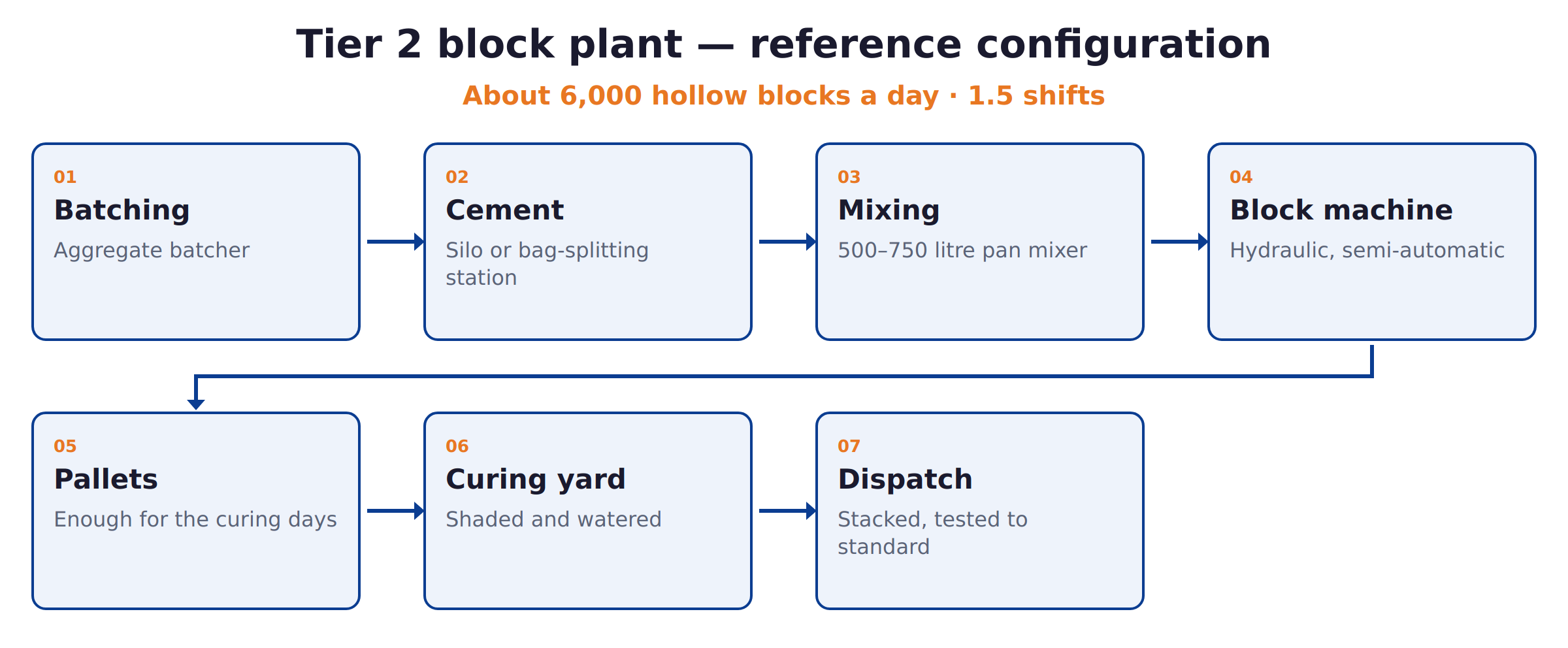
A block factory near Kumasi making 1,500 blocks a day on an egg-laying machine wins a contract with an estate developer who wants 6,000 blocks a day of consistent strength. A semi-automatic pallet plant with a pan mixer, weigh-batching for cement and sand, 1,000 or more pallets and a covered curing area can meet that on one or two shifts. The owner budgets for a three-phase connection upgrade and a standby generator, a larger slab and stockpile area, a forklift, and cement for several weeks. The figures are illustrative; plan your own around confirmed customers.
How to compare quotes
- Blocks per shift for each size, not machine cycles per minute.
- Mould sizes included for 5-inch, 6-inch, solid blocks and pavers.
- Vibration and pressing system, and the block density it achieves.
- Pallets: number and material.
- Mixer and batching: pan mixer, weigh scales.
- Power: connected load and starting current; generator size.
- Installation, commissioning on your sand and cement, and training.
- Spares: mould liners, vibrators, hydraulic seals.
- Lead time to Tema and to site.
- References of plants running the same machine in West Africa.
Choose by situation
- Building your own houses or a single project: a mobile machine may be enough.
- Selling blocks to builders in one town: a complete small yard with a good mixer and curing.
- Supplying estates and contractors: a semi-automatic pallet plant with weigh-batching.
- Regional supplier with pavers and kerbs: an automatic plant.
Curing and stacking in the Ghanaian climate
Heat and dry harmattan winds pull water out of fresh blocks quickly, and blocks that dry too fast never reach their strength. Keep fresh blocks shaded, cover them with plastic sheeting or sacking, and water them morning and evening for the first days before stacking. Stack on level ground, off the soil, and leave space between stacks for air. A plant that plans its curing area as carefully as its machine sells fewer broken blocks and gets fewer complaints from builders.
Mistakes we see
- Cutting cement until blocks break.
- Selling blocks before they cure.
- Buying a stationary plant without checking power.
- Too few pallets for the curing time.
- No buffer for Tema in the delivery plan.
What we see in Ghana
- Sandcrete dominates walling, in 5-inch and 6-inch hollow blocks.
- Manual yards are everywhere; consistent strength is the differentiator.
- Machinery duty is moderate: usually the 5% ECOWAS band.
- The 2026 tax reform merged VAT, NHIL and GETFund into one 20% charge on one base and removed the COVID-19 levy.
- ICUMS is the single window for customs clearance.
- Tema congestion led GPHA to activate measures in August 2026.
- Power is a design input: ECG reports an overloaded distribution network and a multi-billion-cedi upgrade programme.
- Cement and sand are local; quality of sand varies widely between pits.
Where CISH fits
We supply complete block plants, batching, press, moulds, pallets and curing, from audited factories in China, sized to your blocks and output, and we ship them to Tema, clear them, install and commission them, and train your team. For a single manual or egg-laying machine, a local fabricator or dealer is usually the better buy.