Bread is a NAFDAC-regulated food, so register your products and meet its premises requirements. The two costs that decide profit are flour and power: grid availability was about 5.4 GW nationally in 2025, so most bakeries run their ovens and mixers on generators or gas. CISH supplies, installs and commissions complete bread lines for bakeries moving to factory scale.
Step 1: Choose your products and market
| Product | Customers | Equipment focus |
|---|---|---|
| Agege-style soft bread | Hawkers, kiosks, neighbourhood shops | Mixer, dough brake or moulder, oven with high output |
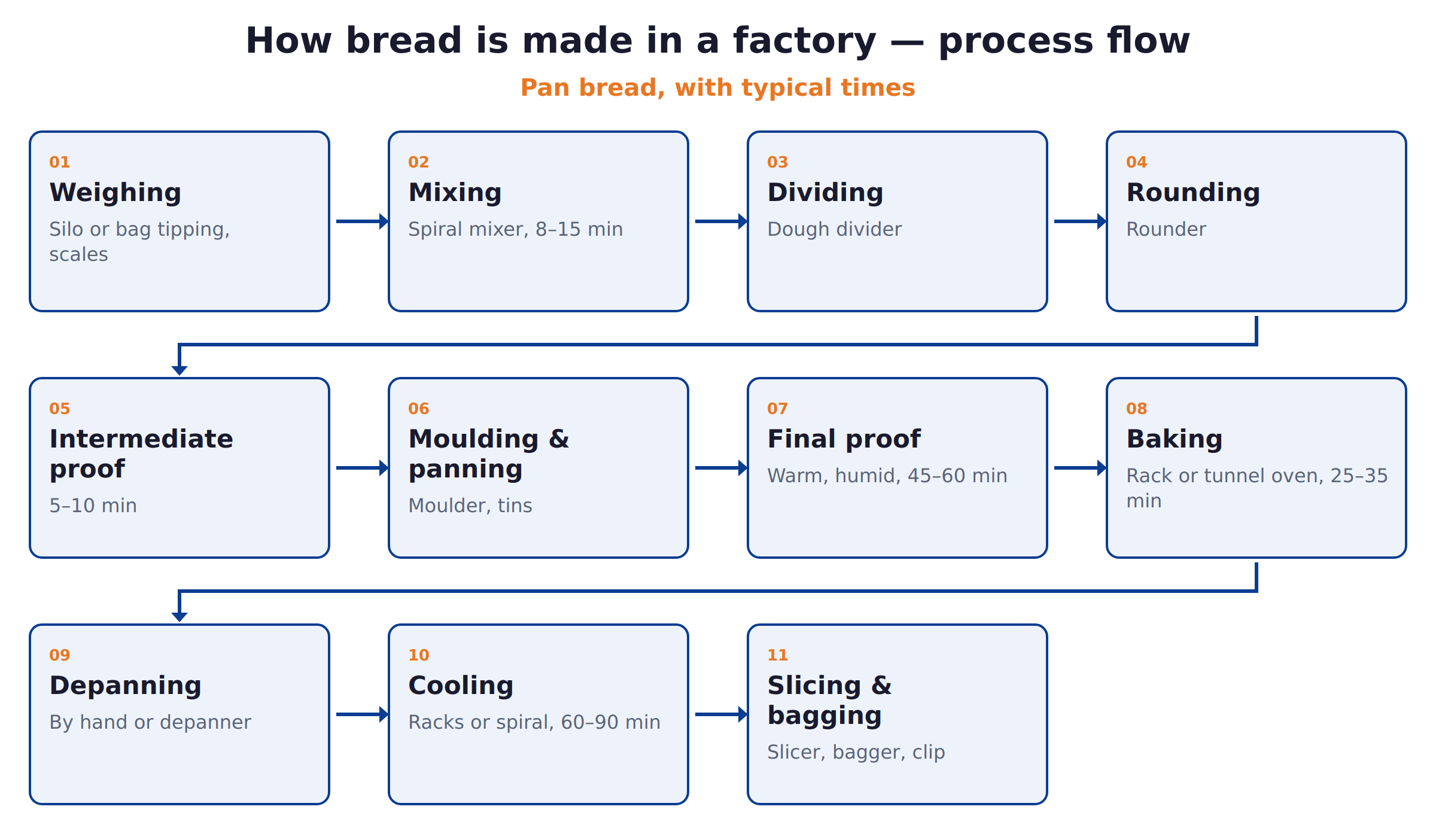
| Sliced bread in bags | Supermarkets, offices, schools | Divider, moulder, proofer, oven, cooling, slicer, bagger |
| Snacks: buns, meat pies, doughnuts | Kiosks, events, offices | Mixer, sheeter, fryer, small ovens |
| Cakes and pastries | Walk-in customers, events | Planetary mixers, deck ovens, display |
Most bakeries start with one main bread product and add snacks for margin.
Step 2: Work out cost per loaf
Prices move quickly in Nigeria, so build your own figures. For each loaf size, add:
- Flour for the loaf, plus sugar, fat, yeast, salt and improver.
- Packaging: bag and closure.
- Energy: diesel or gas for the oven and generator, per batch.
- Labour: bakers, packers and sales staff per day, divided by loaves.
- Distribution: hawker commissions or delivery costs.
- Rent, maintenance and loan repayments.
Compare the total with what distributors and shops pay. Flour is usually the largest cost, so a small change in its price changes your margin; buy in volume when you can and store flour dry and off the floor.
Step 3: Premises and NAFDAC
NAFDAC regulates the manufacture, distribution and sale of food in Nigeria, including bread. Before you sell packaged bread under your brand, register the products with NAFDAC and meet its requirements for the premises: clean, washable surfaces, pest control, clean water, staff hygiene, separate storage for flour and finished bread, and good ventilation around ovens. Expect an inspection. Labels should show the product name, ingredients, net weight, your name and address, NAFDAC registration number and dates.
Step 4: Choose the equipment
| Purchase | What you get | Indicative price (2026) |
|---|---|---|
| Bakery machine set | Spiral mixer, divider or moulder, proofer, deck or rotary rack oven, slicer | About US$15,000–45,000 |
| Semi-automatic bread line | Linked make-up, larger ovens, cooling, slicing and bagging | From about US$80,000 |
| Fully automatic bread line | Continuous dosing and make-up, tunnel oven, spiral cooler, bagging | About US$250,000–800,000 or more |
Size the mixer, proofer, oven and cooling for the same number of loaves an hour. Ovens can run on electricity, diesel or gas; in Nigeria, diesel and gas are common because grid power is unreliable.
Step 5: Power and fuel
NERC's third-quarter 2025 report put national grid availability at about 5.4 GW, and manufacturers spent around ₦1.4 trillion on their own generation in 2025, according to the Manufacturers Association. A bakery needs a generator for mixers, slicers and lights even if the oven runs on gas or diesel. Include fuel in your cost per loaf, keep a reserve of diesel or gas, and plan how to finish a batch if supply fails, because dough in the proofer cannot wait.
Step 6: Importing equipment
Imported bakery equipment pays duty under the ECOWAS Common External Tariff, a 7% surcharge on the duty, 1% CISS on FOB, 0.5% ETLS on CIF and 7.5% VAT, and needs a Form M opened on the B'Odogwu portal before shipment. Budget roughly 1.25–1.45 times the equipment price for landed and installed cost. Our bakery oven price guide compares oven types.
Step 7: Sales and distribution
Agege bread moves through hawkers and distributors who collect early each morning; sliced bread needs supermarket listings, barcodes and steady quality. Plan your distribution before you size the bakery: a bakery that can bake 5,000 loaves but sells 1,500 wastes money on idle equipment and stale returns.
Step 8: Finance and growth
With the maximum lending rate around 33% in mid-2026, according to the Central Bank, most bakeries grow in stages: a machine set first, then a second oven or larger proofer, then a semi-automatic line once distribution is proven.
Worked example: a neighbourhood bakery growing into a bread factory
A bakery in Ibadan starts with a spiral mixer, a bread moulder, a proofer cabinet, a diesel rotary rack oven and a slicer, selling Agege bread through hawkers. Two years later it supplies supermarkets with sliced bread and needs consistent loaves and bagging. It adds a dough divider and rounder, a larger proofer, a second oven, a cooling area and an automatic bagger, and registers the sliced bread with NAFDAC. The next step is a semi-automatic line. The figures are illustrative.
Staff, hygiene and routines
Bakeries work through the night so bread is fresh at dawn. Plan shifts for mixing, baking and packing, and train staff on hygiene, safe use of mixers and slicers, and gas or diesel safety around ovens. Keep cleaning schedules, pest control records and simple batch records of flour used and loaves made. These routines help with NAFDAC inspections and keep waste and theft under control.
Location
Choose a site close to your distributors and customers, with road access for early deliveries, space for flour storage and a safe place for the generator and fuel.
Common mistakes
- Buying a big oven before having distribution.
- No generator or fuel reserve.
- Selling packaged bread without NAFDAC registration.
- Underweight loaves to cut cost.
- No cooling before slicing: bread sweats and goes mouldy.
- Ignoring stale returns in the cost per loaf.
What we see in Nigeria
- Bread is a daily staple sold through hawkers, kiosks and shops.
- Flour is the main cost and moves with the exchange rate.
- Most bakeries run on generators or gas.
- Grid availability was about 5.4 GW nationally in 2025.
- Credit costs around 33% at the maximum lending rate.
- NAFDAC regulates bread and other packaged food.
- Imported equipment pays CET duty plus surcharge, CISS, ETLS and VAT.
- Form M runs on B'Odogwu.
Where CISH fits
We work with bakeries that are ready to move from a machine set to a bread line. CISH specifies complete bread lines from audited factories in China against your loaf sizes and hourly output, ships and clears them, installs and commissions the line with output demonstrated on your recipe, and trains your bakers. For a first neighbourhood bakery, a local equipment dealer is usually the better place to buy.