Many Nigerian bakeries burn diesel or gas in the oven and run the mixers and slicers on a generator, so fuel and power decide the cost per loaf as much as the oven price.
Bakery equipment prices, 2026
| What you buy | Typical output | Indicative price (USD, 2026) | Fits |
|---|---|---|---|
| Bakery set: oven, mixer, moulder, proofer | Hundreds of loaves an hour | US$15,000–45,000 | Neighbourhood and retail bakeries |
| Semi-automatic bread line | Steady output for retail and distributors | From about US$80,000 | Bakeries supplying supermarkets and distributors |
| Continuous plant with tunnel oven | Thousands of loaves an hour | US$250,000–800,000 and up | Industrial bread plants |
| Slicer and bagger | Packed sliced bread | Part of a line or added | Branded bread |
Equipment is priced in US dollars; flour, sugar, fuel and labour are in naira.
Which oven for which bakery
| Oven | Strength | Watch out for |
|---|---|---|
| Deck oven | Flexible, good crust, many products | Labour per loaf |
| Rotary rack oven | Whole racks of pan bread at once | Needs matching proving and cooling |
| Tunnel oven | Lowest labour per loaf at volume | Only works as part of a continuous line |
| Traditional brick or clay oven | Familiar product and low capital | Uneven bake, high fuel use, hard to scale |
Many Nigerian bakeries begin with deck or rack ovens and move to a semi-automatic line when distributors and supermarkets want consistent sliced loaves.
Fuel and power
- Diesel-fired ovens are common where gas is not available; burner maintenance matters.
- Gas ovens heat quickly and cleanly where LPG supply is reliable.
- Electric ovens need a large, steady supply that few Nigerian sites have; usually not the first choice.
- Generators run mixers, dividers, slicers and lights; size them for the motors starting together.
Ask every supplier for fuel use per hour at full output and the electrical load, then cost a loaf with your diesel, gas and generator prices.
Who sells bakery equipment in Nigeria
- Local fabricators build deck and traditional ovens, troughs and racks.
- Dealers and importers sell imported mixers, dividers, ovens and slicers.
- Chinese factories sell sets and lines direct; you manage Form M, freight, clearance and installation.
- Turnkey companies design and commission complete bread lines.
Ask for a bakery you can visit that bakes the same bread on the same equipment.
Worked example: a bakery moving to a semi-automatic line
An illustration only:
| Item | Example |
|---|---|
| Today | Two deck ovens, hand dividing and moulding |
| Target | Sliced, bagged loaves for supermarkets and distributors |
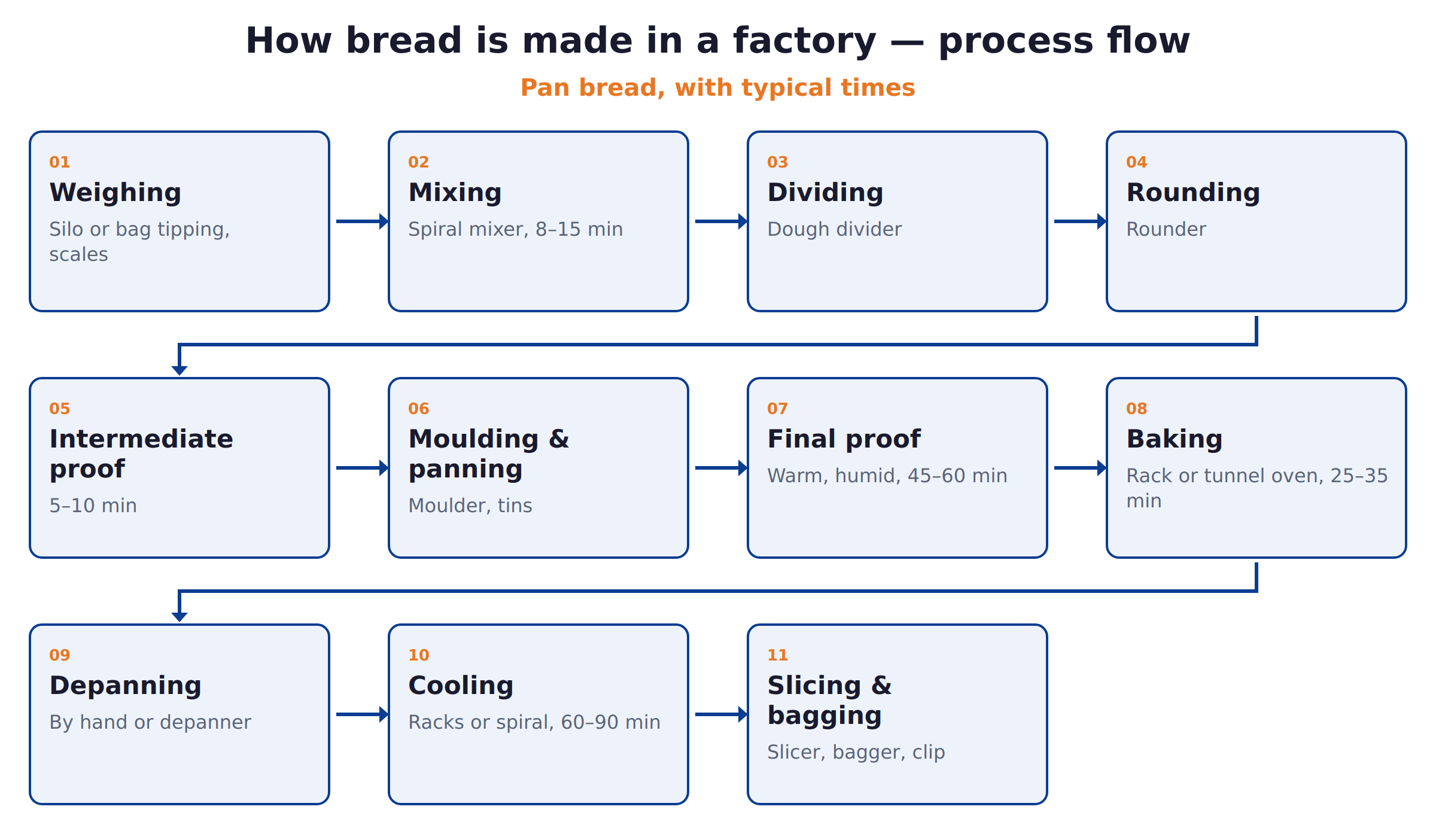
| Line | Mixer, divider, rounder, moulder, proofer, rack or small tunnel oven, cooler, slicer, bagger |
| Power | Generator sized for the mixer, divider and slicer; oven fired by diesel or gas |
| Labour | Fewer hands per loaf, more consistent weight and shape |
The cooler and slicer are often the missing pieces: warm bread tears in the slicer and sweats in the bag.
Flour, sugar and yeast: where the cost per loaf is
Ingredients are most of the cost of a loaf, and their prices move with the exchange rate because much wheat is imported. A line that weighs dough accurately, keeps loaf weight consistent and reduces waste pays for itself through ingredients as much as through labour. Ask suppliers how the divider controls weight, how much dough is lost at changeovers, and how scrap is reworked.
| Cost item | What to watch |
|---|---|
| Flour | Price per bag, quality consistency, storage |
| Sugar, fat, yeast, improvers | Dosing accuracy |
| Fuel for the oven | Litres or kilograms per hour at full output |
| Generator diesel | Hours per day and load |
| Packaging | Bags, clips, labels |
| Labour | People per shift on the line and in packing |
Landed cost in Nigeria
| Item | How to plan |
|---|---|
| Equipment | Ex-works or FOB |
| Freight and insurance | To the nearest port |
| Duty | ECOWAS CET band for each machine |
| Surcharge, CISS and ETLS | 7% of duty, 1% of FOB, 0.5% of CIF |
| VAT | 7.5% on value plus duties |
| Installation | Oven assembly, burner commissioning, electrical work |
| Generator and fuel storage | Often the largest additions |
How to compare bakery quotes
- Loaves per hour at your loaf weight.
- Oven type, baking area and fuel.
- Fuel use per hour.
- Mixer size and dough capacity.
- Divider, rounder, moulder and proofer included or not.
- Cooling and slicing.
- Bagging and coding.
- Electrical load and generator size.
- Installation, training of bakers and operators.
- Spare burners, belts and blades.
Choose by situation
| Situation | Usual choice |
|---|---|
| Neighbourhood bakery | Deck or rack oven with spiral mixer and moulder |
| Bakery supplying distributors | Two rack ovens with divider, moulder and slicer |
| Supermarket supplier | Semi-automatic line with cooler, slicer and bagger |
| Industrial plant | Continuous line with tunnel oven |
Mistakes we see
- An oven bigger than the dough side. The mixer and moulder set output.
- No cooling. Torn slices and mould in the bag.
- A generator too small for motor starts.
- No plan for fuel supply. Bakeries stop when diesel or gas runs out.
- Skipping training. A line needs operators who can set it.
What we see in Nigeria
- Power is self-supplied. With roughly 5.4 GW of grid capacity available nationally (NERC), most bakeries generate their own power; manufacturers together spent about ₦1.4 trillion on it in 2025.
- Money is expensive. A maximum lending rate near 33.16% in mid-2026 means a line must earn its keep quickly.
- Tariffs. Bakery machinery comes in under the ECOWAS CET, generally in the lower bands.
- Import charges. The 4% FOB charge was suspended after its 2025 reintroduction; check before importing.
- Food registration. Packaged branded bread needs NAFDAC registration; confirm current requirements before launch.
Where CISH fits
CISH supplies, installs and commissions complete bread lines from audited factories in China, from mixing to sliced and bagged loaves, with ovens chosen for your fuel and power, and the import into Nigeria handled. For a single deck oven, a local fabricator or dealer may serve you faster.