The next step is making your own feeds, which earns more per bag but needs a mill, formulas, raw materials, quality control and KEBS compliance. A farm-scale hammer mill and mixer, made locally and priced in shillings, is a small part of a feed mill project and suits farmers mixing their own feed. Raw materials, maize and maize germ, wheat bran and pollard, sunflower and cotton seed cake, omena and premixes, are most of the cost, and feeds should meet KEBS standards for animal feeds. Imported mills usually enter at 0% EAC duty, with 16% VAT, the 2.5% IDF and 2% RDL. CISH supplies, installs and commissions complete feed mills.
Two ways to start
| Distributor (stockist) | Manufacturer | |
|---|---|---|
| What you do | Buy bagged feeds from mills, sell to farmers | Buy raw materials, formulate, mill, bag and sell |
| Investment | Shop, stock, transport | Mill, building, power, laboratory, stock |
| Margin | Trade margin per bag | Manufacturing margin per bag |
| Skills | Sales, credit control, farmer advice | Nutrition, buying, milling, quality control |
| Risk | Competition, credit to farmers | Raw material prices, quality complaints |
Distribution teaches you the market. When you know which feeds and which farmers, you can decide what to make.
Choose your feeds
The main feeds sold in Kenya are dairy meal for cows, layers mash and chick and growers mash for poultry, broiler starter and finisher, and pig feeds. Dairy and poultry farmers are the largest groups. Start with two or three feeds you can make well and sell in volume, for example dairy meal and layers mash.
Formulation and raw materials
Feed sells on milk yield, egg production and growth. Work with an animal nutritionist to set formulas, and review them when raw material prices or quality change. Main ingredients:
- Energy: maize, maize germ, wheat bran and pollard.
- Protein: sunflower cake, cotton seed cake, soya meal, omena (fish meal).
- Minerals and vitamins: limestone, dicalcium phosphate, salt and premixes.
Test incoming maize and cakes for moisture and mould, because aflatoxin in feed harms animals and can reach milk and eggs. Buy from several suppliers, and keep a few weeks of key materials in dry storage.
Standards and quality
Animal feeds sold in Kenya should meet KEBS standards for feeds, with labels showing the feed type, the main nutrients and the net weight. Check which standards and certification apply to your products with KEBS before you launch. Keep a sample from every batch, record the raw material lots used, and test finished feeds regularly for protein, fibre, calcium and moisture.
The mill
| Mill | Output | Indicative price (2026) | Fits |
|---|---|---|---|
| Farm hammer mill and mixer | Farm scale | Priced locally in shillings; a small part of a feed mill project | Farmers mixing their own feed |
| Complete small feed mill | 1–3 t/h | About US$60,000–150,000 landed and commissioned | Feed businesses supplying a county |
| Medium feed mill | 3–10 t/h | About US$250,000–900,000 | Regional brands |
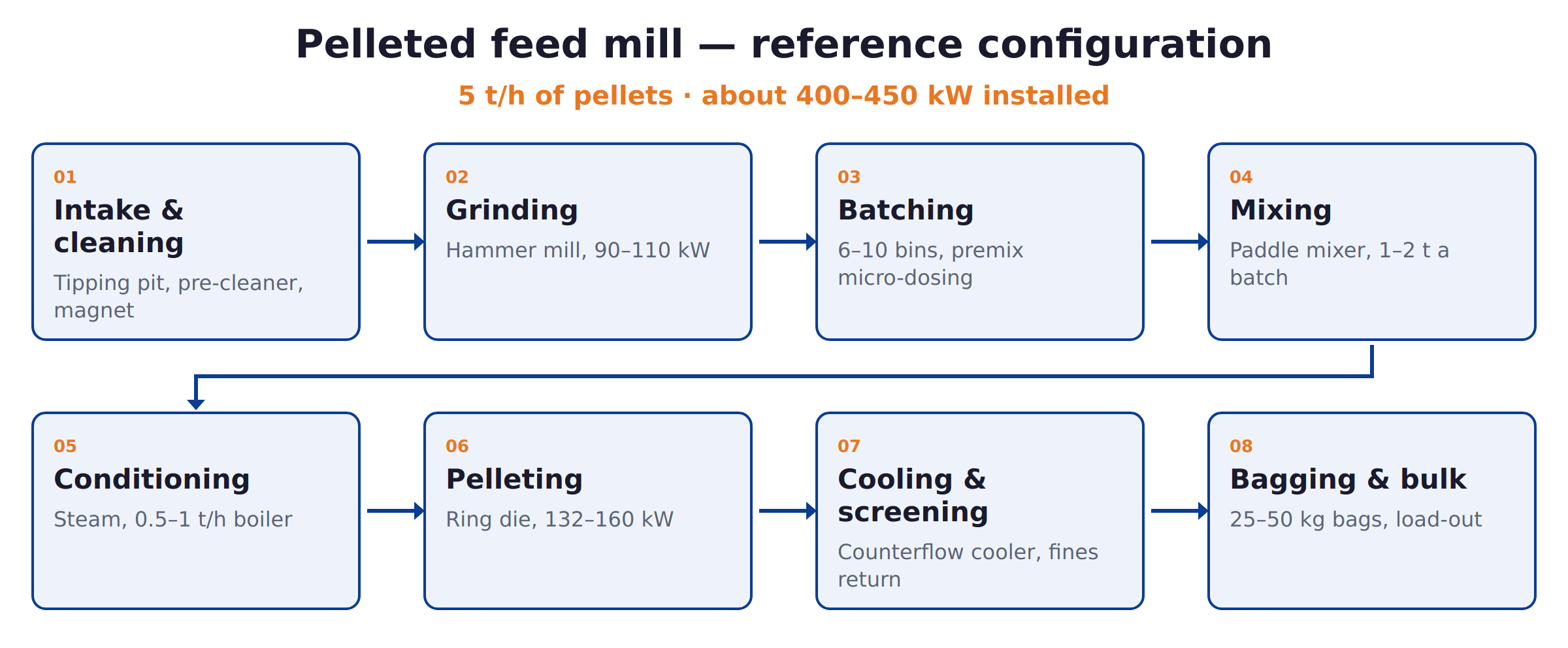
A complete mill includes intake, grinding, batching scales, mixing, micro-dosing for premix, and bagging; for pellets, a steam conditioner, pellet mill, cooler and crumbler. Many Kenyan feed businesses start with mash and add pellets later. Our animal feed machine price guide breaks the bands down.
Power
Hammer mills and pellet mills are heavy electricity users. EPRA's fuel energy cost charge was about KES 3.5 per kWh in August 2026, on top of Kenya Power's base tariff. Choose efficient motors, keep hammers and screens in good condition, and plan the supply for starting current.
Importing a mill
Capital goods usually enter Kenya at 0% under the EAC CET, but 16% VAT, the 2.5% Import Declaration Fee and the 2% Railway Development Levy apply, and regulated goods go through KEBS pre-export verification. Equipment lands at Mombasa and travels inland by road or SGR.
The numbers
Cost per bag is raw materials (usually most of it), premix, bags, labour, power, maintenance, transport and finance. Price per bag must cover these and leave a margin for agro-dealers if you sell through them. Track cost per bag every month as raw material prices change, and adjust formulas with your nutritionist rather than cutting quality.
Worked example: an agro-vet becomes a feed miller
An agro-vet in Nyeri sells about 60 tonnes a month of dairy meal and layers mash from two manufacturers. Farmers ask for a cheaper dairy meal with consistent results. The owner hires a nutritionist, sets formulas for dairy meal and layers mash, and installs a 2 t/h mash mill with a hammer mill, batching scales, a mixer with premix dosing and a bagging scale. She buys maize germ and sunflower cake from local suppliers, tests every lot, applies for KEBS certification, and keeps selling other feeds as a stockist while her own brand builds. The figures are illustrative.
Common mistakes
- Making feeds without a nutritionist.
- No testing of maize and cakes for mould.
- Inaccurate batching.
- Too many feeds at once.
- Credit to farmers without control.
What we see in Kenya
- Dairy meal and layers mash are the main products.
- Agro-vets and stockists are the main sales channel.
- Raw material prices move with harvests and imports.
- KEBS standards apply to feeds.
- Electricity costs include pass-through charges.
- Capital goods usually enter duty-free under the EAC CET.
Selling through agro-dealers
Most bagged feed reaches farmers through agro-dealers and agro-vets. Support them with steady supply, clear bag labels, feeding guides and quick replacement of damaged bags. Visit farmers with the dealer, show results on demonstration farms, and keep a phone line for feeding questions. A dealer who trusts your feed and your delivery will push it ahead of others.
Storage and transport
Store raw materials and finished feed off the floor on pallets, in a dry, ventilated store with pest control. Plan transport for raw materials coming in and feed going out, and load trucks so bags are not damaged or wet in transit.
Records that build trust
Keep a simple file for each batch: date, formula, raw material lots, weights and test results. When a farmer reports a problem, you can check the batch quickly and show what went into it.
Where CISH fits
We supply complete feed mills, grinding, batching, mixing, pelleting, cooling and bagging, from audited factories in China, sized to your feeds. CISH ships to Mombasa, clears, installs and commissions the mill on your formulas, and trains your team. For a farm hammer mill or mixer, a local fabricator is usually the better buy.