A feed mill grinds raw materials such as maize, maize germ, wheat bran, sunflower or cotton seed cake and fish meal, mixes them with minerals and premix, and either bags the mash or presses it into pellets. Local hammer mills and mixers for small farms are made and sold in shillings by Kenyan fabricators and cost a small part of a feed mill project. Most capital goods enter Kenya at 0% EAC duty, but VAT of 16%, the 2.5% Import Declaration Fee and the 2% Railway Development Levy apply, and power carries a fuel energy cost charge.
Animal feed machine prices in Kenya, 2026
| What you buy | Capacity | Indicative price (2026) | Fits |
|---|---|---|---|
| Local hammer mill and mixer | Farm scale | Priced locally in shillings; a small part of a feed mill project | Farmers mixing their own feed |
| Single small pellet mill or extruder | Small output | About US$2,000–60,000 for extruders, by size | Trials, small poultry or fish farms |
| Complete small feed mill | 1–3 t/h | About US$60,000–150,000 landed and commissioned | Feed businesses supplying a county |
| Medium feed mill | 3–10 t/h | About US$250,000–900,000 | Regional feed brands |
| Industrial feed plant | 10–30+ t/h | From about US$1.5 million | Large feed companies |
Mash or pellets?
| Mash | Pellets | |
|---|---|---|
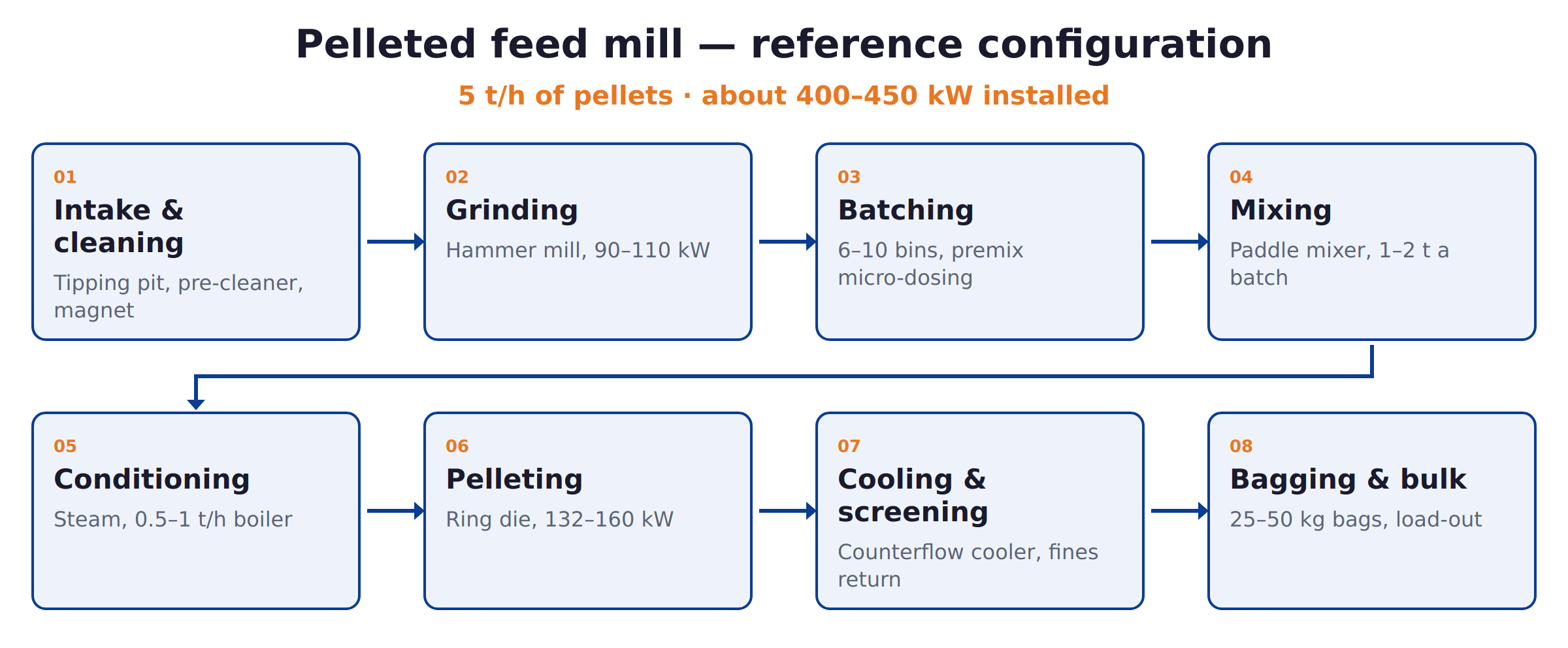
| Machines | Grinding, batching, mixing, bagging | Add conditioner, pellet mill, cooler, crumbler, sifter |
| Animals | Layers, dairy meal, pigs | Broilers, dairy cubes, rabbits, fish (sinking) |
| Benefits | Lower cost, simpler | Less waste and selective eating, better growth, easier handling |
| Energy | Lower | Higher: steam and the pellet mill |
Many Kenyan feed businesses start with mash and add a pellet line for broiler feed and dairy cubes.
Accuracy is the product
Feed sells on animal performance. A dairy meal that is light on protein or minerals shows in milk yields; layers mash with poor calcium shows in shell quality. The equipment must weigh ingredients accurately, mix them evenly and keep batches separate. Batch scales, a horizontal ribbon or paddle mixer with a short mixing time, micro-dosing for premix and good cleaning between formulas are worth more than extra tonnes an hour.
Raw materials
Maize and its by-products, wheat bran and pollard, oilseed cakes, fish meal (omena) and premixes make up most of the cost of feed. Prices change with harvests and imports. A feed mill needs dry, ventilated storage, a way to test moisture and protein, and buying discipline. Many mills keep several weeks of key raw materials.
Electricity costs
EPRA's fuel energy cost charge was about KES 3.5 per kWh in August 2026, on top of Kenya Power's base tariff. Hammer mills and pellet mills are heavy users, so choose efficient motors, use the right screen sizes, and keep hammers and dies in good condition. Plan the supply for the starting current of the largest motor.
Importing into Kenya
| Item | 2026 basis |
|---|---|
| Duty | 0% EAC CET on most capital goods |
| VAT | 16% |
| Import Declaration Fee | 2.5% of customs value |
| Railway Development Levy | 2% of customs value |
| KEBS PVoC | For regulated products, arranged before shipment |
| Port | Mombasa, then road or SGR |
Our Kenya import guide has the sequence.
Standards
Animal feeds sold in Kenya should meet KEBS standards for feeds, with labels showing the type of feed, the main nutrients and the net weight. Check which standards and certification apply to your products with KEBS before launching.
Worked example: a county feed business adds pellets
A feed business near Eldoret makes 2 tonnes an hour of dairy meal and layers mash on a mash line. Broiler farmers ask for pellets, and dairy farmers for cubes. The business adds a steam conditioner, a pellet mill, a cooler, a crumbler for chick feed and a sifter, with a small boiler, sharing the existing grinding and mixing. Electricity use rises, so it moves to a larger transformer and improves motor efficiency. The figures are illustrative.
How to compare quotes
- Tonnes per hour of finished feed, mash and pellets separately.
- Batching accuracy and micro-dosing.
- Mixer type and mixing time.
- Hammer mill power and screen sizes.
- Pellet mill, conditioner and die sizes.
- Boiler and steam demand.
- Bagging and weighing.
- Installation, commissioning on your formulas, and training.
- Spares: hammers, screens, dies, rollers.
- References of mills in East Africa.
Choose by situation
- Farmer mixing own feed: a local hammer mill and mixer.
- County feed business: a complete 1–3 t/h mash and pellet mill.
- Regional brand: a 3–10 t/h mill with silos and automation.
- Large producer: an industrial plant.
Formulation and quality control
A feed mill sells nutrition, not mixed grain. Work with an animal nutritionist to set formulas for each feed, and recalculate them when raw material prices or quality change. Test incoming maize for moisture and mould, because aflatoxin in feed harms animals and can reach milk and eggs. Test finished feed regularly for protein, fibre, calcium and moisture, keep retained samples from each batch, and record which raw material lots went into which batch. Farmers judge a feed by results; consistent quality, supported by records, is what builds repeat orders.
Bags and labels
Bag each feed in clearly printed bags showing the feed type, animal and stage, the main nutrient levels, net weight, batch number and your details. Good labelling reduces wrong purchases and helps agro-dealers sell your feed.
Selling through agro-dealers
Most farm feed reaches farmers through agro-dealers, so support them with consistent supply, clear bag labels and a reliable delivery schedule.
Mistakes we see
- Buying a pellet mill without a conditioner.
- Inaccurate batching.
- No cleaning between formulas.
- Damp raw material storage.
- Ignoring electricity costs.
What we see in Kenya
- Dairy meal, layers mash and broiler feed are the main products.
- Local fabricators make hammer mills and mixers for farms.
- Pellets are growing for broilers and dairy cubes.
- Capital goods are usually duty-free under the EAC CET.
- VAT, the IDF and the RDL apply to imports.
- PVoC comes first for regulated goods.
- Electricity includes a fuel energy cost charge, about KES 3.5 per kWh in August 2026.
- Raw material prices move with harvests and imports.
Where CISH fits
We supply complete feed mills, grinding, batching, mixing, pelleting, cooling and bagging, from audited factories in China, sized to your feeds. CISH ships to Mombasa, clears, installs and commissions the mill on your formulas, and trains your team. For a farm hammer mill or mixer, a local fabricator is usually the better buy.