A complete plant with parboiling, drying, destoning, colour sorting, grading and bagging for 20–50 tonnes a day is quoted per configuration, because the parboiling and drying sections, the sorter and the building change the scope a lot. The key quality issues for local rice are stones, broken grains and mixed colour, which the right machines solve. Machinery usually falls in the 5% ECOWAS duty band, with the merged 20% VAT, NHIL and GETFund charge on top since January 2026, and power from an overloaded ECG network needs planning.
Rice mill prices in Ghana, 2026
| What you buy | Paddy per day | Indicative price (2026) | Fits |
|---|---|---|---|
| Small rice mill set | About 20–30 t | About US$5,000–30,000 ex-works | Service milling, small brands |
| Complete mill with destoning, grading and packing | 20–50 t | Quoted per configuration | Packed local rice for shops |
| Plant with parboiling, drying and colour sorting | 20–50 t | Quoted per configuration | Premium parboiled rice brands |
| Larger plants | Above 50 t | Quoted per configuration | Regional brands and processors |
Ex-works prices. On a coastal route, landed and installed costs are typically about 1.25–1.45 times the ex-works price, before the building and working capital for paddy.
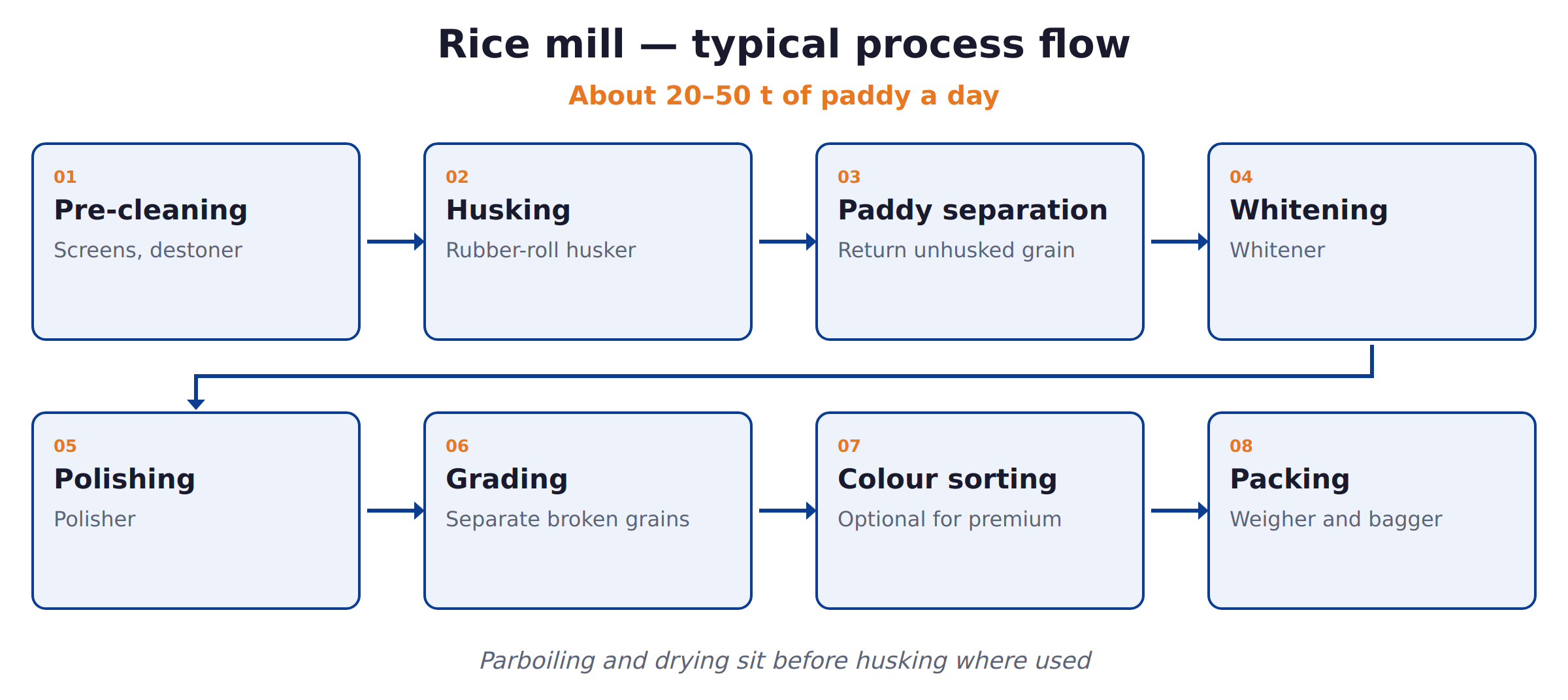
How a rice mill works
- Pre-cleaning: straw, dust and light material removed.
- Destoning: stones and heavy particles removed, the most important step for customer complaints.
- Husking: rubber-roll huskers remove the husk; the husk is separated by aspiration.
- Paddy separation: unhusked grains returned to the husker.
- Whitening: bran layers removed from brown rice, usually in two or three passes.
- Polishing: gives the grain a cleaner, shinier surface.
- Grading: broken grains separated from head rice.
- Colour sorting: discoloured grains and remaining stones removed by optical sorters.
- Packing: weighing and bagging, often in 5, 25 and 50 kg bags.
Parboiling adds soaking, steaming and drying before milling. It hardens the grain, reduces breakage and gives the colour and taste many West African customers prefer.
Parboiling: worth the extra cost?
Parboiled rice usually mills with fewer broken grains and sells well in many markets. But the section needs soaking tanks, a steam boiler, a dryer and space, and it uses water and fuel. Small mills often buy parboiled paddy from women's processing groups or parboil in simple vessels; a commercial plant brings the process inside for consistent quality. Decide on parboiling before choosing the mill, because it changes the layout, the utilities and the dryer size.
Power and utilities
Huskers, whiteners, elevators and sorters run on electric motors, and a parboiling plant adds a boiler and dryer. ECG's managing director said in April 2026 that much of the distribution network was overloaded beyond its thermal limits, with frequent faults and low voltage. In rice-growing areas away from major towns, a generator or dedicated transformer is often part of the project. Husk can fuel the boiler or dryer, cutting fuel costs.
Landed cost in Ghana
| Item | 2026 basis |
|---|---|
| Duty | Usually 5% under the ECOWAS CET for grain milling machinery; confirm each HS code |
| VAT, NHIL, GETFund | 20% combined since 1 January 2026 |
| ECOWAS and AU levies, processing fee | Added on top |
| Clearance | ICUMS single window |
| Port | Tema; allow a buffer for congestion |
| Inland transport | Long road haul to northern regions adds cost and time |
Worked example: moving from service milling to packed rice
A mill in a rice-growing district mills farmers' paddy for a fee on a small mill set. Customers complain about stones, and the mill wants to sell its own packed rice in town markets. It adds a destoner and paddy cleaner in front of the existing husker, a two-pass whitener, a grader and a colour sorter, and a bagging scale with stitching. It also builds a covered paddy store and a drying slab. The packed rice sells at a better price because it is stone-free and evenly coloured. Later, a parboiling section with a husk-fired boiler is added. The figures depend on volumes and site.
How to compare quotes
- Paddy per day and finished rice per hour.
- Destoner and cleaner included.
- Husker type and roll replacement cost.
- Whitening passes and polisher.
- Grader and colour sorter capacity.
- Parboiling and drying scope, if any.
- Power: connected load; generator size.
- Installation, commissioning on your paddy, and training.
- Spares: rubber rolls, screens, sieves.
- References of mills running in West Africa.
Food rules
Packed rice sold under a brand is a food product regulated by the Food and Drugs Authority. Register the product and meet the FDA's requirements for the premises before you sell, and label bags with the product name, net weight, your details and dates.
Choose by situation
- Service milling for farmers: a small mill set with a destoner.
- Packed local rice: a complete mill with grading, colour sorting and bagging.
- Premium parboiled rice: add parboiling, drying and sorting.
- Large processor: a plant with paddy storage and drying, quoted per configuration.
Paddy handling and storage
A mill is only as good as the paddy it receives. Paddy that is too wet breaks in the husker and goes mouldy in store; paddy dried on roadsides picks up stones and dirt. Plan a clean drying floor or a mechanical dryer, a moisture meter at the gate, and a covered, ventilated store on pallets. Buying paddy at harvest and storing it well lets the mill run through the year instead of only for a few months.
By-products
Husk can fire a parboiling boiler or dryer, bran sells as animal feed, and broken rice sells at a lower price for porridge, flour or feed. Planning outlets for each by-product improves the mill's overall return.
Mistakes we see
- No destoner. Stones lose customers.
- One whitening pass. Grain stays dull and uneven.
- Drying paddy on the road. Dirt and stones.
- No colour sorter for branded rice.
- Ignoring paddy moisture. Wet paddy breaks in the husker.
What we see in Ghana
- Customers compare local rice with imported rice on cleanliness, colour and broken grains.
- Parboiled rice is popular in many markets.
- Stones are the most common complaint about poorly milled local rice.
- Machinery is usually in the 5% duty band.
- One merged 20% charge for VAT, NHIL and GETFund since 1 January 2026.
- Tema congestion and long inland haulage to rice areas need buffers.
- Power is uneven; generators and husk-fired heat are common.
- FDA registration is needed for branded packed rice.
Where CISH fits
We supply complete rice mills, cleaning, destoning, husking, whitening, grading, sorting, parboiling and packing, from audited factories in China, sized to your paddy and market. CISH ships to Tema, clears and delivers to site, installs and commissions the mill on your paddy, and trains your team. For a single small mill for service milling, a local dealer is often the better buy.