Avocado oil is a different process: the fruit is pulped and the oil separated by centrifuge, not pressed in a screw press, so an avocado oil line is quoted per configuration. Decide first which crop you can buy all year and whether you sell crude, refined or cold-pressed oil.
Oil press and oil line prices, 2026
| What you buy | Typical capacity | Indicative price (2026) | Fits |
|---|---|---|---|
| Single screw press with filter | A few hundred kg of seed an hour | Under US$10,000 | Cold-pressed or crude oil for local sales |
| Small pressing unit (cleaner, press, filter press, tanks) | A few tonnes of seed a day | Quoted per configuration | Farmer groups and town processors |
| Sunflower pressing and refining line | About 20 t of seed a day | About US$150,000–400,000 | Packed refined oil for shops |
| Larger line with refining | About 50 t of seed a day | About US$400,000–900,000 | Regional brands |
| Industrial line | About 100 t a day | US$700,000–1.5 million and up | Large processors |
| Avocado oil extraction line | Tonnes of fruit per hour | Quoted per configuration | Exporters and processors with fruit supply |
Equipment prices are in US dollars, before freight, clearance, installation, building work and utilities.
Two routes: seeds or avocado
| Sunflower, canola, groundnut | Avocado | |
|---|---|---|
| Raw material | Dry seed, stored for months | Fresh fruit, ripened and processed quickly |
| Extraction | Screw press, then filtering | Washing, destoning, pulping, malaxing, decanter centrifuge, polishing |
| Products | Crude or refined oil, plus seed cake for feed | Extra virgin or refined avocado oil, plus pulp waste |
| Buyers | Shops, supermarkets, food factories | Export buyers, cosmetics makers, premium retail |
| Season | Grain stored year-round | Fruit seasons; pulp cannot be stored long |
| Main risk | Seed supply and refining costs | Fruit quality, ripeness and export standards |
Most Kenyans searching for a cooking oil machine mean the seed route. Most searching for an avocado oil machine are exporters or growers with rejected fruit. The equipment has almost nothing in common.
Cold pressing, crude oil or refining?
- Cold-pressed oil: the seed is pressed without high heat and the oil is only filtered. It keeps flavour and sells at a premium, but yield is lower and the oil has a shorter shelf life.
- Crude (hot-pressed) oil: seed is conditioned or warmed before pressing for a higher yield; the oil is filtered and sold to traders or refiners.
- Refined oil: degummed, neutralised, bleached and deodorised, for clear, stable oil in supermarket bottles.
A refinery multiplies the cost of the line and needs steam, chemicals and a laboratory. Many small Kenyan processors begin with cold-pressed or crude sunflower oil and add refining when volume grows.
Avocado oil: how the line works
Avocado oil comes from the fruit's flesh, not a seed. A typical line:
- Receiving and ripening: fruit must be ripe for good oil release.
- Washing and destoning: skins and stones are separated or partly kept.
- Pulping: the flesh is ground to a paste.
- Malaxing: the paste is mixed gently with controlled heat so oil droplets join.
- Decanter centrifuge: separates oil, water and solids.
- Polishing: a disc separator and filters give clear oil.
- Storage and filling: in inert-gas or sealed tanks, then drums or bottles.
Ask any seller for oil yield per tonne of fruit at your fruit's oil content, and for the decanter's capacity. Small screw presses sold as avocado machines rarely give good yields.
Who sells oil presses in Kenya
- Local dealers sell imported screw presses and filters from stock.
- Jua kali and local fabricators build tanks, frames, seed roasters and simple filters, and repair presses.
- Chinese factories selling direct offer presses, filter presses, refineries and avocado oil lines by catalogue.
- Turnkey companies design and commission complete lines from seed or fruit intake to filled bottles.
We keep supplier names off this page. Ask each one to show their press or line running on your crop: sunflower, canola and groundnut all press differently, and avocado oil needs a decanter line.
Power, heat and utilities
A screw press is mainly a motor load. Refining and avocado malaxing add heat. In Kenya, electricity bills include pass-through charges such as the fuel energy cost charge, which stood at about KES 3.5 a kilowatt-hour in August 2026, so efficient motors and correct sizing matter. A refinery also needs a steam boiler and cooling water. Ask each seller for installed kW, steam demand and water use, so the utilities can be planned with the building.
Importing an oil line into Kenya
| Item | Detail |
|---|---|
| Duty | Oil presses and refining plant usually carry 0% under the EAC tariff; confirm the HS code of each item |
| VAT | 16% on the landed value |
| IDF | Import Declaration Fee at 2.5% of customs value |
| RDL | Railway Development Levy at 2% of customs value |
| PVoC | Conformity checks before shipment where KEBS regulates the item |
| Logistics | Mombasa, then SGR or road to the processing site |
Worked example: a sunflower oil line for a farmer cooperative
An illustration only:
| Item | Assumption |
|---|---|
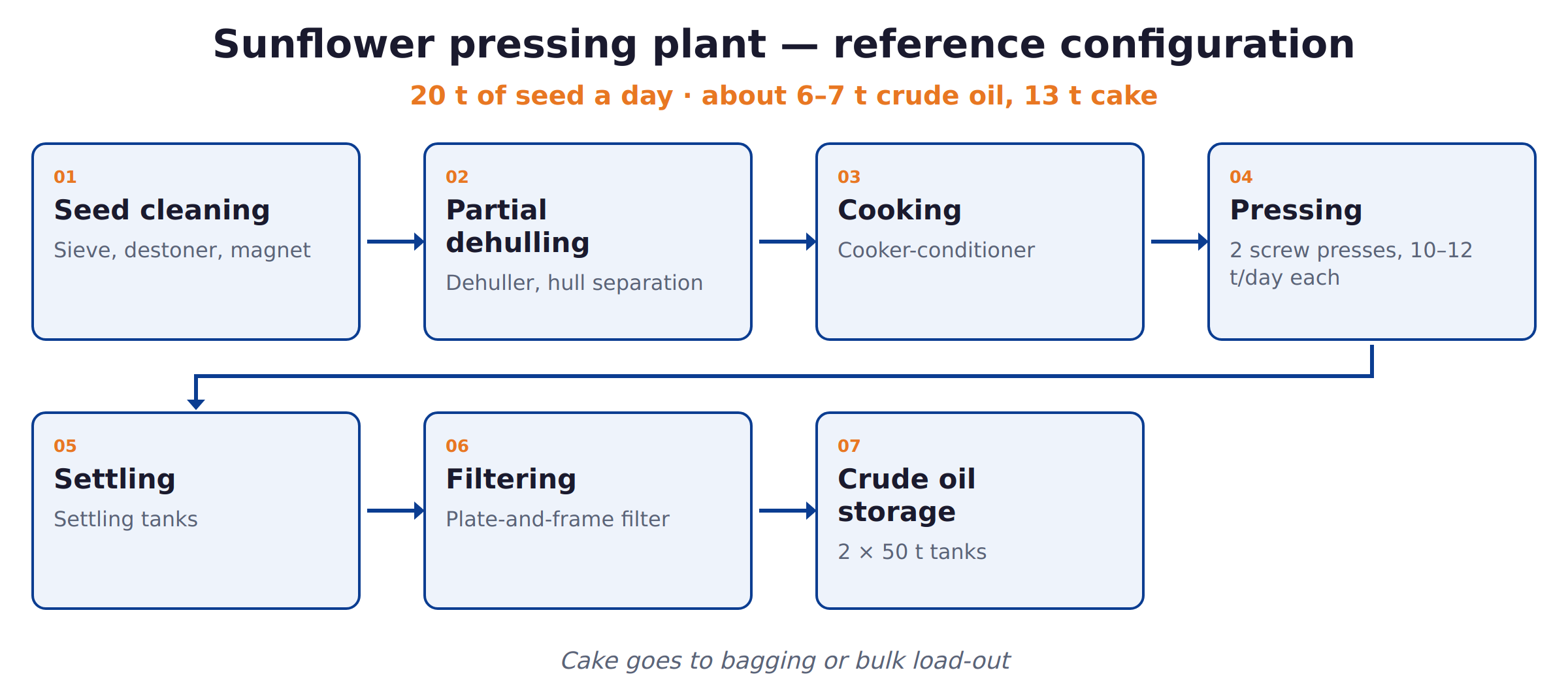
| Seed pressed | About 20 t of sunflower seed a day |
| Oil | Roughly a third of seed weight as oil, depending on seed and press |
| Cake | The remainder sold to feed millers |
| Line | Pressing, filtering and refining, within US$150,000–400,000 |
| Seed stock | Several months of seed bought after harvest |
| Approvals | Product certification and food premises approval for packed oil |
Seed supply decides the plan. If farmers grow sunflower for only one season, the mill needs storage and finance to buy enough seed for the year.
How to compare quotes
- Crop the line is designed for, and throughput per day.
- Oil yield and oil left in the cake (or, for avocado, yield per tonne of fruit).
- Press screw and cage material, and expected life.
- Filtering: plate filter press, cloth supply.
- Refining section included or not, with steam and chemical use.
- For avocado: decanter capacity and polishing separator.
- Filling machine and container sizes.
- Installed power, steam and water demand.
- Installation, commissioning on your crop, and training.
- Warranty and who answers for yield.
Mistakes we see
- Buying a screw press for avocado. Yield is poor; avocado oil needs a decanter line.
- No seed cleaning. Stones and sand wear the press.
- Too little seed stock. The press stands idle after the harvest is sold.
- Refining without steam or a lab. Quality drifts and buyers reject the oil.
- Ignoring cake sales. Seed cake is a second income stream.
- Testing the press on a different seed than you will buy.
What we see in Kenya
- A large edible oil gap. Kenya produces only about a third of the roughly 900,000 tonnes of edible oil it needs, according to figures reported by Milling MEA in 2025, and imports most of the rest as palm oil.
- A national push for oil crops. AFA's Edible Oil Crops Promotion Project, launched in July 2023, promotes sunflower, canola, soybean and coconut and aims to raise local supply to half of demand by 2028.
- Canola in the Rift Valley. Nakuru County and AFA have distributed canola seed to farmers, adding a crop for local presses.
- Record avocado harvests. Production reached about 694,000 tonnes in 2025, according to USDA FAS Nairobi figures reported by Food Business MEA.
- Fresh exports fell. Red Sea disruptions and AFA export controls cut avocado exports to about 121,000 tonnes in 2025.
- Avocado oil tripled. Output rose from 3,326 tonnes in 2024 to 10,188 tonnes in 2025, as processors turned surplus fruit into oil.
- Import costs beyond duty. Most oil machinery enters duty-free, but VAT at 16%, the 2.5% IDF and the 2% RDL apply.
- Energy pass-throughs. Electricity surcharges make motor efficiency and heat recovery worth paying for.
Where CISH fits
CISH supplies, installs and commissions complete oil lines from audited factories in China: seed cleaning, conditioning, pressing, filtering, refining and filling, or avocado washing, pulping, malaxing, centrifuging and polishing, with the import into Kenya arranged and the line commissioned on your crop. For a single press, a local dealer is the better choice, and we will say so.