A common machine class makes roughly 500–1,500 kg of nails in an eight-hour shift, depending on nail size. Profit depends mostly on the price and steady supply of wire rod, not the machine. Machinery usually pays 5% duty under the ECOWAS CET plus the merged 20% VAT, NHIL and GETFund charge since January 2026, and the machines need a stable three-phase supply. CISH supplies, installs and commissions complete nail and wire workshops.
Nail machine prices in Ghana, 2026
| What you buy | Typical output | Indicative price (2026) |
|---|---|---|
| Single light nail machine | One size range | About US$2,000–15,000 |
| Single heavy machine | Larger nails, or heavy wire products | About US$10,000–70,000 |
| Starter nail workshop | 2–4 machines, each about 0.5–1.5 t a shift | About US$15,000–50,000 |
| Wire products yard | Rod drawing, nails, mesh, brick force, razor wire | About US$150,000–350,000 |
| Yard with wire galvanising | Continuous hot-dip line added | Quoted per configuration |
Ex-works prices; coastal landed and installed costs are typically 1.25–1.45 times.
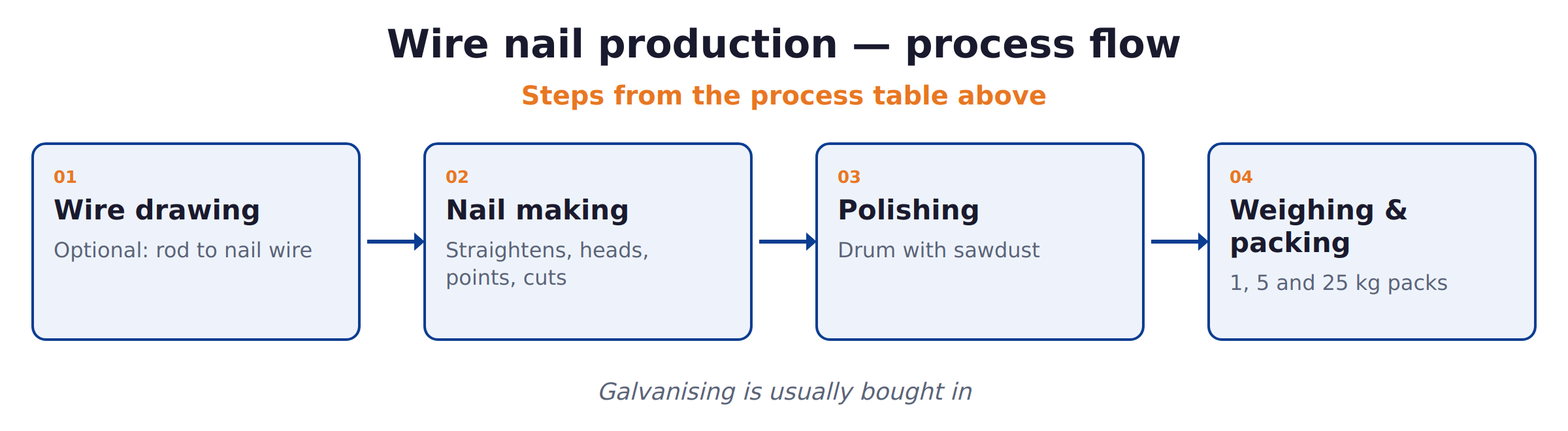
What a nail workshop includes
- Wire drawing machine: reduces wire rod, often 5.5–6.5 mm, to the diameter each nail needs.
- Nail making machines: feed, cut, head and point the wire.
- Polishing drum: cleans and brightens nails, removes burrs.
- Weighing and packing: boxes or bags of 1, 5, 25 or 50 kg.
- Tooling: dies, punches and cutters for each nail size.
- Compressor and small tools for maintenance.
Most workshops make common wire nails from about 1 inch to 6 inches. Roofing nails with washers, concrete nails and coil nails need extra machines.
Wire rod: where the margin is
Wire rod is the main cost of a nail, often far more than labour or power. Before buying machines, secure a supplier of wire rod in the grade and diameter you need, at a known price, with deliveries you can rely on. Keep several weeks of rod in stock. A drawing machine lets you buy one rod size and make many nail sizes; without one, you buy drawn wire, which costs more.
Power
Wire drawing and nail machines run on electric motors, and a drawing machine draws a heavy load. ECG's managing director said in April 2026 that much of its distribution network was overloaded beyond its thermal limits, leading to frequent faults and low voltage. Check transformer capacity at your site, fit voltage protection, and budget a generator if supply is unreliable.
Landed cost in Ghana
| Item | 2026 basis |
|---|---|
| Duty on machinery | Usually 5% under the ECOWAS CET; confirm HS codes |
| VAT, NHIL, GETFund | One 20% charge since 1 January 2026, under the VAT Act 2025 |
| ECOWAS and AU levies, processing fee | Added on top |
| Clearance | ICUMS single window at Tema |
| Port | Allow a buffer; GPHA announced congestion measures in August 2026 |
Worked example: a three-machine workshop
A hardware wholesaler in Kumasi decides to make its own nails. It installs one wire drawing machine, three nail machines covering 1 to 6 inch nails, a polishing drum and a packing scale, on a three-phase supply with a standby generator. With rod delivered every two weeks, the workshop runs one shift and supplies its own stores and a few builders. Its first lesson is tooling: dies and cutters wear quickly on hard wire, so it keeps a set of spares for each size. The figures are illustrative.
How to compare quotes
- Nails per minute and kg per shift for each size.
- Wire diameter range each machine handles.
- Drawing machine passes and speed.
- Tooling sets included for each nail size.
- Polishing drum capacity.
- Power: motor sizes and starting current.
- Installation, commissioning on your wire, and training.
- Spare dies, punches and cutters.
- Delivery to Tema.
- References of workshops in West Africa.
Choose by situation
- Small hardware business: one or two nail machines with bought drawn wire.
- Nail supplier to builders: a starter workshop with drawing, three or four machines and polishing.
- Wire products business: add mesh, brick force or razor wire machines.
- Large producer: add galvanising for roofing and outdoor nails.
Running the workshop
Nail machines are simple but they need daily care. Check and replace dies and cutters before nails come out with poor heads or points, keep the machines oiled, and clean the polishing drum regularly. Keep a record of kilograms produced per machine per shift; a falling figure usually means worn tooling or poor wire. Train at least two people to set up each machine, so production does not stop when one is absent.
Selling nails
Most nails are sold by weight to hardware stores and builders, in cartons or bags. Consistent sizes, clean polished nails and full-weight packs keep customers. Some workshops add roofing nails or concrete nails later to widen the range and raise margins.
Space and the workshop floor
A starter workshop needs a covered, ventilated floor with room for rod coils, the drawing machine and its take-up, the nail machines, the polishing drum and a packing area, plus dry storage for finished cartons. Nail machines are noisy and vibrate, so mount them on solid concrete and keep them away from offices. A three-machine workshop typically fits in a small industrial unit, but plan space to add machines. Keep wire rod off the ground and under cover to prevent rust, which wears dies faster and dulls the finished nails. Leave a clear path for forklifts or trolleys from the rod store to the drawing machine and from packing to dispatch, so heavy coils and cartons are not carried by hand.
Mistakes we see
- Buying machines before securing wire rod.
- No drawing machine, so drawn wire costs more.
- Too few spare dies.
- Undersized power.
- Packing by count instead of weight checks.
What we see in Ghana
- Nails sell steadily through hardware stores and building sites.
- Wire rod supply decides cost and continuity.
- Machinery duty is usually 5% under the ECOWAS CET.
- One merged 20% charge has applied since January 2026.
- ICUMS is the customs single window.
- Tema congestion needs a buffer.
- ECG's network is overloaded in places; generators are common.
- Simple machines are available locally; complete workshops are usually imported.
Where CISH fits
We supply complete nail and wire workshops, drawing, nail making, polishing and packing, from audited factories in China, sized to your nails and tonnes a month. CISH ships to Tema, clears, installs and commissions the workshop, and trains your operators. For a single nail machine, a local dealer is usually the better choice.