CISH supplies, installs and commissions complete nail workshops and wire-products yards.
Nail making machine prices, 2026
| What you buy | Capacity | Indicative price (USD, 2026) |
|---|---|---|
| Single nail machine | One size range | US$2,000–15,000 per machine |
| Starter nail workshop | 2–4 machines, about 0.5–1.5 t of nails each per shift | US$15,000–50,000 |
| Heavy machine for mesh or razor wire | Per machine | US$10,000–70,000 |
| Wire-products yard | Rod drawing, nails, mesh, brick force, razor wire | US$150,000–350,000 |
| Yard with in-house galvanising | Continuous hot-dip wire line | Quoted per configuration |
Equipment is priced in US dollars; wire rod and power costs in naira decide your margin.
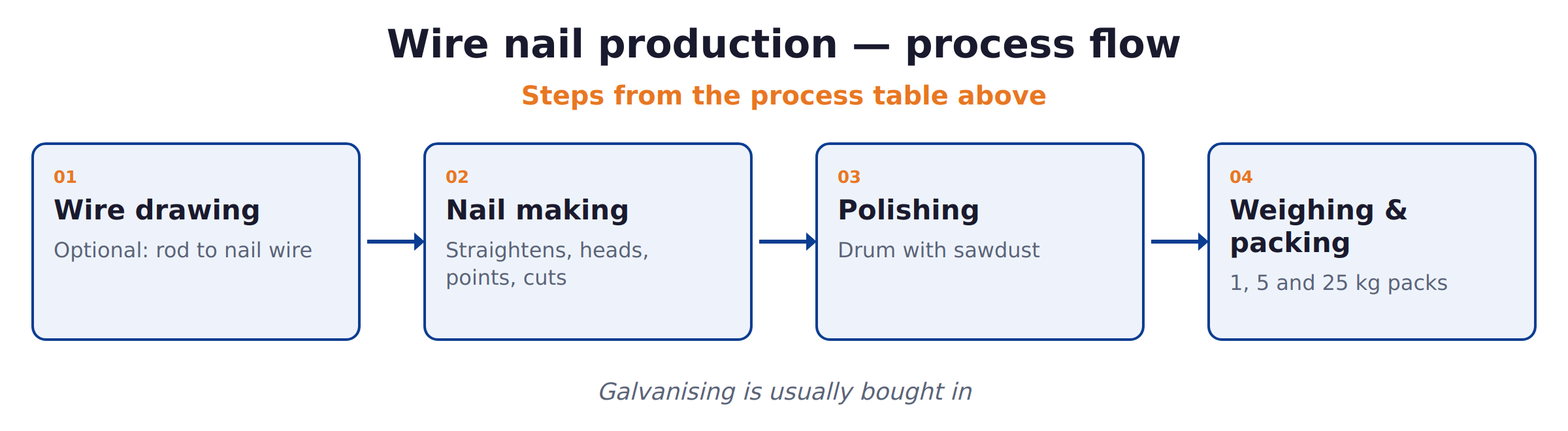
What a nail workshop needs
- Wire rod pay-off and wire drawing to the diameters for your nail sizes.
- Nail making machines, one for each size band.
- Polishing drum to clean nails and remove burrs.
- Weighing and packing in boxes or bags.
- Tooling: dies, punches and cutters, with spares.
- Power for drawing and nail machines.
Most buyers ask for "a nail machine"; most working businesses run three or four.
Who sells nail machines in Nigeria
- Local dealers and workshops sell imported single machines and spare dies.
- Importers bring in machines from China and sometimes install them.
- Chinese factories sell machines and wire lines direct.
- Turnkey companies set up the whole workshop with drawing, nails, polishing and packing.
Ask every seller for kilograms per shift at each size, the tooling supplied, and who resets the machine when nails come out bent.
Wire: where the margin is
Nails are wire with a head and a point. Buying wire already drawn to each diameter at merchant prices leaves little margin. Drawing your own wire from rod lets you make several sizes from one raw material and usually lowers cost per kilogram. The trade-off is power: a wire drawing line uses much more electricity than the nail machines.
Power and the generator
With limited grid supply, most Nigerian workshops plan a diesel generator. Size it for the wire drawing motor and the nail machines starting together, and price fuel per tonne of nails. A small yard without drawing can run on a modest generator; a yard with drawing and mesh needs a much larger one.
Landed cost in Nigeria
| Item | How to plan |
|---|---|
| Machines, drawing line and tooling | Ex-works or FOB |
| Freight and insurance | To the nearest port |
| Duty | ECOWAS CET band for each machine's HS code |
| Surcharge, CISS and ETLS | 7% of duty, 1% of FOB, 0.5% of CIF |
| VAT | 7.5% on value plus duties |
| Installation, foundations and setting | Machines need firm foundations and setting by an experienced fitter |
Budget roughly 1.25–1.45 times the equipment price landed and installed in a coastal market.
Worked example: a three-machine workshop
An illustration only; output depends on sizes and operators.
| Item | Example |
|---|---|
| Machines | Three, covering small, medium and large common nails |
| Output per machine per shift | About 0.5–1.5 t depending on size |
| Workshop output per shift | About 2–3 t across the mix |
| Monthly output on one shift, 24 working days | Roughly 50–70 t |
| Wire needed | Slightly more than nail output, allowing for scrap |
| Supporting equipment | Wire drawing, polishing drum, weighing and packing |
At this scale, wire purchasing and the generator cost per tonne decide whether you beat imported nails on price.
How to compare quotes
- Nail sizes covered and the number of machines.
- Kilograms per shift for each size.
- Wire drawing included or not, with finished diameters.
- Tooling supplied and the price of replacements.
- Polishing and packing.
- Electrical load and generator size.
- Foundations required.
- Installation, setting and training.
- Warranty.
- A workshop you can visit.
Common mistakes
- One machine for every size. Each machine covers a band.
- No spare dies. Machines stop within weeks without them.
- Buying drawn wire at retail. The margin disappears.
- Undersized generator. Wire drawing trips it.
- Galvanising without a plan. Coating is a separate process; most small yards buy galvanised wire or outsource.
Choose by situation
| Situation | Usual choice |
|---|---|
| Hardware trader starting production | Two or three machines for the best-selling sizes, buying drawn wire |
| Growing workshop | Add wire drawing to cut wire cost, and a polishing drum |
| Supplier to builders' merchants | Full size range, packing in branded boxes |
| Building-materials producer adding products | Mesh, brick force or razor wire machines beside the nail line |
| Yard targeting tenders | Wire-products yard with consistent sizing and packing records |
Start with the sizes your buyers order most, then add bands as volumes justify the next machine.
What we see in Nigeria
- Generation is your problem. About 5.4 GW of grid capacity is available nationally according to NERC's 2025 third-quarter report, and the Manufacturers Association estimated self-generation spending of around ₦1.4 trillion in 2025.
- Credit is expensive. With the maximum lending rate around 33.16% in mid-2026, start with a workshop sized to the sizes that sell, then add machines.
- Tariffs. Nigeria applies the ECOWAS CET; machinery is usually in the lower bands, but check each machine's code.
- Customs. Form M now runs on the B'Odogwu portal; plan for processing time.
- The suspended 4% FOB charge may change; confirm before importing.
Where CISH fits
CISH supplies, installs and commissions nail workshops and wire-products yards from audited factories in China: wire drawing, nail machines, polishing and packing, with output per shift demonstrated on your wire and the import into Nigeria handled. For a single nail machine, a local dealer may serve you faster.