Pasteurised milk in East Africa is heated to at least 65 °C for 30 minutes in batch, or at least 73 °C for 16 seconds in a continuous HTST unit, under EAS 69, and every processor needs a Kenya Dairy Board permit. CISH supplies, installs and commissions complete dairy lines; for a single batch pasteuriser, a local supplier is usually the better buy.
Milk pasteuriser and dairy line prices, 2026
| What you buy | Typical capacity | Indicative price (2026) | Fits |
|---|---|---|---|
| Batch pasteuriser (vat) with heating and cooling | Hundreds of litres per batch | A much smaller purchase, often bought locally | Milk bars, cooperatives starting processing |
| Small yoghurt and mala set | Batch pasteuriser, incubation tanks, cup or pouch filler | Depends on filler; quoted per configuration | Mini dairies adding fermented products |
| Small HTST dairy line | A few thousand litres a day | About US$50,000–125,000 ex-works; US$95,000–250,000 landed | Cooperatives packing milk for shops |
| Medium HTST dairy line | Tens of thousands of litres a day | About US$125,000–310,000 ex-works; US$250,000–560,000 landed | Regional brands |
| ESL or UHT lines | Long-life milk | Higher; quoted per configuration | Large processors |
Building works and utilities, including the boiler, chilled water and effluent, usually add another 20–40% to a dairy project. Prices are in US dollars.
Batch or continuous (HTST) pasteurising?
| Batch (vat) pasteuriser | HTST plate pasteuriser | |
|---|---|---|
| How it heats | Milk held in a jacketed tank | Milk flows through plates, held in a holding tube |
| EAS 69 minimum | At least 65 °C for at least 30 minutes, then cooled to 10 °C or less | At least 73 °C for at least 16 seconds, then cooled to 10 °C or less |
| Capacity | Hundreds to a few thousand litres a day | Thousands of litres an hour |
| Energy use | Higher per litre; little heat recovery | Lower; plates recover heat from hot milk to cold milk |
| Control | Thermometer and timer | Automatic temperature recording and flow diversion |
| Best for | Mini dairies, yoghurt and mala batches | Packed milk in volume |
These temperatures come from the first edition of the East African pasteurised milk standard, EAS 69, which has since been revised; check the current edition with KEBS. The same standard says pasteurised milk must not contain preservatives.
Products: packed milk, yoghurt and mala
- Packed fresh milk needs a pasteuriser, a homogeniser if you sell standardised milk, a pouch or bottle filler, and a cold room.
- Yoghurt adds incubation and cooling tanks, fruit and sugar dosing, and cup or bottle filling.
- Mala (fermented milk) is popular in Kenya and needs similar fermentation tanks, often with a different culture and incubation time.
- Ghee and butter need a cream separator and churning or a ghee kettle.
Many cooperatives start with packed milk and add yoghurt and mala because they earn more per litre.
Kenya Dairy Board permits
Every milk processor in Kenya needs a permit from the Kenya Dairy Board, renewed each year, and premises are inspected before a permit is issued. Older regulations still define a "specified dairy" as one producing more than 450 litres of milk a day, and require it to be managed by a dairy manager licensed by the Board. Check the current permit categories and fees with KDB before you plan the building. You will also need county permits and public health approval for the premises.
Who sells milk pasteurisers in Kenya
- Local fabricators make stainless batch pasteurisers, milk cans, tables and cooling tanks, with varying grades of steel and welding.
- Dealers sell imported batch pasteurisers, cream separators and small fillers from stock.
- Chinese factories selling direct offer batch and HTST pasteurisers, homogenisers and complete dairy lines.
- Turnkey companies design the dairy, supply the line and commission it with your milk.
This page does not name any dairy equipment supplier. Check the stainless steel grade (food-grade 304 or 316), the welding finish inside tanks and pipes, and whether the pasteuriser records temperature and diverts under-heated milk.
What a complete small dairy line includes
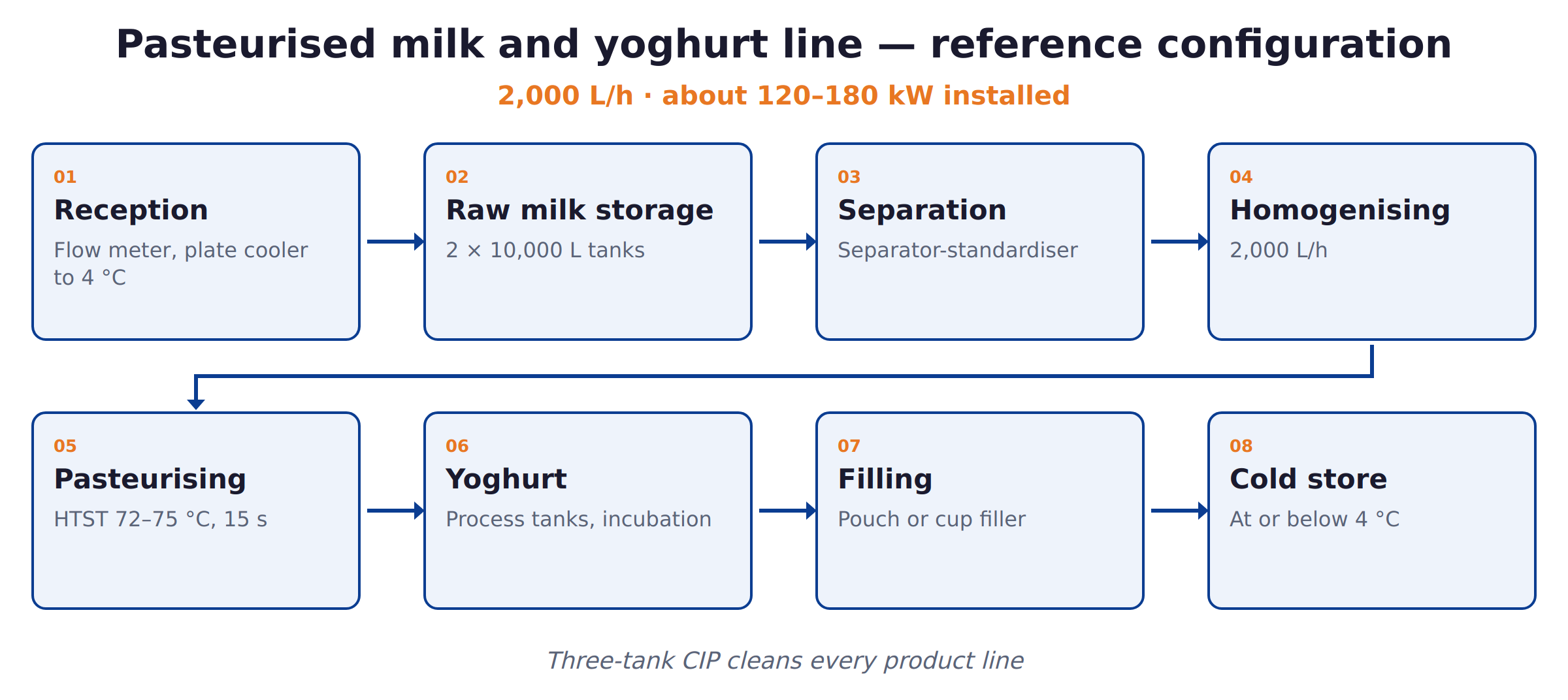
- Milk reception: weighing, filtering, testing and a cooling tank.
- Clarifier or filter: removes dirt before processing.
- Separator and standardising: if you sell milk at set fat levels or make cream.
- Homogeniser: stops cream rising in packed milk.
- Pasteuriser: batch or HTST, with recording and flow diversion.
- Fermentation tanks: for yoghurt and mala.
- Filling: pouch filler, bottle or cup filler with sealing and coding.
- Cleaning in place (CIP): tanks and pipes cleaned without dismantling.
- Utilities: boiler or hot water, chilled water or ice bank, compressed air, effluent handling.
- Cold room: for packed milk and yoghurt before delivery.
Power and energy in a Kenyan dairy
A dairy uses heat to pasteurise and refrigeration to cool, and both cost money. Kenyan electricity bills add pass-through items to the base tariff; the fuel energy cost charge was about KES 3.5 per kWh in August 2026. HTST plate units recover most of the heat, which is one reason they pay off as volume grows. Ask each seller for steam or hot water demand, refrigeration load and installed kW.
Importing a dairy line into Kenya
| Cost or step | How it applies |
|---|---|
| Duty | Dairy machinery generally enters free of EAC duty; check the HS code of each item |
| VAT | Payable at 16% |
| IDF | 2.5% of customs value |
| RDL | 2% of customs value |
| PVoC | KEBS pre-shipment verification for regulated items |
| Port | Mombasa, then by SGR or road to the dairy |
Worked example: a cooperative moving to packed milk
An illustration only:
| Item | Assumption |
|---|---|
| Milk collected | About 5,000 litres a day |
| Today | Selling raw milk to a processor |
| Plan | Small HTST line, homogeniser, pouch filler, yoghurt tanks, CIP and a cold room |
| Price | Small HTST line about US$50,000–125,000 ex-works, US$95,000–250,000 landed |
| Building | Food-grade floors, walls and drainage, plus 20–40% for works and utilities |
| Permits | KDB processor permit, county permits and public health approval |
The decision rests on margin per litre after processing compared with the raw milk price, and on whether the cooperative can sell packed milk every day.
How to compare quotes
- Litres per hour, and whether the pasteuriser is batch or HTST.
- Temperature and holding time, with recording and flow diversion.
- Stainless steel grade and internal finish.
- Homogeniser and separator included or not.
- Filler type, pack sizes and speed.
- Fermentation tanks for yoghurt and mala.
- CIP system included or not.
- Steam or hot water demand, refrigeration load and installed power.
- Installation, commissioning with your milk, and training.
- Warranty and support.
Mistakes we see
- Buying a pasteuriser without cooling capacity. Milk must be cooled to 10 °C or less straight after heating.
- No temperature recording. You cannot prove pasteurisation to inspectors or buyers.
- Poor stainless steel or welding. Bacteria survive in rough welds.
- Skipping CIP. Hand cleaning of pipes is slow and unreliable.
- No cold room. Packed milk spoils before it reaches shops.
- Planning the building before checking KDB requirements.
What we see in Kenya
- Record milk output. Kenya produced about 5.5 million tonnes of fresh milk in 2025, up 3.5% on 2024, according to KNBS figures reported by Dairy Business MEA.
- Formal intake passed a billion litres. Processors took in about 1.014 billion litres in 2025, up 11.5% from 909 million litres.
- Many small processors. USDA counted 32 active industrial dairies and 186 small processors in 2024, with combined capacity of about 3,750 tonnes a day.
- Most milk is still informal. Formal intake is a small share of total production, which is the opportunity for cooperative dairies.
- Regional pasteurisation rules. EAS 69 sets the batch and HTST minimums and bans preservatives in pasteurised milk.
- KDB permits every year. Processors need a Kenya Dairy Board permit, renewed annually after inspection.
- Energy pass-throughs. Electricity surcharges make heat recovery and efficient refrigeration worth paying for.
- Machinery usually duty-free. Dairy equipment generally enters at 0% EAC duty, with VAT, the IDF and the RDL on top.
Where CISH fits
CISH supplies, installs and commissions complete dairy lines from audited factories in China: reception, cooling, separation, homogenising, HTST pasteurising, fermentation, filling, CIP and cold storage, with the import into Kenya arranged and the line commissioned with your milk. For a single batch pasteuriser, a local supplier is usually the better choice, and we will say so.