Demand is strongest in the hot dry season and around festivals and events, and weaker in the rainy season, so the plant must be sized on hot-season sales with a plan for quieter months. The business lives or dies on two numbers: how many blocks you sell a day, and what each block costs you to make, of which power is usually the largest part. Grid supply is limited: NERC's report for the third quarter of 2025 puts available generation at about 5.4 GW for the whole country, and manufacturers spent about ₦1.4 trillion on their own power in 2025, so most ice plants run on generators, solar, or a mix with whatever grid supply exists. Location matters because ice melts: most sales happen within a short delivery radius. CISH supplies, installs and commissions complete ice block plants with storage and power sized together.
Who buys ice blocks
| Buyer | What they need | Pattern |
|---|---|---|
| Fish and meat sellers | Blocks every morning to keep stock cold | Daily, all year |
| Drinks sellers, bars, kiosks | Blocks to chill drinks in coolers | Daily, peaks in heat and events |
| Event caterers and party organisers | Large orders for weddings, funerals, festivals | Weekends, festive seasons |
| Fishermen and fish traders | Ice for catch on boats and in transit | Daily in season |
| Hospitals, clinics, laboratories | Cooling during outages | Irregular |
| Households | Blocks during outages and hot weather | Irregular, peaks in heat |
Regular daily buyers, such as fish sellers and drinks distributors, are the base of the business. Events and outages add peaks.
How many blocks you must sell
Work out your break-even before you choose a machine. For each block: the cost of power (generator fuel, solar share or grid), water, bags or moulds, labour, maintenance and delivery, plus a share of rent and the plant's capital cost. Subtract that from your selling price to get your margin per block. Divide your monthly fixed costs by that margin to find how many blocks a month you must sell to cover them. Then compare with what your buyers will actually take in the rainy season, not just in the hot season. If the quiet-season sales do not cover fixed costs, plan another product, such as tube ice, cold storage space or frozen goods, to use the plant all year.
Power: the largest running cost
| Power source | Strengths | Weaknesses |
|---|---|---|
| Grid | Lowest cost per kWh when available | Unreliable supply in many areas |
| Diesel or gas generator | Reliable, available anywhere | Fuel cost and maintenance; price swings |
| Solar with batteries | No fuel cost after purchase; daytime output | High capital cost; needs space and good design |
| Mix | Best balance | More complex control |
Many plants run the freezing during the cheapest power hours and store blocks in an insulated room. Solar works best when the plant freezes mainly during daylight and stores ice for evening and morning sales. Our ice block machine price guide explains how power choices change the plant.
Location and delivery radius
Ice loses weight every hour it travels. Most sales come from buyers within a short distance, or along routes you can deliver to every morning. Choose a site close to markets, fish landing points, drinks distributors or busy roads, with water, space for storage and loading, and access for delivery vehicles. Insulated vans, tricycles with cool boxes, and a pick-up point for small buyers help you reach more customers.
Water and hygiene
Ice that touches drinks or food must be made from clean, treated water in a clean plant. Treat borehole or supplied water with filtration and disinfection, keep moulds and storage clean, and train staff in hygiene. If you sell packaged ice for direct consumption, check NAFDAC's current requirements for your product; NAFDAC's regulatory guidelines set out what applies to food and water facilities.
Seasons and planning
The hot dry season from roughly the end of the rains until the next rains brings the highest demand, along with festive periods such as Christmas and Sallah, and wedding seasons. The rainy season brings lower demand in many places. Plan maintenance for the quiet months, build stock before big events, and agree regular supply with daily buyers so that the base load holds through the year.
What the plant costs
| Item | Indicative cost (2026) |
|---|---|
| Ice block machine, about 10 t/day | About US$10,000–45,000 ex-works |
| Landed and installed in a coastal market | About 1.25–1.45 times the equipment price |
| Insulated storage room | See cold room bands |
| Generator, solar or mixed power | Priced per configuration |
| Water treatment | Priced per configuration |
Import duties and charges at Nigerian ports follow the ECOWAS common external tariff plus levies and VAT; your clearing agent confirms the heading. Finance costs matter too: the Central Bank of Nigeria's money market indicators showed maximum lending rates of about 33% in 2026, so a plant sized well beyond your sales costs a great deal to carry.
Worked example: a fish market supplier in Lagos
A trader near a busy fish market in Lagos buys ice blocks from a plant across town and loses melt on every trip. She builds a small ice plant on her own plot: a block ice machine sized for her hot-season sales, an insulated storage room, a generator with a solar array for daytime freezing, and water treatment. Fish sellers in the market collect blocks every morning; drinks sellers and event caterers make up the rest. In the rainy season she runs fewer moulds and rents part of the storage room to a fish trader. The figures and names are illustrative.
Common mistakes
- Sizing on the hottest week instead of steady daily sales.
- No storage, so ice must be sold as soon as it is made.
- Ignoring power cost in the price per block.
- Too far from buyers, losing ice to melt.
- Untreated water for ice that touches food and drinks.
Moulds, cans and handling
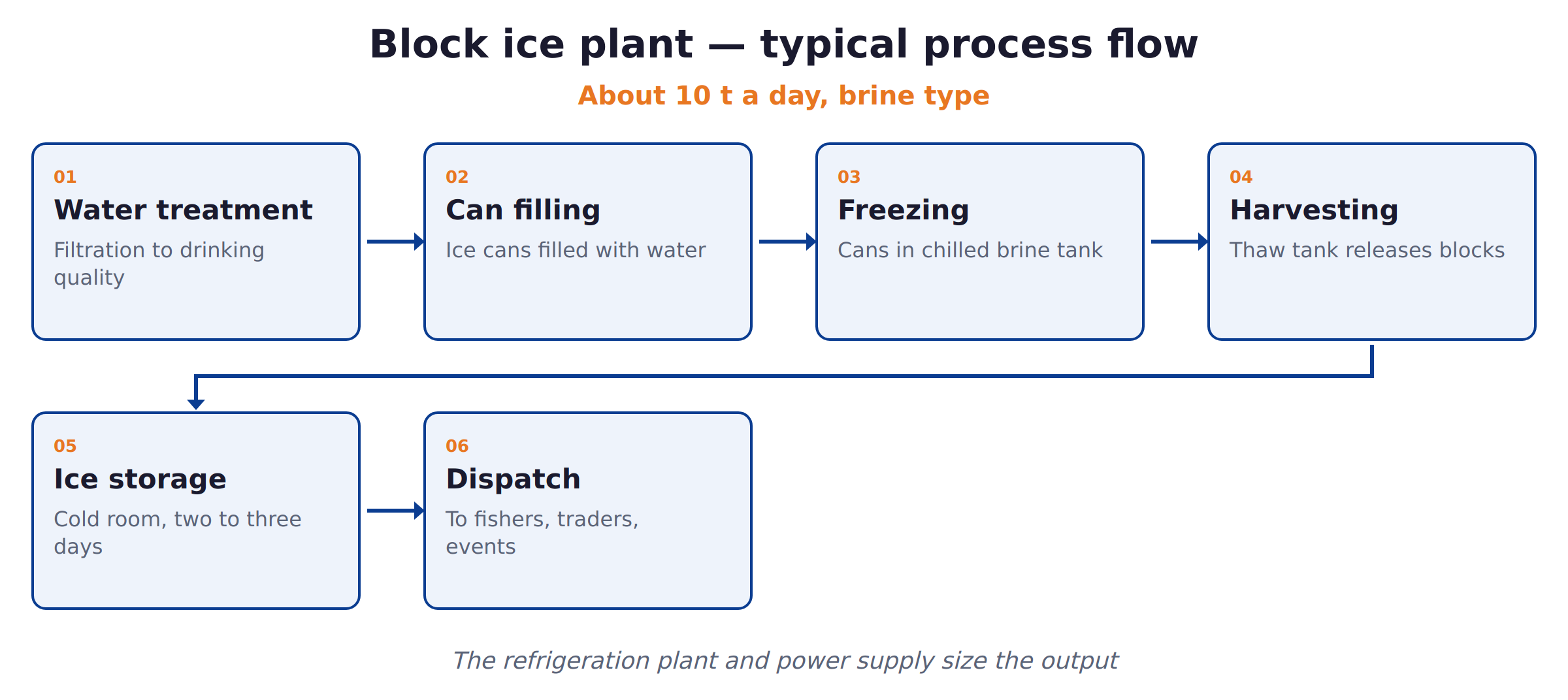
Block ice is frozen in metal cans or moulds dipped in chilled brine, or in direct-cooled moulds, then released by warming and tipped out. Count how many cans the plant holds and how long each freezing cycle takes, because that, not the brochure tonnage, sets how many blocks you can sell each morning. Keep cans clean and undamaged, and handle blocks with clean tools and gloves. Wrap or bag blocks for buyers who need clean ice for drinks, and keep a scale so customers can see they get the weight they pay for.
Staff and opening hours
Most ice is sold early in the day, before markets and drinks sellers open. Plan shifts so that freezing finishes in time, staff are ready to load buyers' vehicles and deliveries leave on time. Keep simple daily records of blocks made, sold, delivered and melted, and of fuel and power used, so you can see your real cost per block each week.
Where CISH fits
We supply complete ice block plants, machines, moulds, storage, water treatment and power sized together, from audited factories in China. CISH ships the plant, installs and commissions it on your site and power, and trains your team. For a single small ice machine, a local dealer is usually the better buy.