A grinding mill itself is made and sold locally and costs a small part of a plant budget; the bigger decisions are the power source and the location. Electric mills are cheapest to run where supply holds, and 2026 has been the steadiest year for power in more than two decades, with no scheduled load-shedding through the winter; diesel mills and solar mills with batteries keep milling through faults and off-grid. A busy location near homes and fields matters more than the machine. When customers ask for refined meal in branded bags, the next step is a mealie meal plant: about US$250,000–400,000 for 30 tonnes a day as an indication for 2026, landed and commissioned in Zimbabwe, with a CBCA certificate before shipment.
Two ways to make money
| Service milling | Selling your own meal | |
|---|---|---|
| How it works | Customers bring maize; you mill for a fee | You buy maize, mill, bag and sell |
| Main costs | Power or fuel, labour, hammers and screens, rent | Maize, power, labour, bags, transport |
| Working capital | Very little | Maize stock |
| Busy season | After harvest and through the dry season | All year, if you store maize |
| Risk | Quiet months when household maize runs out | Maize price swings |
Many mills combine both, milling for customers most of the year and selling their own meal when household stocks run low.
Power choices
| Power | Running cost | Strength | Watch for |
|---|---|---|---|
| ZESA grid | Low | Cheapest per bag when supply holds | Faults and maintenance outages |
| Diesel | High | Works anywhere | Fuel price and maintenance |
| Solar with batteries | Very low | No fuel; works off-grid | Upfront cost; size panels and batteries for the motor |
| Grid plus diesel or solar | Low to moderate | Keeps milling during outages | Needs a changeover switch |
The Herald reported 304 consecutive days without scheduled load-shedding by late October 2026, with outages caused by faults and planned maintenance. On 6 July 2026 a fault caused a nationwide grid collapse, restored the same evening. A backup engine or solar system protects income on those days.
Location
- Near customers and fields: growth points, business centres, residential areas.
- Few competing mills within walking distance.
- Power available: a three-phase connection, or space and sun for solar.
- Access: customers carry maize by scotch cart, bicycle and bus.
Working out payback (example)
- Investment: mill, motor or engine, shed, wiring, solar system if any.
- Bags milled per day and the fee per bag, or meal sold and margin per bag.
- Monthly costs: power or fuel, labour, hammers, screens, rent, licences.
- Monthly profit = income − costs.
- Payback (months) = investment ÷ monthly profit.
As an example, a busy electric mill grinding several dozen buckets a day can pay back its mill and shed within months; a solar mill costs more upfront but saves fuel every day. Use your own fees and volumes; these figures are illustrative.
Licences and hygiene
Register the business and get the local authority licence for the premises. If you bag and sell meal, keep the mill and store clean, dry and free of pests, and label bags with the product, weight and your details. Supermarkets expect products to meet SAZ standards.
When to build a mealie meal plant
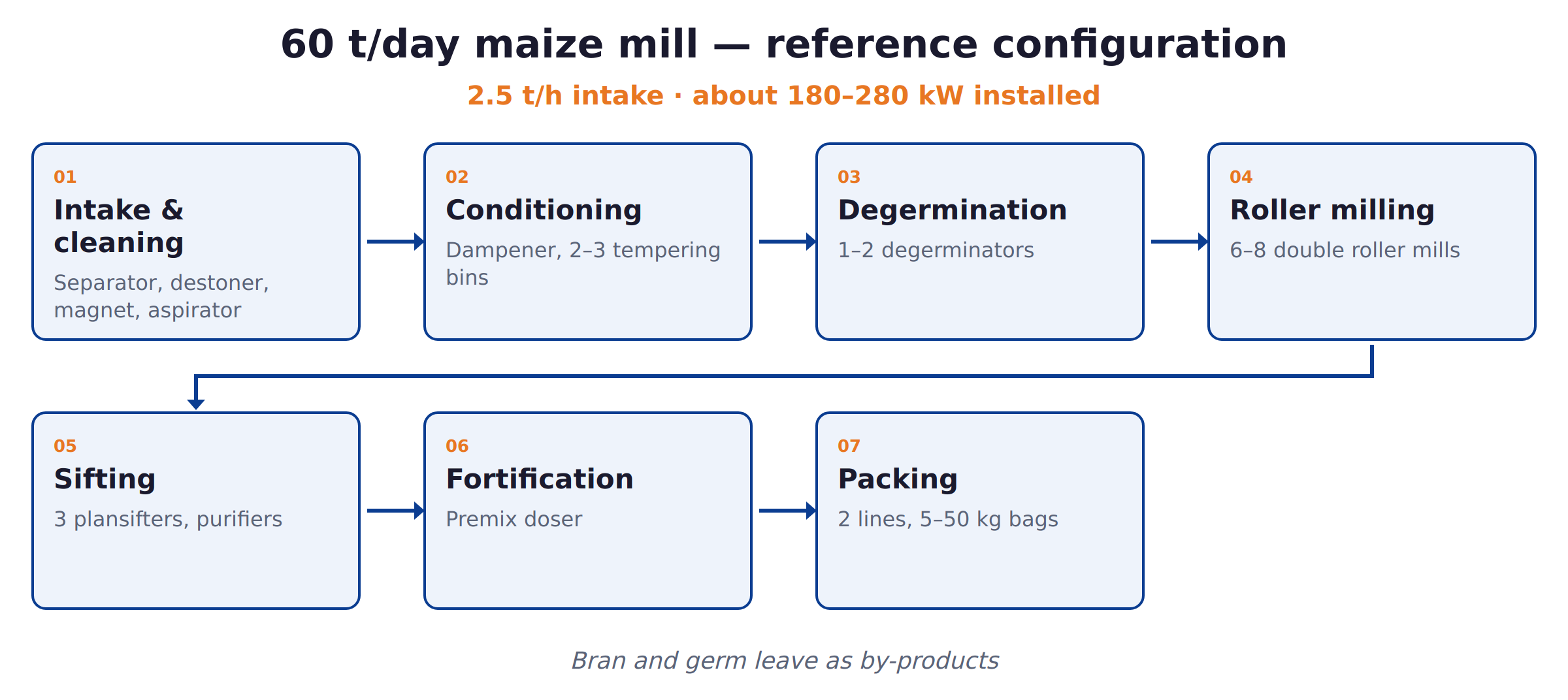
Signs it is time: shops and supermarkets ask for refined meal in branded bags, schools want regular supply, and you sell more of your own meal than service milling. A plant with cleaning, degerming, roller milling, sifting and bagging is a different investment. Regulated goods need a CBCA certificate before shipment to avoid a penalty of 12% of CIF, and import VAT is 15.5% from January 2026. Our grinding mill price guide and maize mill sizing guide explain the options.
Worked example: a solar mill in Mashonaland East
A farmer in Mashonaland East opens a grinding mill at a business centre with a diesel engine. Fuel costs eat most of the fees. He installs a solar system with batteries sized for the mill's motor and keeps the diesel engine as backup. Fuel use falls sharply, the mill runs every sunny day, and he adds a second mill for customers who want finer meal. The figures are illustrative.
Maintenance
Turn or replace worn hammers, change screens when holes wear, keep belts tight, grease bearings and clean the mill daily. Keep spare hammers, a screen and a belt on site. A mill that is down for a day loses customers to the next one.
Common mistakes
- A quiet location.
- Diesel only, when grid or solar would cost less per bag.
- Worn hammers that waste power and give coarse meal.
- Buying maize without storage.
- A plant before having buyers.
What we see in Zimbabwe
- Grinding mills are the main way households mill maize.
- Power was steadier in 2026, but faults still happen.
- Solar mills are spreading off-grid.
- Service milling peaks after harvest.
- Refined meal needs a plant.
- CBCA and 15.5% VAT apply to imported plants.
Customer service wins mills
Customers choose a grinding mill for short queues, fine and even meal, honest weighing and a clean mill house. Post fees clearly, use a calibrated scale, keep the area swept and dry, and open at times that suit customers, such as early mornings and weekends. Many mills add small sales, such as maize, bags, salt or cooking oil, to customers who wait.
Planning for growth
When one mill is always busy, a second mill often earns more than a larger one, because it shortens queues and gives backup when one is being serviced. A dehuller for whiter meal, bagged meal sales in the lean season, and a solar system to cut fuel costs are the usual next steps before a full plant.
Records
Write down buckets or bags milled, fees collected, fuel or units of power used and parts replaced every day. After a month you will know your cost per bag and your busiest days, and you can show a lender how the business performs.
Fees and fairness
Display fees on a board, weigh every bucket or bag on a calibrated scale, and treat every customer the same. Fair treatment brings people back even when another mill opens nearby.
Maize storage
If you sell meal, store maize dry, off the floor and protected from weevils.
Where CISH fits
For a grinding mill, a local workshop or dealer is usually the better buy, and we will say so. When the business grows into refined meal, CISH supplies complete mealie meal plants, cleaning, degerming, roller milling, sifting and packing, from audited factories in China, arranges CBCA with our factory test, ships through Durban and Beitbridge, clears, installs and commissions the plant, and trains your miller.