Grinding mills, hammer mills or plate mills driven by electric motors, diesel engines or solar systems with batteries, are made and sold locally and cost a small part of what a mealie meal plant costs. Imported plants come overland from Durban through Beitbridge, and regulated goods need a CBCA certificate before loading: arriving without one carries a penalty of 12% of CIF value. VAT rose to 15.5% from 1 January 2026. Power has been unusually steady: by late October 2026 Zimbabwe had gone 304 days without scheduled load-shedding, though a grid collapse in July showed why backup still matters. CISH supplies, installs and commissions complete mealie meal plants in Zimbabwe.
Grinding mill prices in Zimbabwe, 2026
| What you buy | Use | Indicative price (2026) | Fits |
|---|---|---|---|
| Electric grinding mill | Service milling, roller meal | Sold locally; a small part of a plant budget | Mills with a ZESA connection |
| Diesel grinding mill | Where power is weak, or as backup | Sold locally | Rural centres |
| Solar grinding mill with batteries | Daytime milling off-grid | Sold locally; depends on panels and batteries | Villages, farms |
| Dehuller and mill set | Whiter roller meal | Priced per set | Mills improving their meal |
| Complete mealie meal plant | About 30 t/day | About US$250,000–400,000 landed and commissioned | Branded meal for shops |
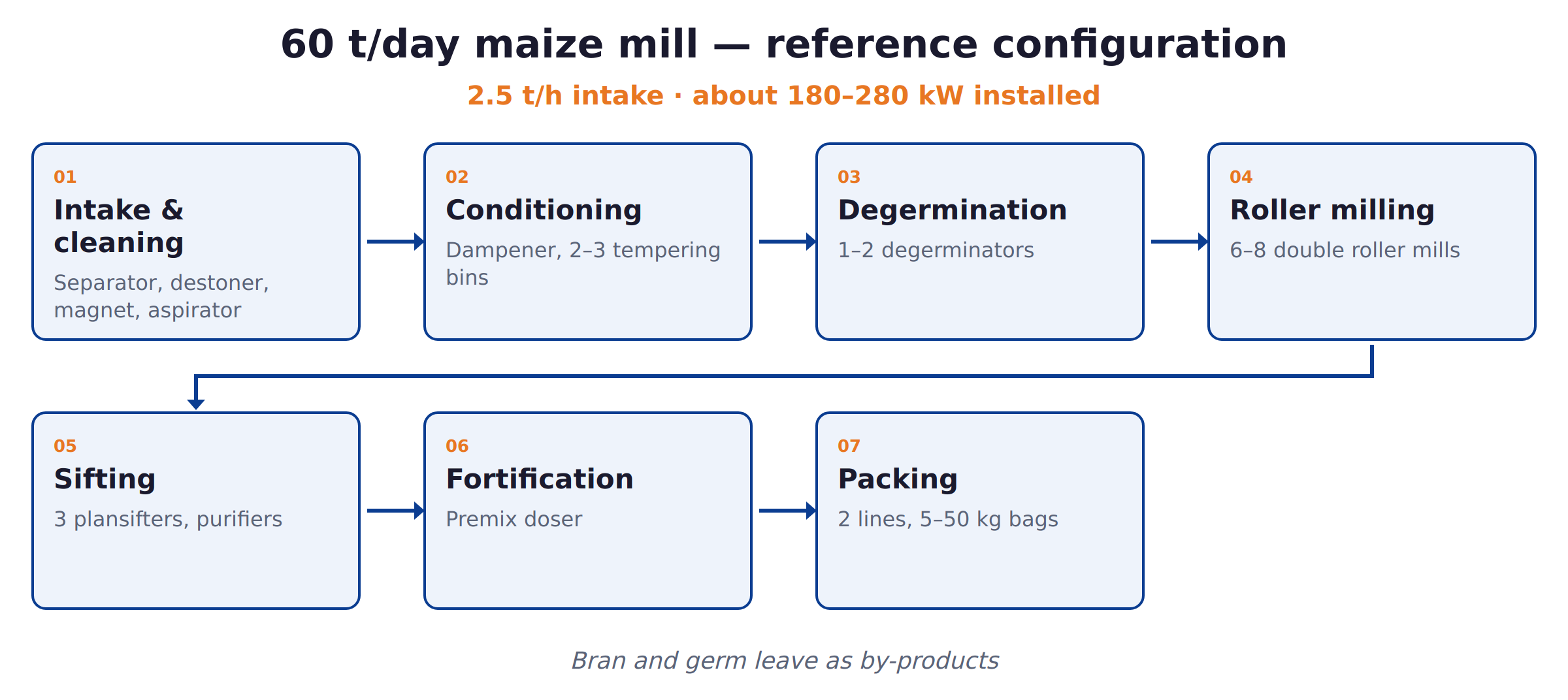
| Larger plant | About 60 t/day | About US$700,000–1.1 million | Regional millers |
Prices in Zimbabwe are commonly quoted in US dollars; confirm the currency and terms on every quote.
Roller meal or refined meal?
| Roller meal | Super-refined meal | |
|---|---|---|
| Machine | Grinding mill, sometimes with a dehuller | Degerming, roller mills, sifters |
| Product | Coarser, higher extraction, more of the grain | Finer, whiter, lower extraction |
| Buyers | Households, rural shops, service milling customers | Supermarkets, urban shops |
| By-products | Little | Bran and germ for stockfeed |
Electric, diesel or solar?
- Electric: cheapest per bag where supply holds. The Herald reported that 2026 was the first year in more than two decades that Zimbabwe went through the whole winter without a day of scheduled load-shedding, thanks to Hwange and Kariba South generation.
- Diesel: works anywhere; fuel is the main cost.
- Solar with batteries: no fuel bill; size panels and batteries for the motor and milling hours.
- Backup: on 6 July 2026 a fault caused a nationwide grid collapse, restored the same evening with imports and local generation, a reminder that faults still happen.
Importing a plant into Zimbabwe
| Item | 2026 basis |
|---|---|
| Payments at import | Import duty, surtax where applicable, and VAT, per the Tariff Handbook |
| VAT | 15.5% from 1 January 2026 |
| CBCA | Pre-shipment conformity certificate for regulated goods; 12% of CIF penalty without it |
| Route | Sea to Durban, then road through Beitbridge |
| Landed factor | About 1.45–1.60 times ex-works for equipment priced at the factory; our plant prices already include it |
Our Zimbabwe import guide explains CBCA sequencing and the Beitbridge leg.
Worked example: a growth-point mill in Masvingo Province
A miller at a growth point in Masvingo Province runs two electric grinding mills for service milling and keeps a diesel mill for outages. Customers ask for bagged meal between harvests, so he buys maize after harvest, stores it and sells 10 kg bags of roller meal to local shops. When a supermarket asks for refined meal, he plans a small degerming and roller plant, with the CBCA certificate arranged before the plant leaves China. The figures are illustrative.
How to choose a grinding mill
- Motor or engine size for your daily volume.
- Hammers or plates and how easily they are replaced.
- Screens for the fineness customers want.
- Dust control and a clean outlet.
- Local spares and a workshop nearby.
- Power source and backup.
What we see in Zimbabwe
- Grinding mills do most service milling.
- Roller meal is the everyday product; refined meal sells in supermarkets.
- Power has been steady in 2026, with occasional faults.
- Solar mills are spreading in rural areas.
- CBCA certificates must be in place before shipment for regulated goods.
- VAT is 15.5% from January 2026.
The season shapes the business
In Zimbabwe, service milling follows the harvest. After the main harvest, households bring maize from their fields and grinding mills are busy; as household stocks run down, customers buy meal instead, and mills that store maize and sell their own roller meal keep earning. Plan cash, staff and maintenance around these seasons, and service mills before the busy months.
Maintenance and spares
Grinding mills wear hammers, plates and screens quickly. Keep spares on site, turn or replace hammers on a schedule, and check belts, bearings and the motor or engine weekly. A mill that breaks down in the busy season loses customers to the next mill, so preventive maintenance is part of the business.
Choosing between a mill and a plant
A plant makes sense only when there are buyers for refined meal in branded bags and you can store enough maize to run it. Until then, extra grinding mills, a dehuller and good service often earn more for less money.
Safety and the mill house
Grinding mills throw dust and have fast-moving belts and pulleys. Guard belts, keep the mill house swept, store fuel away from the engine, and keep a fire extinguisher by the door.
Solar mills in rural Zimbabwe
Solar-powered grinding mills have spread in rural areas where the grid is far away or diesel is expensive. A solar mill needs panels and batteries sized for the motor and the hours you mill, a motor matched to the mill, and a secure site for the panels. The upfront cost is higher, but daily fuel savings can repay it over time.
Licences
Register the business and obtain the local authority licence for the premises. If you bag meal for sale, label bags with the product, weight and your details, and keep the mill house clean and free of pests.
Working with a local workshop
A nearby engineering workshop that can rewind motors, machine shafts and make hammers is worth more than a cheaper mill from far away.
Power connection
Ask ZESA about a three-phase connection early, because it changes which motors you can run.
From a delivered project: On a delivered 60 t/day super-fine maize mill more than six hours from the nearest engineering hub, the mill itself was the easy part: extra pre-cleaning for maize at 11–16% moisture, an on-site critical-spares buffer and a year of support took the plant to about 85% of nameplate by month four. Read the maize mill case study.
Where CISH fits
For a grinding mill, a Zimbabwean workshop or dealer is usually the better buy, and we will say so. For refined meal at scale, CISH supplies complete mealie meal plants, cleaning, degerming, roller milling, sifting and packing, from audited factories in China, sequences the CBCA inspection with our factory test, ships through Durban and Beitbridge, clears, installs and commissions the plant, and trains your miller.