On top of equipment come the premises, county business and public health permits, KEBS certification for packed bread, a few weeks of flour, delivery vehicles and working capital. Flour is the largest running cost, and Kenya imports most of its wheat, about 2.6 million tonnes in 2025/26, so flour prices follow world markets and the shilling. Ovens and proofers are big power users, and EPRA's fuel energy cost charge was about KES 3.5 per kWh in August 2026, so many bakeries choose gas or diesel-fired ovens. Imported equipment usually enters at 0% EAC duty but pays 16% VAT, the 2.5% IDF and the 2% RDL. CISH supplies, installs and commissions complete bakery lines.
What a bakery costs to start: the main blocks
| Cost block | Neighbourhood bakery | Bread factory |
|---|---|---|
| Equipment | Machine set: about US$15,000–45,000 | Semi-automatic line from about US$80,000; automatic US$250,000–800,000+ |
| Premises | A shop with a back bakery | An industrial unit with dispatch area |
| Fit-out | Tiling, washable walls, drains, ventilation, hand-wash stations | The same at larger scale, plus a cooling and packing room |
| Power and gas | Three-phase connection, gas installation | Larger supply, gas or diesel for ovens, generator backup |
| Permits and certification | County business permit, public health licence | Plus KEBS certification for packed bread |
| Vehicles | One delivery van or motorbike | A fleet for routes |
| Working capital | Flour, sugar, yeast, fat and packaging for several weeks | The same, larger, plus supermarket payment terms |
Equipment: what to buy first
| Machine | Why |
|---|---|
| Spiral mixer | Mixes dough consistently; the heart of any bakery |
| Dough divider and moulder | Even loaf weights save flour and prevent short-weight complaints |
| Prover | Controlled rising saves time and gives even loaves |
| Oven: deck or rotary rack | Deck ovens for mixed products; rack ovens for volume |
| Bread slicer and bagging | For sliced loaves in shops |
| Cooling racks | Bread must cool before slicing and bagging |
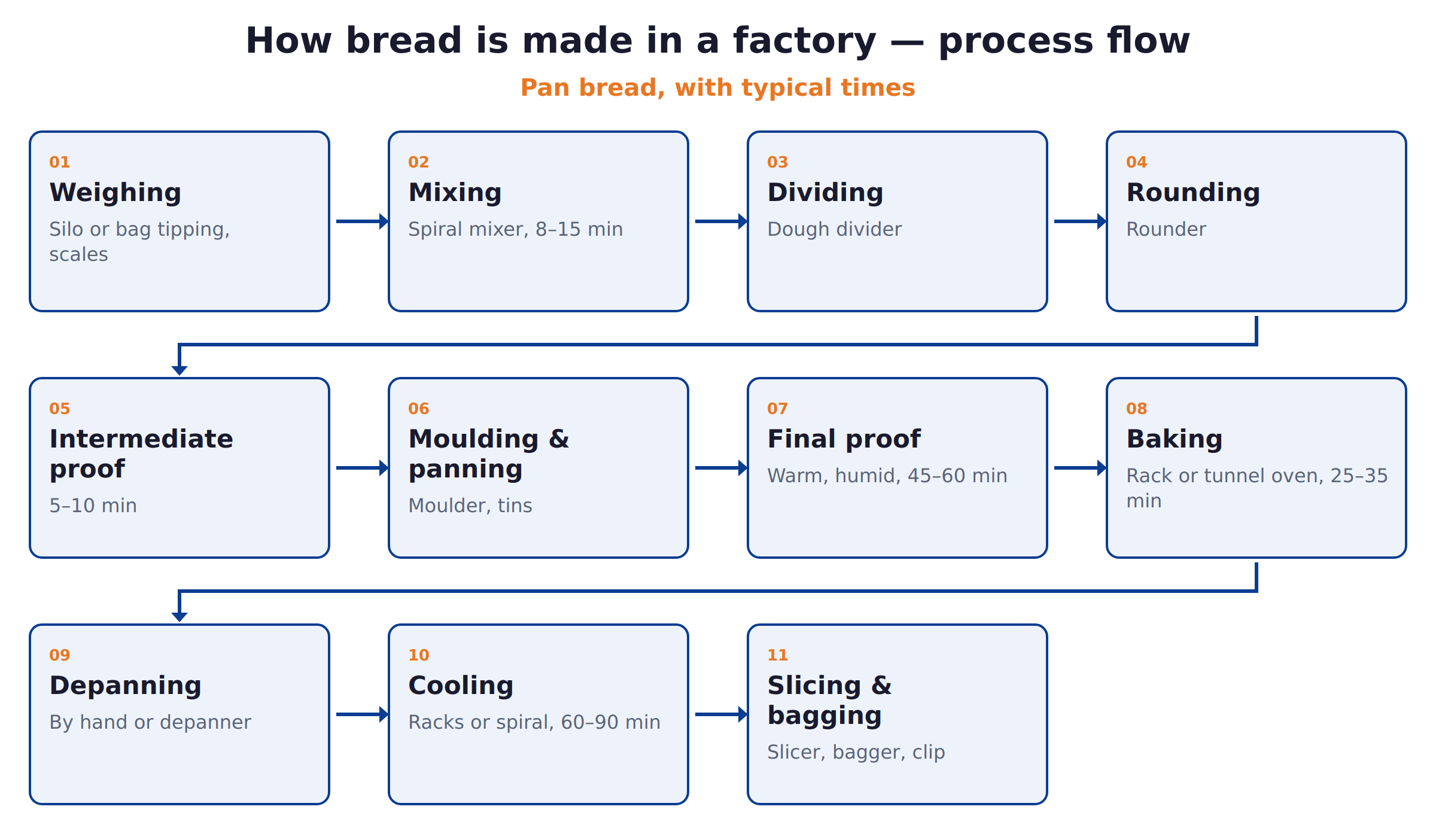
A fully automatic line adds continuous mixing, dividing and moulding, a tunnel oven, spiral cooling and automatic slicing and bagging. Our bakery oven price guide covers ovens and machine sets in detail.
Permits and certification
- Business registration and a KRA PIN.
- County business permit for the premises.
- Public health licence from the county public health department for food premises, with medical certificates for food handlers.
- Fire safety approval from the county for ovens and gas installations.
- KEBS: packed bread sold to shops and supermarkets is expected to carry the KEBS Standardization Mark.
Fees and timelines vary by county; confirm each before you set an opening date.
Flour and ingredients
Flour is usually the largest running cost of a bakery. Kenya imports most of its wheat: the Nation reported import demand of about 2.6 million tonnes for 2025/26, and The Star reported Russian wheat exports to Kenya rising to about 1.4 million tonnes. Flour prices therefore follow world wheat prices, freight and the exchange rate. Buy from more than one miller, keep a few weeks of stock, and weigh dough pieces accurately; a few grams over on every loaf adds up to bags of flour a month.
Power, gas and running costs
Ovens and provers use the most energy. On grid power, Kenya Power's base tariff carries pass-through charges; EPRA's fuel energy cost charge was about KES 3.5 per kWh in August 2026. Many bakeries use LPG or diesel-fired ovens and keep electricity for mixers, dividers and slicers. Plan backup power for proving and baking, because a power cut mid-bake wastes a whole batch.
Delivery and sales
Bread is sold fresh every day. A neighbourhood bakery sells over the counter and to nearby kiosks and shops; a factory needs routes and vehicles to reach shops, supermarkets, schools and institutions before morning. Supermarkets pay on terms, so plan working capital for that.
Importing equipment
Most bakery machines are imported. Capital goods usually enter Kenya at 0% under the EAC Common External Tariff, but 16% VAT, the 2.5% Import Declaration Fee and the 2% Railway Development Levy apply, and regulated goods need KEBS pre-export verification before shipment. Equipment lands at Mombasa and travels by road or SGR to your site.
Worked example: a bakery in Eldoret
A baker in Eldoret runs a small shop bakery with a domestic-size oven. She leases a larger unit, tiles it, fits a gas installation and buys a spiral mixer, a divider, a moulder, a prover, a gas-fired rotary rack oven, a slicer and cooling racks, a machine set at the lower-middle part of the band. She gets the county permits and public health licence, then KEBS certification for her sliced loaf, and supplies kiosks and two supermarkets with one van. The figures are illustrative.
Common mistakes
- Buying a big oven before a mixer and divider.
- No gas or backup power.
- Loaf weights not controlled.
- No working capital for flour and supermarket terms.
- Selling packed bread without KEBS certification.
What we see in Kenya
- Bread, buns and mandazi are daily products.
- Flour follows imported wheat prices.
- Gas-fired ovens are common where power is costly.
- KEBS certification is expected for packed bread.
- County permits differ, so check locally.
Staff and skills
A neighbourhood bakery needs a head baker, helpers for mixing and moulding, a sales person and a driver. A bread factory needs bakers per shift, an oven operator, packing staff, a maintenance person and drivers. Train staff in hygiene and safe use of mixers, dividers, ovens and slicers, and keep medical certificates up to date as the county requires.
Products beyond bread
Buns, mandazi, cakes, scones and pastries use the same equipment and often earn more per kilogram of flour than bread. Many bakeries sell bread for volume and cakes and buns for margin. Plan the oven and proofer so they can handle mixed products during the day.
Planning daily production
Bake to orders, not to hope. Agree daily quantities with shops and kiosks, track returns of unsold bread, and adjust production by day of the week. Returns of stale bread are one of the largest hidden costs in small bakeries.
Where CISH fits
We supply complete bakery lines, mixing, dividing, moulding, proving, baking, cooling, slicing and bagging, from audited factories in China, sized to your loaves a day. CISH ships to Mombasa, clears, installs and commissions the line, and trains your bakers. For a single small oven or mixer, a local dealer is usually the better choice.