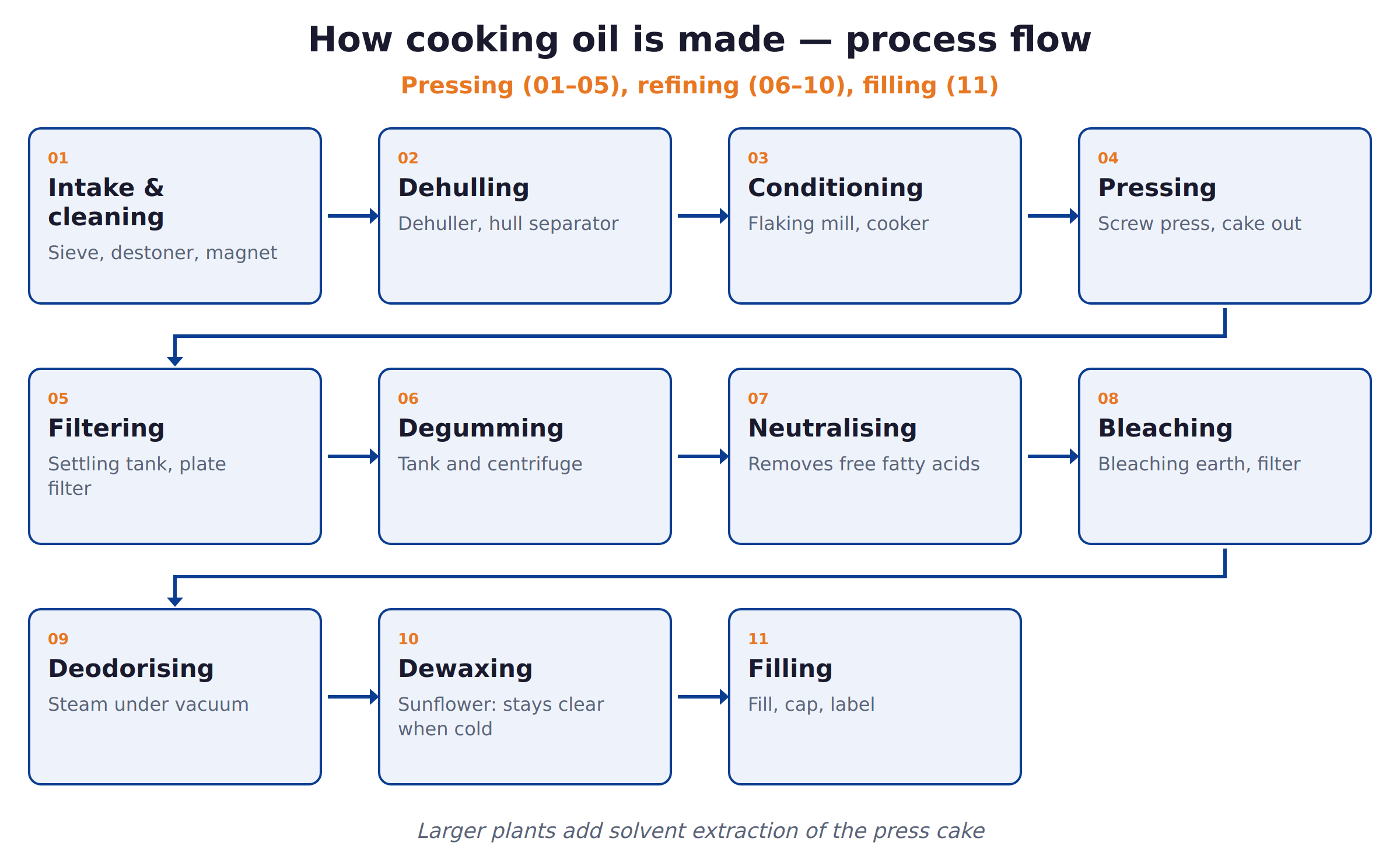
Simple expellers with a filter cost under about US$10,000 and produce crude or filtered oil only. Pressing yields oil of roughly a third of the seed weight, and the oilcake sells to animal feed makers, which is an important part of the income. Uganda is landlocked, so imported plants cost about 1.45–1.60 times ex-works landed and installed. Capital goods usually enter duty-free under the EAC CET, with 18% VAT and UNBS pre-shipment verification for regulated goods. Bottled oil sold in shops is expected to meet UNBS standards. CISH supplies, installs and commissions complete oil pressing and refining plants in Uganda.
Cooking oil machine prices in Uganda, 2026
| What you buy | Capacity | Indicative price (2026) | Product |
|---|---|---|---|
| Single screw expeller with filter | Small | Under about US$10,000 | Crude or filtered oil |
| Pressing line: cleaning, dehulling, conditioning, pressing, filtering | About 20 t of seed a day | About US$150,000–400,000 ex-works | Crude oil and cake |
| Pressing and refining plant | About 50 t a day | About US$400,000–900,000 ex-works | Refined bottled oil |
| Larger plant | About 100 t a day | About US$700,000–1.5 million+ | Refined oil at scale |
For Uganda, budget about 1.45–1.60 times ex-works for landed and installed costs.
Crude, filtered or refined?
| Crude or filtered oil | Refined oil | |
|---|---|---|
| Process | Press and filter | Press, then degum, neutralise, bleach, deodorise, winterise |
| Look and taste | Darker, nutty, may cloud | Clear, light, neutral |
| Market | Local markets, jerrycans, food vendors | Supermarkets, bottled oil brands, food factories |
| Investment | Low | High |
| Skills | Moderate | Refinery operator, laboratory |
Many plants start by pressing and selling crude oil to a refinery or filtered oil locally, and add refining once seed supply and sales are secure.
Seed supply
Sunflower is grown by many smallholders in northern and mid-northern Uganda, usually in two seasons. Mills buy from farmers, traders and contract-farming schemes. Plan:
- Storage: dry, ventilated stores for several months of seed.
- Quality checks: moisture, impurities, oil content where possible.
- Working capital: seed is the largest cost and must be bought at harvest.
Oilcake
About two-thirds of the seed leaves the press as cake. Sunflower cake is a protein ingredient for poultry, pig and dairy feeds, and Ugandan feed makers buy it. Agree sales before you start, and keep cake dry to prevent mould.
Power and steam
Presses, dehullers and pumps need a strong electric supply or diesel engines; refining needs steam and vacuum. After UEDCL took over distribution in 2025, approved first-quarter 2026 tariffs were about UGX 203.6 per unit for extra-large and UGX 300.4 for large industrial users. Plan backup power so presses and the refinery are not stopped mid-batch.
Importing an oil plant
| Item | 2026 basis |
|---|---|
| Duty | 0% for capital goods under the EAC CET; the 8-digit HS code decides |
| VAT | 18% |
| UNBS PVoC | Pre-shipment verification for regulated goods |
| Route | Mombasa or Dar es Salaam, then inland |
| Landed factor | About 1.45–1.60 times ex-works |
Our sunflower oil refining sizing guide sets out what each plant size needs.
Standards
Bottled cooking oil sold in shops is expected to meet UNBS standards, and many buyers ask for the UNBS Q-Mark. Test oil for free fatty acids, peroxide value and moisture, and keep records for each batch.
Worked example: a seed trader in Lira presses oil
A sunflower seed trader in Lira sells seed to factories in Kampala. He installs a 20 t/day pressing line with seed cleaning, dehulling, two expellers and a filter press, sells filtered oil in 20-litre jerrycans to traders in the north, and sells cake to a feed mill. With steady seed buying, he plans a small refinery and a bottling line to sell clear oil to supermarkets. The figures are illustrative.
How to compare quotes
- Tonnes of seed per day and oil yield guarantee.
- Dehulling for higher-protein cake.
- Expeller type and residual oil in cake.
- Filtration: filter press or leaf filter.
- Refining sections, if included, and losses.
- Steam, power and water needs.
- Installation, commissioning on your seed, and training.
- Spares: press worms, cages, filter cloths.
- References in East Africa.
What we see in Uganda
- Sunflower is the main local oilseed.
- Many small presses sell filtered oil locally.
- Refined bottled oil competes with imports in supermarkets.
- Oilcake sells to feed makers.
- Oil plants reach Uganda by road or rail from the coast, which raises landed cost.
- Agro-processing has strong budget support in 2026/27.
Crude oil quality starts with seed
The quality of sunflower oil depends as much on the seed as on the press. Seed that is dry, clean and stored well gives oil with low free fatty acids and a clean taste; damp or mouldy seed gives darker, sourer oil and higher refining losses. Clean seed before pressing to remove stones, sticks and dust, which also protects the press from wear. Dehulling sunflower seed raises the protein of the cake and the capacity of the press, but adds a machine and some oil loss to the hulls.
Filtering and settling
Crude oil from the press contains fine solids. A filter press or settling tanks remove them; well-filtered oil looks clearer, keeps longer and sells better in local markets. Refining goes further, removing gums, free fatty acids, colour and smell. Many Ugandan processors sell filtered oil locally while they build seed supply and sales, then add refining for supermarket listings.
Selling the oil
Filtered oil sells in jerrycans to traders, restaurants and food vendors; refined oil sells in bottles to supermarkets and shops. Price per litre depends on clarity and taste, so keep quality steady from batch to batch.
Space and staff
A 20 t/day pressing line needs a building for seed cleaning, pressing and filtration, a seed store for several months, an oil store with tanks, and a cake store. It typically needs operators for seed preparation, pressing and filtration on each shift, plus a supervisor and maintenance person. A refinery adds a trained refiner, a boiler operator and a laboratory technician.
Packaging filtered oil
Filtered oil sold in jerrycans and bottles should be clean, sealed and labelled with the product, volume, batch and your details. Use food-grade containers and keep filled stock out of the sun so the oil does not go rancid.
Where CISH fits
We supply complete oil plants, seed cleaning, dehulling, pressing, filtering, refining and filling, from audited factories in China, sized to your seed and output. CISH ships through Mombasa or Dar es Salaam, clears, installs and commissions the plant on your seed, and trains your team. For a single expeller, a local supplier is usually the better buy.