Potato supply is the real constraint: most potatoes come from smallholders in Nyandarua, Nakuru and neighbouring counties, and the right variety and storage decide oil uptake and colour. CISH supplies, installs and commissions complete crisps and frozen chips lines; for a fryer or a single slicer, a local dealer is the better buy.
Chips and crisps machine prices, 2026
| What you buy | Typical output | Indicative price (2026) | Fits |
|---|---|---|---|
| Chips cooking machine (deep fryer) | Fast-food portions | A small purchase from local dealers | Restaurants and chips kiosks |
| Single slicer, peeler or fryer for a workshop | Small batches | A few thousand US dollars or less | Home-scale crisps makers |
| Semi-automatic crisps or chips line | 100–300 kg/h | About US$15,000–80,000 | First packaged crisps brand |
| Fully automatic frozen chips line | Blanch, fry, quick-freeze, pack | About US$120,000–500,000 or more | Supplying restaurants, hotels and supermarkets |
| Industrial continuous crisps line | Tonnes per hour | Higher, quoted per configuration | Large snack brands |
Prices are for equipment in US dollars, before freight, clearance, installation, building work and cold storage.
Crisps or frozen chips: two different businesses
| Packaged crisps | Frozen chips (French fries) | |
|---|---|---|
| Buyers | Shops, supermarkets, schools, kiosks | Restaurants, hotels, fast-food chains, supermarkets |
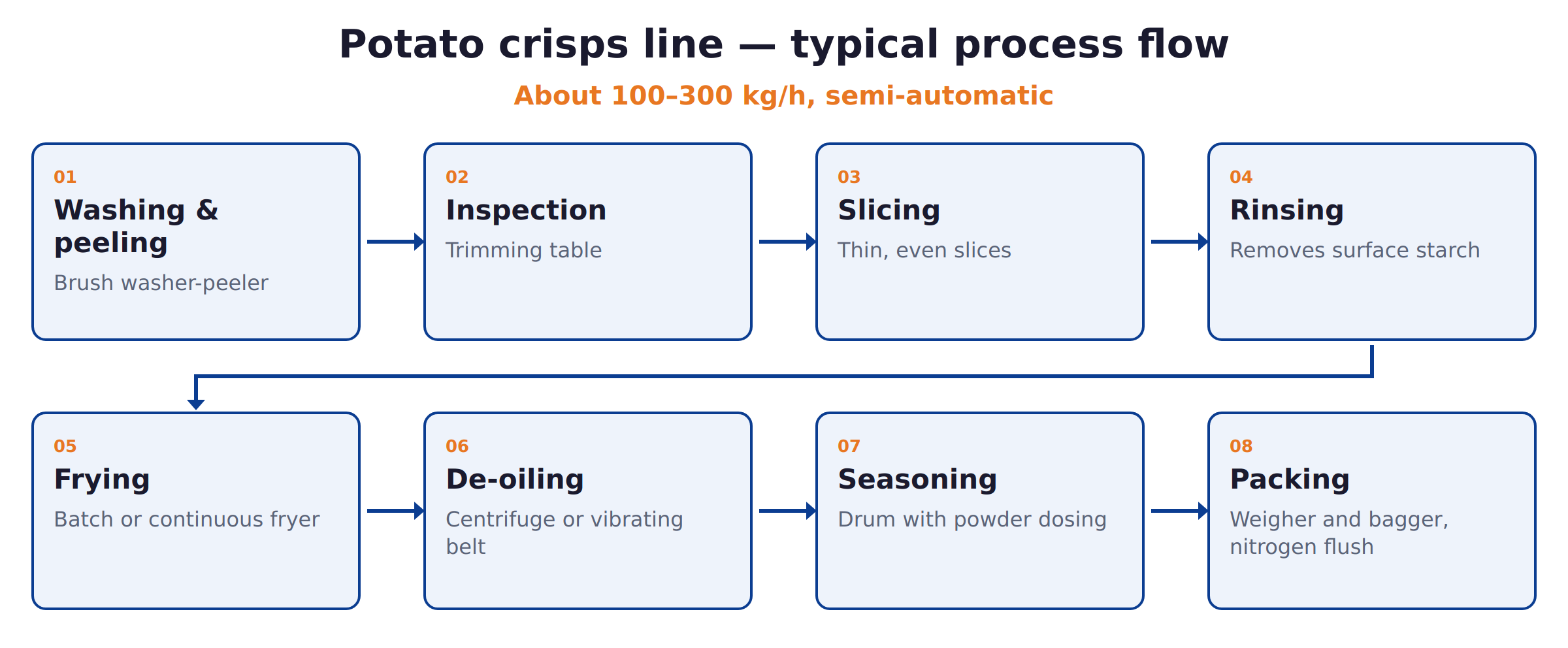
| Process | Wash, peel, slice thin, wash starch, fry, de-oil, season, pack | Wash, peel, cut, blanch, dry, par-fry, quick-freeze, pack |
| Packaging | Nitrogen-flushed foil packs to stop breakage and rancidity | Frozen bags in cartons |
| Cold chain | Not needed | Freezer storage and refrigerated delivery |
| Key cost | Cooking oil and packaging | Freezing energy and cold storage |
| Capital | Lower | Higher, because freezing and cold storage are added |
Decide the product first. A crisps line cannot be turned into a frozen chips line by adding a freezer; the cutting, blanching and frying are different.
Nitrogen packing for crisps
Crisps break and go rancid when exposed to air. Packed crisps are usually filled into foil or metallised film with nitrogen flushing, which cushions the crisps and keeps oxygen out. Ask every seller:
- Whether the packing machine includes nitrogen flushing and a nitrogen generator or bottle supply.
- What bag sizes it handles, from small kiosk packs to family packs.
- How many packs per minute at each size.
The potato is the bottleneck
Kenya grows plenty of potatoes, but most come from smallholders. National Potato Council of Kenya figures cited by The Star in 2025 put production at about 2.06 million tonnes a year from about 160,000 hectares, with smallholders producing 83% of it. Nyandarua accounts for about 29.8% of production and Nakuru for about 18.9%. For a processor, that means:
- Variety matters. Popular table varieties include Shangi, Unica and Wanjiku, but crisps need potatoes with low sugar and the right dry matter, or they fry dark and absorb more oil. Test the varieties you can buy before choosing the line settings.
- Supply is seasonal. Plan storage or contracts with farmer groups for the months between harvests.
- Buying by weight. The Crops (Irish Potato) Regulations, 2019 set 50 kg as the maximum single package and require potatoes to be sold by the kilogram, which makes buying by weight easier to enforce.
Who sells chips and crisps machines in Kenya
- Local dealers sell fryers, chips cutters and small peelers for restaurants and kiosks.
- Jua kali and local fabricators make frames, tables, simple slicers and seasoning drums.
- Chinese factories selling direct offer semi-automatic and automatic crisps and frozen chips lines by catalogue.
- Turnkey companies design the line from potato intake to packed product and commission it on local potatoes.
We leave individual sellers unnamed. Ask every seller for output in kg of finished product per hour, oil consumption per kg, and to show the line running on potatoes similar to yours.
What a complete crisps line includes
- Potato intake and washing: removes soil and stones.
- Peeling: abrasive or steam peeler, depending on scale.
- Slicing: blade set for crisp thickness; blades wear and need spares.
- Starch washing and dewatering: stops slices sticking and lowers oil uptake.
- Frying: batch or continuous fryer, with oil filtration and heating.
- De-oiling: centrifuge or vibrating belt.
- Seasoning: drum with powder dosing.
- Packing: weigher and bagger with nitrogen flushing.
- Utilities: heating for the fryer (gas, diesel or thermal oil), power, water, waste water handling.
A frozen chips line adds blanching, drying, par-frying and a quick freezer, plus cold storage.
Power, heat and oil
Frying needs a lot of heat. Fryers heated by electricity are simple but expensive to run where tariffs are high; gas or thermal oil heating is common on larger lines. In Kenya, an energy surcharge known as the fuel energy cost charge was about KES 3.5 per kilowatt-hour in August 2026, before other pass-throughs, so an all-electric fryer adds up quickly. Cooking oil is the other big cost: most of Kenya's vegetable oil is imported palm oil, so oil uptake per kg of crisps directly changes your margin.
Importing a chips line into Kenya
| Item | What to expect |
|---|---|
| Duty | Food processing machinery is generally duty-free under the EAC tariff; confirm per HS code |
| VAT | 16% |
| Import Declaration Fee | 2.5% |
| Railway Development Levy | 2% |
| KEBS PVoC | Pre-shipment verification for regulated items |
| Route | Mombasa, then SGR or road to Nairobi, Nakuru or the potato counties |
Worked example: a 200 kg an hour crisps line
An illustration only:
| Item | Assumption |
|---|---|
| Finished crisps | About 200 kg an hour |
| Raw potatoes | Several times that weight, because peel and water are lost in frying |
| Line | Semi-automatic, within US$15,000–80,000 |
| Heating | Gas or diesel fryer burner, sized by the seller |
| Packing | Weigher and nitrogen-flush bagger |
| Main running costs | Potatoes, cooking oil, packaging film, heat |
Check the ratio of raw potato to finished crisps with each seller on your variety. It sets the potato tonnage you must buy every week.
How to compare quotes
- Output in kg of finished product per hour.
- Raw potato input per kg of product.
- Oil uptake and oil consumption per hour.
- Fryer type, heating method and heat input.
- Peeler type and peel loss.
- Slicer blade set and spare blades.
- Packing machine, bag sizes and nitrogen flushing.
- For frozen chips: blancher, freezer type and freezing capacity.
- Installation, commissioning on your potatoes and training.
- Warranty and local service.
Mistakes we see
- Testing on the wrong potatoes. Variety and storage change colour and oil uptake.
- Buying a fryer too small for the slicer. The line runs at the fryer's speed.
- Packing without nitrogen. Crisps break and go stale on the shelf.
- Forgetting waste water. Washing and starch removal produce effluent that must be handled.
- Frozen chips without cold storage. The freezer is only half of the cold chain.
- No potato supply plan. The line stands idle between harvests.
What we see in Kenya
- A large potato crop from smallholders. About 2.06 million tonnes a year, mostly from small farms.
- Nyandarua leads. The county is Kenya's top potato grower, with Nakuru second.
- Packaging rules. Potatoes must be sold by weight, with 50 kg as the maximum single package under the 2019 regulations.
- Seed improvement. Farmers have been receiving disease-free planting material of varieties such as Shangi, Unica and Wanjiku through public programmes.
- Imported cooking oil. Frying oil is mostly imported palm oil, so oil uptake is a key cost.
- Energy surcharges. Pass-through charges on electricity favour gas or thermal oil heating for larger fryers.
- Import costs. Duty is usually zero for processing machinery, but VAT at 16%, the IDF and the RDL apply.
- PVoC. Build pre-shipment verification into the order timeline.
Where CISH fits
CISH supplies, installs and commissions complete crisps and frozen chips lines from audited factories in China: washing, peeling, slicing, frying, de-oiling, seasoning, nitrogen packing, and for frozen chips, blanching and quick freezing, with the import into Kenya arranged and the line commissioned on your potatoes. For a fryer or a single slicer, a local dealer is the better choice, and we will say so.