Many households and institutions use them as a cleaner, cheaper and longer-burning alternative to lump charcoal. Raw material supply and drying decide the business more than the press. Most capital goods enter Kenya at 0% EAC duty, with 16% VAT, a 2.5% Import Declaration Fee and a 2% Railway Development Levy. Charcoal production and transport are regulated, so check permits early. CISH supplies, installs and commissions complete briquette plants.
Briquette machine prices in Kenya, 2026
| What you buy | Capacity | Indicative price (2026) | Fits |
|---|---|---|---|
| Locally made manual or motorised press | Small | Priced locally in shillings | Community groups, small businesses |
| Single briquette press | Up to about 1–2 t/h | About US$1,000–25,000 | Charcoal dust briquettes |
| Carbonisation and briquetting line | 1–2 t/h | About US$150,000–350,000 ex-works | Biomass to charcoal briquettes |
| Wood or biomass pellet line | About 1 t/h | About US$150,000–350,000 | Fuel pellets for boilers and stoves |
| Multi-tonne export plant | 3 t/h and up | Quoted per configuration | Large producers |
Ex-works prices; landed and installed through Mombasa is typically 1.25–1.45 times, higher for inland sites.
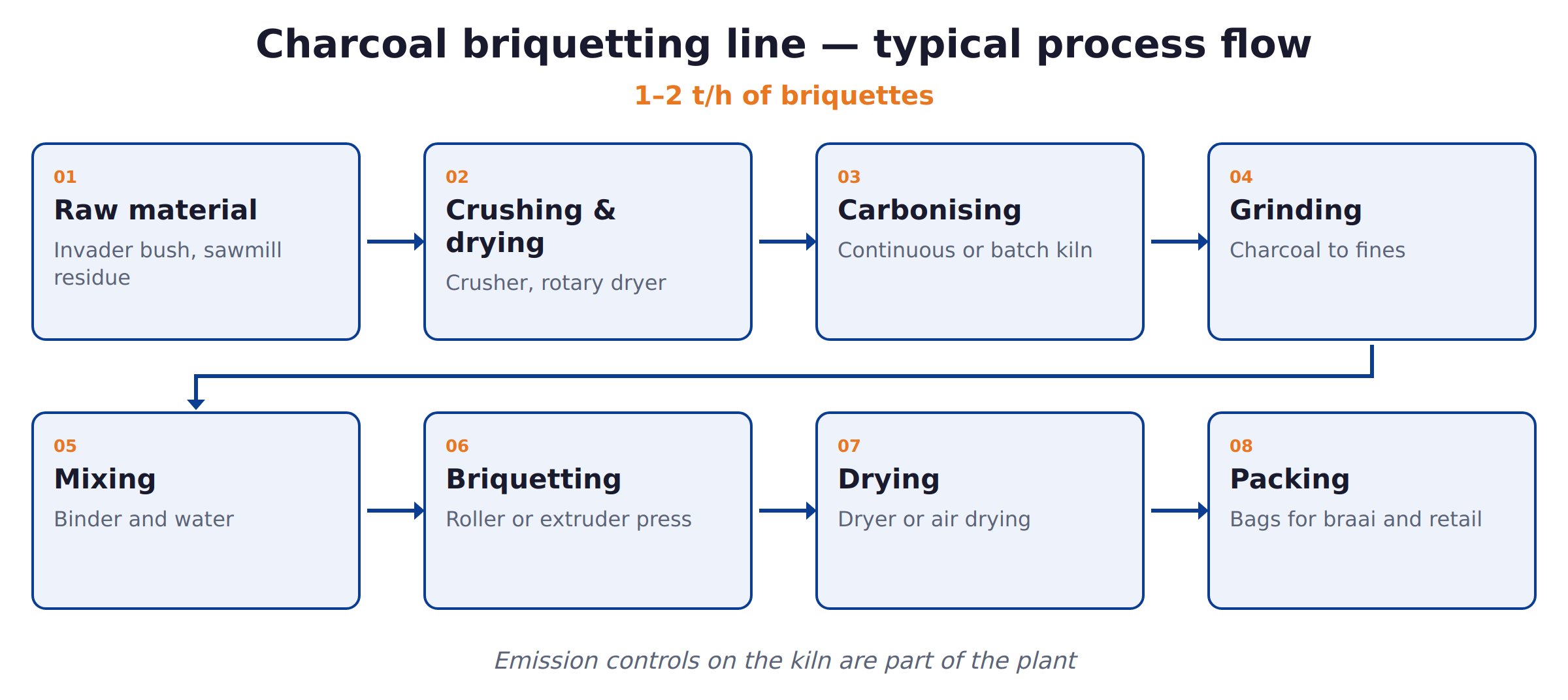
Two routes: charcoal dust or biomass
| From charcoal dust | From biomass (sawdust, bagasse, husks) | |
|---|---|---|
| Raw material | Fines and dust from charcoal yards | Sawdust, bagasse, coffee husks, maize cobs, nut shells |
| Carbonisation | Not needed | Needed: kiln or continuous carbonisation furnace |
| Process | Crush, sieve, mix with binder and water, press, dry | Dry, carbonise, crush, mix with binder, press, dry |
| Investment | Lower | Higher |
| Supply risk | Depends on charcoal trade | Depends on sawmills, sugar factories, farms |
The press is not the hard part
Briquette businesses usually struggle with three things before the press:
- Raw material supply: steady volumes of dust or biomass at a known cost, within a short transport distance.
- Drying: wet briquettes crack, smoke and do not sell. Sun drying works in dry seasons; a dryer is needed for consistent output.
- Binder and mix: too much binder or clay makes briquettes hard to light and leaves ash; too little and they crumble.
A good line matches crushing, mixing, pressing and drying to the same output.
Power
Crushers, mixers and presses run on electric motors, and continuous carbonisation furnaces need fans and controls. EPRA's fuel energy cost charge was about KES 3.5 per kWh in August 2026, on top of Kenya Power's base tariff. Plan supply capacity for starting loads, and use the gas from carbonisation to heat the dryer where the line allows it.
Importing into Kenya
| Item | 2026 basis |
|---|---|
| Duty | 0% EAC CET on most capital goods |
| VAT | 16% |
| Import Declaration Fee | 2.5% of customs value |
| Railway Development Levy | 2% of customs value |
| KEBS PVoC | For regulated products, before shipment |
| Port | Mombasa, then road or SGR inland |
Permits and rules
Charcoal production and transport are regulated, and rules have changed over the years. Briquettes made from waste biomass or charcoal dust may be treated differently from wood charcoal, but you should confirm what applies to your raw materials, your plant and the transport of your product with the Kenya Forest Service and your county before you invest. Carbonisation also produces smoke, so site the plant away from homes and check environmental requirements with NEMA.
Worked example: a sawdust briquette plant
A business near a cluster of sawmills in central Kenya collects sawdust that is otherwise burnt or dumped. It installs a line of about 1 tonne an hour: a dryer, a continuous carbonisation furnace, a crusher, a mixer with starch binder, a briquette press and a drying room, with bagging in 2 kg and 5 kg packs. Sales go to households through shops, and in bulk to schools and hotels. The first months are about drying: briquettes that leave the press too wet crack in storage, so the business adds drying racks and checks moisture before bagging. The figures are illustrative.
How to compare quotes
- Tonnes per hour of dried briquettes, not press output alone.
- Carbonisation method and capacity, if needed.
- Dryer type and capacity.
- Press type: roller, screw or hydraulic, and briquette shape.
- Binder dosing and mixing.
- Power and fuel needs.
- Smoke and dust control.
- Installation, commissioning on your raw material, and training.
- Spares: screws, rollers, dies.
- References in East Africa.
Choose by situation
- Community or small business: a locally made press for charcoal dust.
- Charcoal dust briquettes at volume: an imported press with crusher, mixer and dryer.
- Biomass briquettes: a complete carbonisation and briquetting line.
- Industrial fuel: a pellet line for boilers.
Quality customers notice
Buyers judge briquettes by how easily they light, how long they burn, how much smoke and ash they leave, and whether they break in the bag. Test each batch by burning a sample, check moisture before bagging, and keep the binder and clay content consistent. Uniform size and shape help in jikos and institutional stoves. Schools, hotels and restaurants often buy in bulk and stay loyal to a supplier whose briquettes perform the same every week.
Packaging and sales
Households buy briquettes in small bags from shops and kiosks, while institutions buy in sacks. Printed bags with the weight, burning instructions and your brand build trust. Plan distribution with shops near your plant first, then expand as output grows.
Cost per bag
Add raw material and its transport, binder, power, labour, drying fuel if any, and bags, then compare with shop prices for lump charcoal.
Mistakes we see
- Buying a press before securing raw material.
- No dryer.
- Too much clay binder.
- Carbonising near homes.
- Ignoring transport and permit rules.
What we see in Kenya
- Charcoal remains a major cooking fuel, and briquettes compete on price and burn time.
- Charcoal dust, sawdust, bagasse and coffee husks are common raw materials.
- Local workshops make simple presses.
- Capital goods usually enter duty-free under the EAC CET.
- VAT, the IDF and the RDL apply on import.
- PVoC comes before shipment for regulated goods.
- Electricity carries a fuel energy cost charge, about KES 3.5 per kWh in August 2026.
- Charcoal is regulated; confirm permits for production and transport.
Where CISH fits
We supply complete briquette and biomass fuel plants, drying, carbonisation, crushing, mixing, pressing and packing, from audited factories in China, sized to your raw material. CISH ships to Mombasa, clears, installs and commissions the plant, and trains your team. For a single small press, a local jua kali workshop is usually the better buy.