Machinery usually pays 5% duty under the ECOWAS CET plus the merged 20% VAT, NHIL and GETFund charge since January 2026, clears through ICUMS at Tema, and needs stable power. The product must be registered with the FDA. CISH supplies, installs and commissions complete bottled water lines.
Bottled water machine prices in Ghana, 2026
| What you buy | Capacity | Indicative price (2026) |
|---|---|---|
| Semi-automatic PET blowing machine | Small output, 2 cavities | About US$3,500–15,000 ex-works |
| Automatic PET blowing machine | 2–6 cavities, thousands of bottles an hour | About US$20,000–95,000 ex-works |
| Rinse-fill-cap monoblock | 1,000–4,000 bottles an hour | About US$13,000–60,000 |
| Complete bottled water line | 2,000–4,000 bottles an hour | About US$150,000–400,000 ex-works |
| Faster line | 6,000–12,000 bottles an hour | About US$400,000–900,000 ex-works |
| High-speed plant | 18,000+ bottles an hour | US$1 million and up |
A complete line includes treatment, bottle blowing or handling, filling, capping, labelling, coding and shrink wrapping. Coastal landed and installed costs are typically about 1.25–1.45 times ex-works.
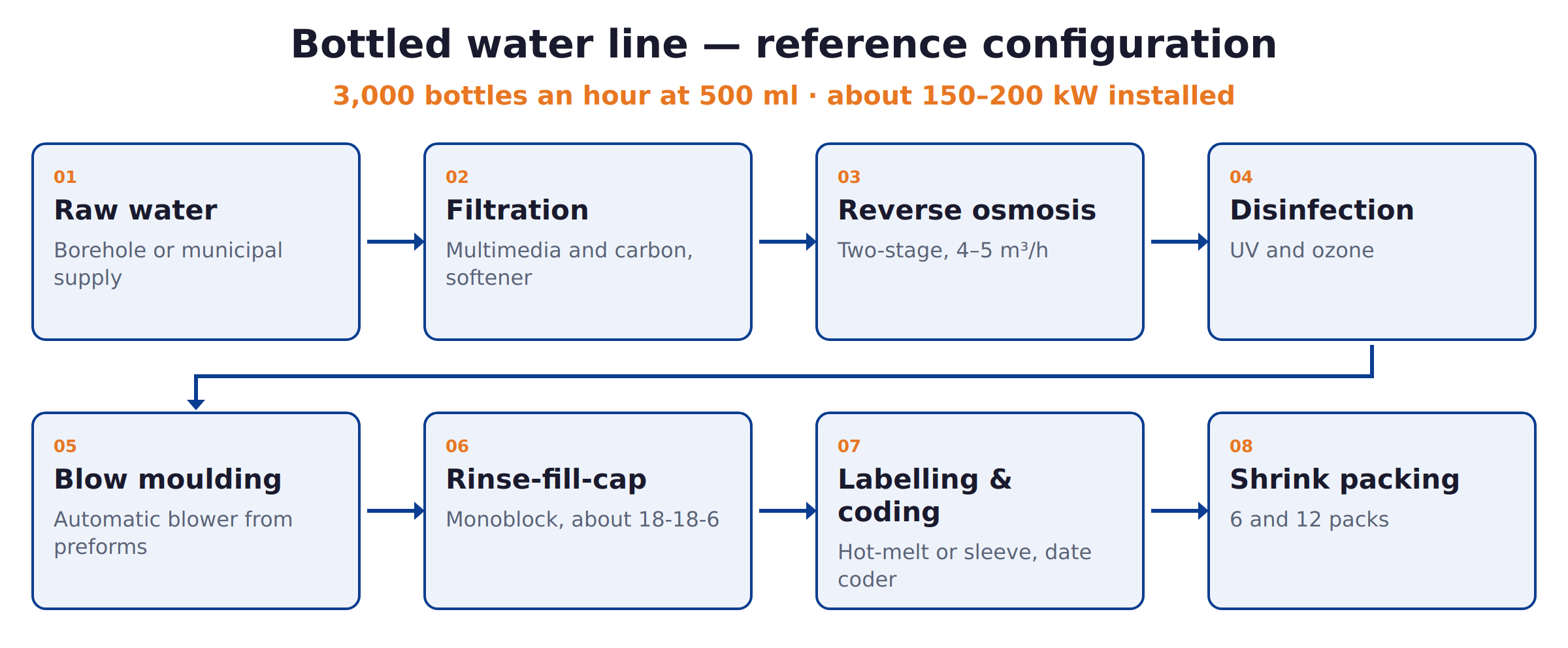
Sachet to bottles: what changes
| Sachet water | Bottled water | |
|---|---|---|
| Packaging | Printed film, form-fill-seal | PET preforms blown into bottles, caps, labels, shrink film |
| Machines | Sachet packing machines | Blower, rinse-fill-cap monoblock, labeller, shrink wrapper |
| Water treatment | Filtration, UV, often RO | Same, with higher consistency and often ozone |
| Hygiene | Clean packing area | Separate clean filling room, controlled access |
| Customers | Street vendors, households, retailers | Supermarkets, offices, hotels, events, institutions |
| Margin and investment | Lower per pack, smaller investment | Higher per pack, larger investment |
Many producers run both: sachets for the mass market and bottles for higher-value channels.
Blow your own bottles or buy them?
Blowing PET bottles from preforms in-house usually costs less per bottle at volume and avoids storing bulky empty bottles. It needs a blowing machine, a high-pressure compressor, a chiller, moulds for each bottle size and stable power. Buying bottles suits small volumes or many bottle sizes. Most lines above 2,000 bottles an hour blow their own.
Water treatment comes first
The treatment train decides the taste and safety of the water: typically sand and carbon filtration, softening where needed, reverse osmosis, remineralisation if you want a particular taste, and ozone or UV disinfection, with storage tanks. Test your source water before the line is designed; borehole water in particular varies widely.
Power and utilities
Blowers and compressors draw large starting currents, and fillers stop on low voltage. ECG's managing director said in April 2026 that much of the distribution network was overloaded beyond its designed limits, causing faults and low voltage, and launched a GHS 3.46 billion investment programme. Plan a transformer check, voltage protection and a generator sized for the compressor and blower.
Landed cost in Ghana
| Item | 2026 basis |
|---|---|
| Duty on machinery | Usually 5% under the ECOWAS CET; confirm HS codes |
| VAT, NHIL, GETFund | 20% combined since 1 January 2026 |
| ECOWAS and AU levies, processing fee | Added on top |
| Clearance | ICUMS; about 5–7 business days with clean documents |
| Port | Tema; buffer for congestion |
Imports of filling and packing machinery into Ghana rose 59.2% to US$17.5 million in 2024, according to UN Comtrade data, much of it for water and beverage producers.
Worked example: adding a 2,000 bottles an hour line
A sachet producer in Kasoa wants 500 ml and 1.5 L bottles for supermarkets. It adds an RO and ozone stage to its treatment, a four-cavity automatic blower with compressor and chiller, a rinse-fill-cap monoblock for about 2,000–3,000 bottles an hour, a sleeve or wrap-around labeller, an inkjet coder and a shrink wrapper, all in a new clean filling room. Sachet packing continues on the existing machines. The producer registers the bottled product with the FDA before launch. The figures depend on output and site.
How to compare quotes
- Bottles per hour for each size.
- Treatment train and its capacity in litres per hour.
- Blower cavities and the compressor and chiller included.
- Monoblock: rinse, fill and cap heads.
- Labeller and shrink wrapper speeds.
- Clean room design and air filtration.
- Power: connected load, starting current, generator.
- Installation, commissioning on your water, and training.
- Moulds and change parts for each bottle.
- References of plants in West Africa.
Choose by situation
- Sachet producer testing bottles: buy bottles and add a monoblock and labeller.
- First bottled water line: about 2,000–4,000 bottles an hour with an automatic blower.
- Regional brand: 6,000–12,000 bottles an hour with full automation.
Preforms, caps and packaging stock
A bottling line stops when preforms, caps, labels or shrink film run out. Most preforms and caps are bought in, priced in or linked to US dollars, so keep several weeks of stock and agree supply with more than one source if you can. Match preform neck finish and weight to your blower moulds and capper, and test each new batch. Label stock must match the FDA-registered product details, so reorder labels before running low.
Distribution
Bottled water is heavy and bulky. Plan delivery vehicles, routes and payment terms for supermarkets, distributors and offices before you size the line, because a fast line with no distribution fills the warehouse, not the market.
Mistakes we see
- Filling in the sachet room. Bottled water needs a clean filling room.
- Skipping treatment upgrades.
- Blower without a proper compressor and chiller.
- No plan for preform supply.
- No FDA registration before launch.
What we see in Ghana
- Sachet producers are upgrading to reach new channels.
- Packing machinery imports rose 59.2% in 2024.
- Machinery duty is usually 5% under the ECOWAS CET.
- The 2026 merged 20% VAT, NHIL and GETFund charge is on one base.
- ICUMS is the single window at Tema.
- Tema congestion needs a delivery buffer.
- Power quality affects blowers and compressors most.
- FDA registration is needed for each water product.
Where CISH fits
We supply complete bottled water lines, treatment, blowing, filling, capping, labelling and packing, from audited factories in China, sized to your bottles and output. CISH ships to Tema, clears, installs and commissions the line on your water, and trains your team. For a single small filler, a local dealer is usually the better choice.