In Nigeria, with grid supply short and borrowing costly, size the yard to your real daily sales and plan the generator.
Block moulding machine prices, 2026
| Tier | What it is | Indicative price (USD, 2026) | Typical buyer |
|---|---|---|---|
| Manual or mobile (egg-laying) | Small machine, often moving on the slab; hand or small mixer feed | US$8,000–40,000 machine; whole project under about US$80,000 | New block industry and site yards |
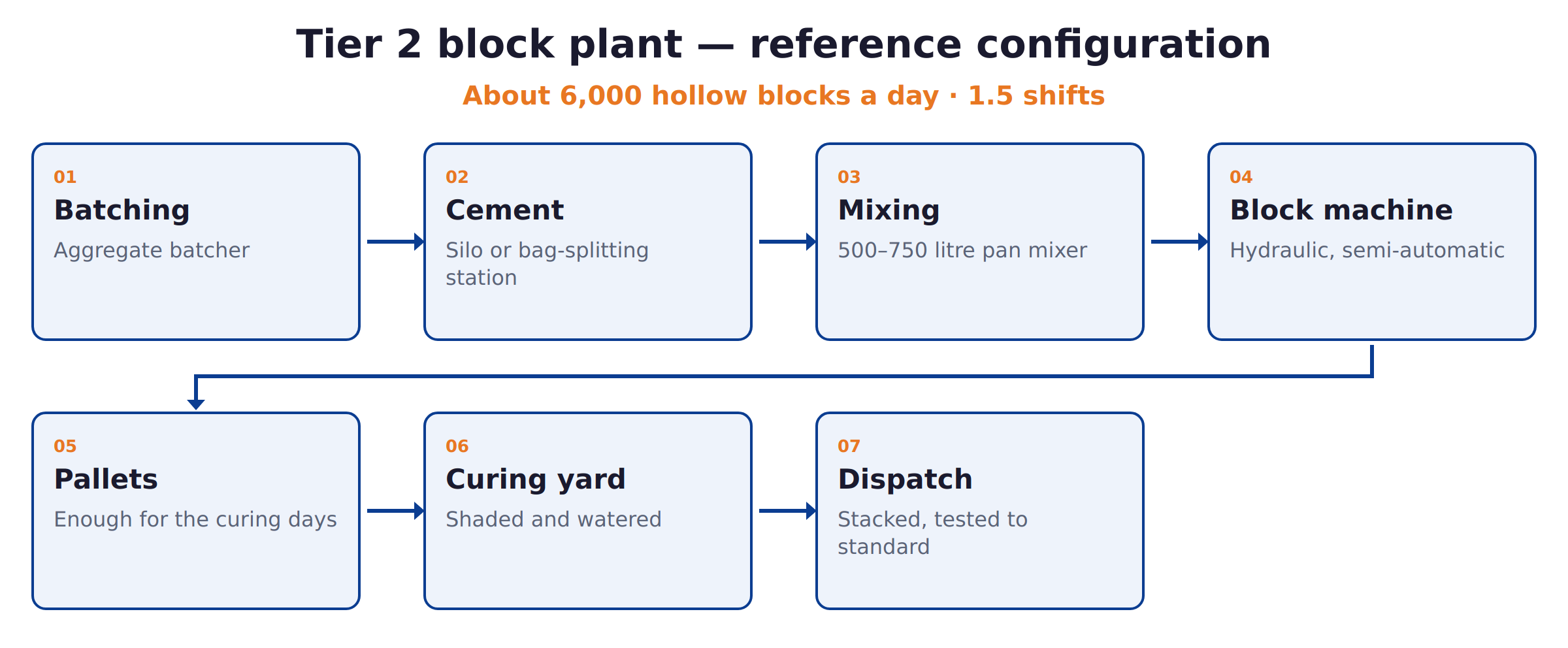
| Semi-automatic stationary plant | Stationary machine with pallets, batching and mixer, curing area | US$120,000–450,000 landed and commissioned | Commercial yards supplying builders and estates |
| Fully automatic plant | Automatic batching, block machine, stacking and curing system | US$600,000–1.5 million and up; civils extra | Large producers and pavers for public works |
The equipment is priced in US dollars because the naira moves; your local costs, such as cement and labour, are in naira.
Who sells block moulding machines in Nigeria
- Local fabricators build manual and egg-laying machines and moulds; quick to buy and repair.
- Dealers and importers sell imported stationary machines and spare moulds.
- Chinese factories sell machines and plants direct; you handle Form M, shipping, clearance and installation.
- Turnkey companies design and commission the yard: batching, machine, pallets, curing and handling.
Ask every seller to show blocks from their machine with your sand and cement, and to tell you who sets the vibration and who supplies new moulds.
What makes a block worth buying
Builders judge blocks by strength, shape and how many break on site. Strength comes from the mix, compaction and curing. Many yards save cement and skip curing, then lose customers when blocks crumble. A machine that compacts well, accurate batching and at least a week of protected curing produce blocks that sell on reputation.
Manual, semi-automatic or automatic?
| Factor | Manual or egg-laying | Semi-automatic | Fully automatic |
|---|---|---|---|
| Daily output | Low hundreds to a few thousand blocks | Several thousand blocks | Tens of thousands |
| Labour | High | Moderate | Low |
| Consistency | Depends on operators | Good | Very good |
| Power | Small motor or engine | Larger motors, mixer, hydraulics | Large connected load |
| Capital | Lowest | Moderate | Highest |
Most growing yards move from egg-laying machines to a semi-automatic stationary plant when contracts demand consistent blocks and labour becomes the main cost.
Power and site
A stationary plant draws power for vibration, hydraulics, the mixer and conveyors. With grid supply limited, many Nigerian yards run on diesel. Ask for the connected load and starting current, size the generator to it, and price fuel per thousand blocks. Lay out the yard so cement, sand and stone arrive at one end and cured blocks leave at the other.
Landed cost in Nigeria
| Item | What to plan |
|---|---|
| Machine and moulds | Ex-works or FOB |
| Freight and insurance | To your nearest Nigerian port |
| Duty | ECOWAS CET band for the machine's HS code; machinery is usually in the lower bands |
| Charges | 7% surcharge on duty, 1% CISS on FOB, 0.5% ETLS on CIF |
| VAT | 7.5% on value plus duties |
| Clearance and transport | Agent, port and trucking |
| Installation and commissioning | Foundations, erection, trial production |
Budget roughly 1.25–1.45 times the equipment price for a coastal landing and installation, before civil works.
Worked example: a semi-automatic yard's output
An illustration only, to show how output is really set:
| Item | Example |
|---|---|
| Machine cycle | About 20 seconds per pallet |
| Blocks per pallet (9-inch hollow) | 4 |
| Theoretical output per 8-hour shift | About 5,700 blocks |
| Realistic output after changeovers, breaks and mix waiting | About 4,000–4,500 blocks |
| Pallets needed for two days of curing | About 2,500 or more |
| Curing area for those pallets | Several hundred square metres under cover |
The pallets and the curing area, not the machine cycle, usually cap a yard's daily sales. Count them in every quote.
How to compare block machine quotes
- Blocks per shift of each size, demonstrated.
- Mould sizes included and the price of extra moulds.
- Vibration and compaction method.
- Batching and mixer included or not.
- Number and material of pallets.
- Block transport and curing method.
- Connected electrical load.
- Foundations required.
- Installation, commissioning and training.
- Warranty and parts supply in Nigeria.
Mistakes that cost Nigerian block yards
- Saving cement and skipping curing. Weak blocks lose builders.
- Too few pallets. A stationary machine waits for pallets while blocks cure.
- No plan for power. The generator is part of the plant.
- Buying for a boom. Size to sales you have, with room to add shifts.
- Cheap moulds. Worn moulds give oversized, rough blocks.
Choose by situation
| Situation | Usual choice |
|---|---|
| Builder making blocks for own sites | Egg-laying machine with a small mixer |
| New commercial yard in a growing town | Semi-automatic stationary plant with 2,000+ pallets |
| Yard supplying estates and contractors | Semi-automatic plant with batching scales and a block carrier |
| Producer adding pavers and kerbs | Additional moulds and a curing area sized for the new products |
| Supplier to public works | Automatic plant with documented strength testing |
What we see in Nigeria
- Power is the constraint. NERC reports about 5.4 GW of grid capacity available nationally, and manufacturers spent around ₦1.4 trillion on their own generation in 2025, so every yard plan must include a generator or other supply.
- Capital is expensive. The Central Bank's maximum lending rate was about 33.16% in mid-2026; buy the tier that pays back from current sales.
- Tariffs. Nigeria applies the five-band ECOWAS Common External Tariff; check the band for your machine and moulds before you budget.
- Customs systems. Form M processing has moved to the B'Odogwu portal; allow time.
- The 4% FOB charge. Suspended after being reintroduced in 2025; confirm before import.
- Local naming. Buyers ask for 6-inch and 9-inch hollow blocks and for interlocking pavers; make sure your moulds match what your market calls for.
Where CISH fits
CISH supplies, installs and commissions block and paver yards from audited factories in China: batching, stationary block machine, moulds, pallets, curing and handling, sized to your daily sales and power, and handled through import and clearance into Nigeria. For a single egg-laying machine, a local fabricator is often the quicker buy.