As an example, a 6-inch hollow block of 450 × 150 × 225 mm weighs roughly 18 kg, and a mix of one part cement to eight to eleven parts sand gives roughly 25–35 blocks per 50 kg bag; mixes leaner than that make weak blocks that crack and lose customers. Cement is usually the largest cost per block, followed by sand, water, labour, diesel and delivery. Most block industries are won or lost on sales and delivery, not on the machine. The Standards Organisation of Nigeria sets standards for building products. CISH supplies, installs and commissions semi-automatic and automatic block plants.
What decides profit
| Factor | Why it matters |
|---|---|
| Blocks per bag of cement | Cement is the largest cost; a few more blocks per bag adds margin, but too lean a mix makes weak blocks |
| Blocks sold per day | Fixed costs (rent, staff, machine payments) are spread over every block sold |
| Delivery | Most buyers want blocks on site; a truck and route planning are part of the business |
| Quality and curing | Strong, square, well-cured blocks win repeat customers and larger contracts |
| Location | Close to building activity and to sand supply |
| Power and water | Vibrating machines and mixers need power; curing needs water |
Blocks per bag of cement: an example
A 6-inch hollow block (450 × 150 × 225 mm) has a gross volume of about 0.015 m³; with the cavities, the concrete is roughly 60% of that, about 0.009 m³, weighing roughly 18 kg. If cement makes up about one-ninth of the dry mix by weight, each block uses about 2 kg of cement, so a 50 kg bag makes about 25 blocks; at one-eleventh, about 30–35 blocks. 9-inch blocks use more. These figures are an example: the right mix depends on your sand, the machine's compaction and the strength your buyers need. Test blocks for strength rather than stretching the mix.
Machines: manual, mobile or static
| Class | Typical output | Indicative price (2026) | Fits |
|---|---|---|---|
| Manual or hand-operated | A few hundred blocks a day | Low end of the US$8,000–40,000 band, or local machines | Small yards, site production |
| Egg-laying (mobile) vibrated | Thousands of blocks a day | US$8,000–40,000; whole yard under about US$80,000 | Most block industries |
| Semi-automatic static plant | More blocks with consistent strength | About US$120,000–450,000 landed and commissioned | Contractors, estates, supply contracts |
| Fully automatic plant | Large volumes, pavers and kerbs | From about US$600,000 (civils extra) | Large suppliers |
Vibrated blocks are denser and stronger than hand-rammed ones. Our block moulding machine price guide and block plant sizing guide show the classes in detail.
The site
- A level slab or yard for egg-laying machines and curing.
- Sand storage close to the mixer, protected from contamination.
- Water: a borehole or reliable supply for mixing and curing.
- Shade or covers so blocks do not dry too fast in the sun.
- Truck access for cement deliveries and block dispatch.
- Security for cement and equipment.
Curing: the step most yards rush
Blocks gain strength over days and weeks. Keep fresh blocks damp by watering them several times a day, shade them from direct sun, and do not stack or sell them too early. Rushed curing gives blocks that break in handling and crack in walls, and builders remember.
Power
NERC's third-quarter 2025 report put national available grid capacity at about 5.4 GW, so most block industries run vibrating machines and mixers on diesel engines or generators. Include fuel in your cost per block.
Sales and delivery
Builders, developers, estate projects and individual home builders buy blocks. Many want delivery to site, so a truck or tipper is part of the investment. Supply contracts with developers give steady volume; walk-in sales give better prices but irregular volume. Keep enough stock for a full house order.
The numbers: a simple way to check profit
- Cost per block: cement per block plus sand, water, labour, fuel, machine maintenance, curing and a share of rent and loan repayments.
- Delivery cost per block for each area you serve.
- Selling price per block in your area, delivered and collected.
- Blocks sold per month.
Profit per month = (price − cost − delivery) × blocks sold − fixed costs not already counted. With the maximum lending rate around 33% in mid-2026, machine finance adds to cost per block; buying a larger plant than your sales justify reduces profit.
Worked example: a yard in Abuja
A builder in Abuja makes blocks for his own projects with a hand machine. Other builders want to buy. He installs an egg-laying vibrated machine with a mixer on a slab, a borehole, curing covers and a used tipper, and sells about 1,500 6-inch blocks a day to builders in two districts. After testing blocks for strength, he settles on a mix that gives about 28 blocks per bag. Two years later, with a developer contract, he plans a semi-automatic static plant. The figures are illustrative.
Importing a plant
Semi-automatic and automatic plants are often imported. Expect the ECOWAS tariff for each item, a 7% surcharge on the duty, the 1% CISS, 0.5% ETLS and 7.5% VAT, with Form M opened before shipment on the B'Odogwu portal.
Common mistakes
- Stretching the mix to get more blocks per bag.
- Selling uncured blocks.
- No delivery truck.
- No water plan for curing.
- Buying a plant larger than sales.
What we see in Nigeria
- "Block industry" is everywhere, from small yards to large plants.
- 6-inch and 9-inch hollow blocks are the main products.
- Vibrated blocks sell better than hand-rammed ones.
- Cement is the main cost.
- Diesel powers most machines.
- Delivery wins customers.
Quality buyers notice
Builders judge blocks by how they ring when tapped, square edges and corners, even size, and how many break in handling. Make a few blocks from each day's production and keep them for strength checks, measure blocks against your mould sizes, and keep the mix the same from batch to batch. A yard known for strong, square blocks can charge more than one known for cheap blocks.
Staff and safety
A block yard needs a machine operator, mixer and loader crew, people for curing and stacking, and a driver. Train them to handle cement safely, wear boots and gloves, and keep hands clear of vibrating moulds. Rotate heavy lifting and stack blocks safely.
Where CISH fits
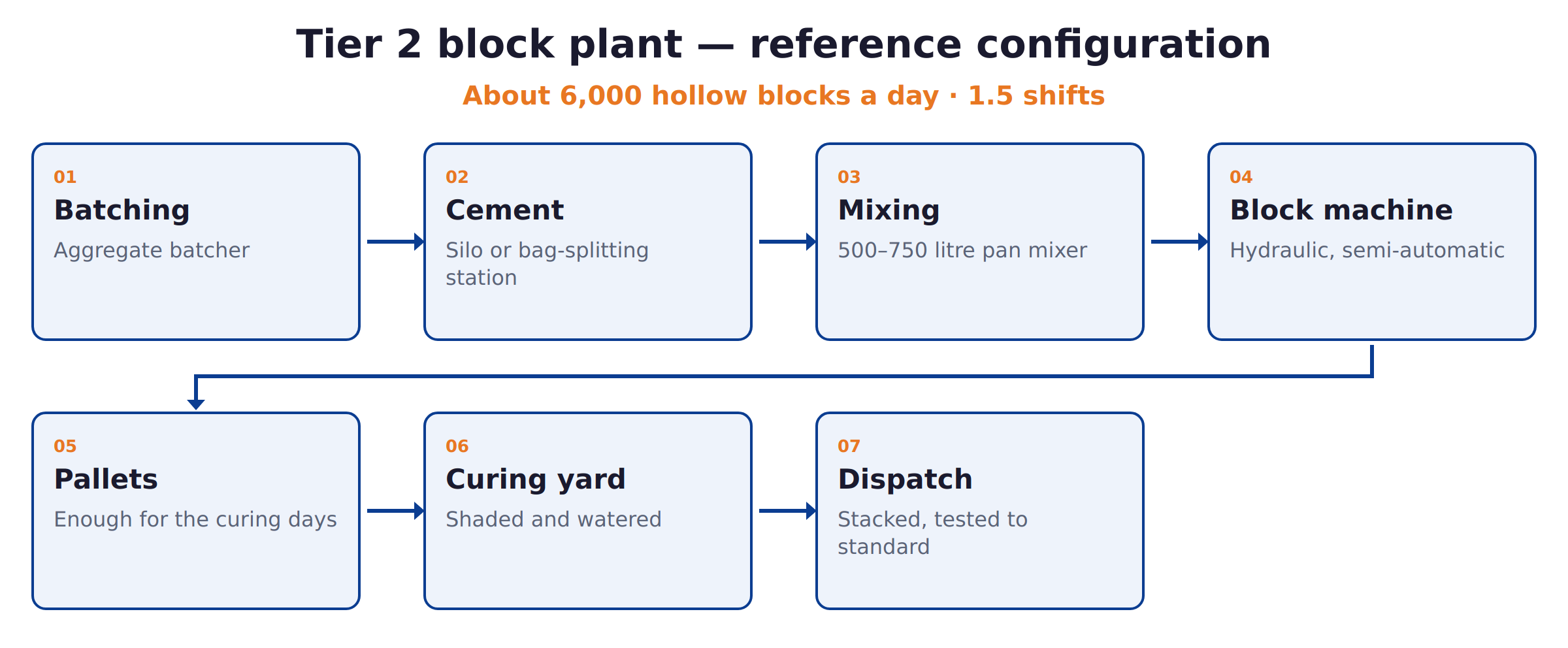
We supply semi-automatic and automatic block and paver plants, mixers, batching, block machines, moulds, pallet handling and curing, from audited factories in China, sized to your blocks a day. CISH ships to Lagos, clears, installs and commissions the plant on your materials, and trains your operators. For a manual or egg-laying machine, a local supplier is usually the better buy.