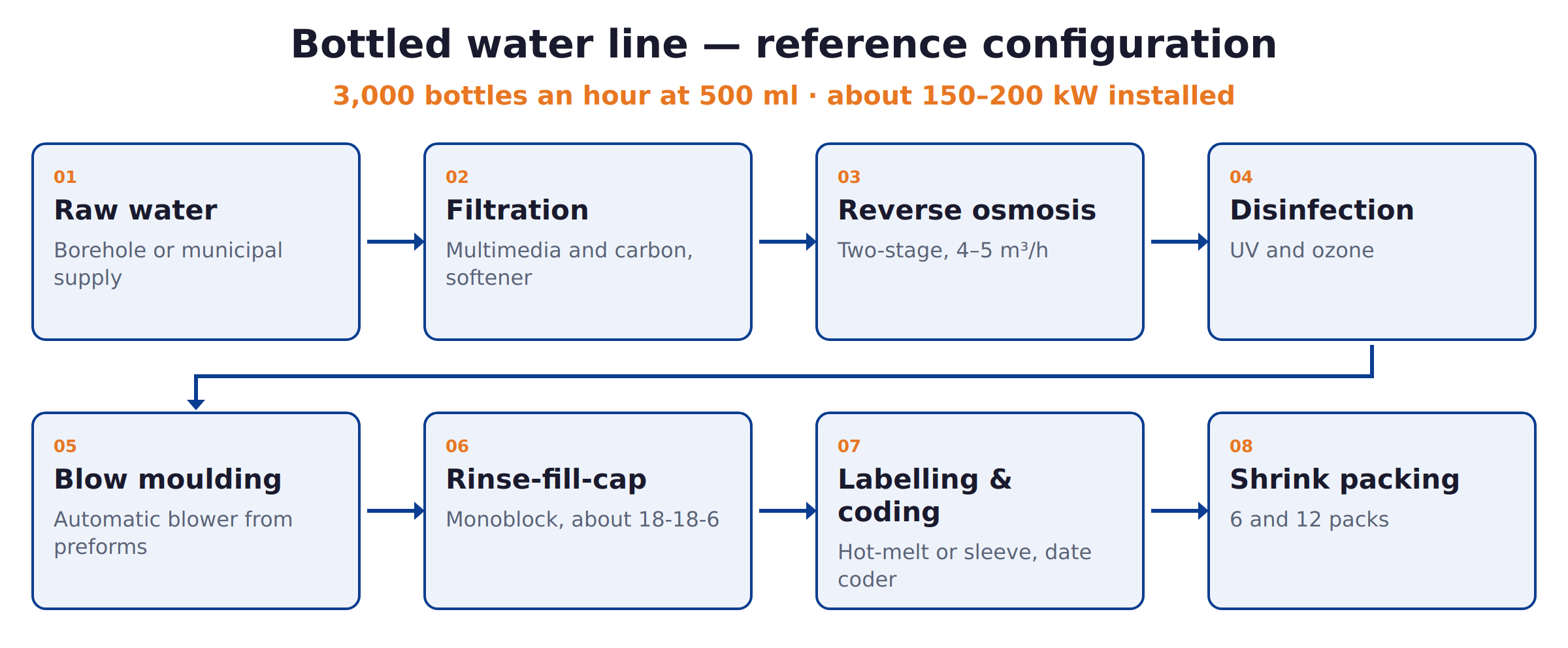
Bottled water needs more than a sachet machine: water treatment, a PET bottle blower or bought-in bottles, a rinse-fill-cap monoblock, labelling, date coding and shrink wrapping, in a clean filling room. Imports pay the ECOWAS tariff plus a 7% surcharge on the duty, the 1% CISS and 0.5% ETLS levies and 7.5% VAT, with Form M on the B'Odogwu portal. Power is the hidden cost: grid capacity was about 5.4 GW in 2025, so most plants run on generators. CISH supplies, installs and commissions complete water bottling lines in Nigeria.
Water bottling machine prices in Nigeria, 2026
| What you buy | Capacity | Indicative price (2026) |
|---|---|---|
| Sachet water machine | Local market | Sold locally; a small part of a bottling project |
| Semi-automatic filler, capper or labeller | Small runs | About US$1,000–10,000 each |
| Rinse-fill-cap monoblock | 1,000–4,000 bottles an hour | About US$13,000–60,000 |
| Semi-automatic PET blower | 2 cavities | About US$3,500–15,000 ex-works |
| Automatic PET blower | 2–6 cavities | About US$20,000–95,000 ex-works |
| Complete line with treatment | 2,000–4,000 bottles an hour | About US$150,000–400,000 ex-works |
| Faster complete line | 6,000–12,000 bottles an hour | About US$400,000–900,000 ex-works |
Machines are priced in US dollars here because the naira moves; check the exchange rate on the day you pay.
From sachet to table water: what changes
| Sachet water | Bottled table water | |
|---|---|---|
| Pack | Printed LDPE sachet, usually 50 cl | PET bottle with cap and label |
| Machine | Form-fill-seal sachet machine | Blower or bottles, monoblock, labeller, coder, shrink wrapper |
| Filling room | Clean area | Enclosed, filtered air, controlled access |
| Customers | Hawkers, kiosks, homes | Supermarkets, restaurants, offices, events, hotels |
| Price per litre | Low | Higher |
| Logistics | Bags in bulk | Shrink-wrapped packs, cartons |
Both share the same treatment system, so many businesses run sachet and bottle lines side by side.
Water treatment comes first
Borehole water quality varies across Nigeria. Test your source for chemistry and microbiology before the line is designed. A typical system includes sand and carbon filters, softening where water is hard, reverse osmosis for high dissolved solids or salinity, and ozone or UV before filling, with stainless steel storage tanks. The treatment system must be sized for all lines that draw from it.
Make bottles or buy them?
- Buy preforms and blow your own bottles: cheaper per bottle at volume, but needs a blower, a high-pressure compressor, a chiller and moulds for each size.
- Buy ready-made bottles: no blower, but bottles take space and cost more to transport.
Most plants above about 2,000 bottles an hour blow their own.
Importing into Nigeria
| Charge | 2026 basis |
|---|---|
| Import duty | ECOWAS CET band for the HS code |
| Surcharge | 7% of the import duty |
| CISS | 1% of FOB value |
| ETLS | 0.5% of CIF value |
| VAT | 7.5% |
| Form M | Opened on the B'Odogwu portal before shipment |
The Federal Ministry of Information reported that the 4% FOB charge was suspended after stakeholder engagement. Confirm the HS code for each machine at quotation.
Power and running costs
NERC's third-quarter 2025 report put available grid capacity at about 5.4 GW for the whole country, and the Manufacturers Association estimated factories spent around ₦1.4 trillion on their own power in 2025. Blowers and their compressors are the largest loads, followed by RO pumps and chillers. Size the generator for starting current, choose efficient compressors, and include diesel or gas in your cost per bottle.
NAFDAC registration
NAFDAC regulates packaged water among the products under its mandate. Every product and pack size needs registration, and your plant will be inspected. Plan laboratory tests, a hygienic filling room, staff health checks and records from the start.
Worked example: a sachet business in Ogun adds bottles
A sachet water business in Ogun State sells pure water to hawkers and kiosks. Supermarkets and an events company ask for 75 cl bottles. The owner upgrades the treatment with RO and ozone, adds a two-cavity automatic blower with a compressor and chiller, a monoblock of about 2,000 bottles an hour, a labeller, a coder and a shrink wrapper in a new enclosed filling room, and applies for NAFDAC registration of the bottled product. A larger generator is installed for the blower. The sachet line continues alongside. The figures are illustrative.
Cost per bottle
Add the preform or bottle, cap, label and shrink film, treated water including RO reject, diesel or gas for the generator, grid power when it is available, labour, filters and chemicals, laboratory tests, distribution, rent and loan repayments. At current lending rates, finance costs can be a large part of the price per bottle in the first years, so size the line to the orders you have. Price your packs against the shelf prices of established brands in the supermarkets and outlets you will supply, and remember that distributors need a margin too.
Distribution decides the business
Bottled water is heavy and cheap per litre, so most sales stay within a few hours' drive of the plant. Plan delivery vehicles, a depot or distributor network, and the payment terms supermarkets and distributors expect. A plant that makes more than it can deliver ties up cash in stock.
How to compare quotes
- Bottles per hour for each size.
- Treatment capacity in litres per hour.
- Blower cavities, compressor pressure and chiller.
- Monoblock heads for rinsing, filling and capping.
- Labeller, coder and shrink wrapper speeds.
- Connected load and generator size.
- Moulds and change parts for each bottle.
- Installation, commissioning on your water, and training.
- Spares: valves, seals, heaters, belts.
- References of plants in West Africa.
Choose by situation
- Sachet business adding bottles: a monoblock with bought-in bottles first.
- Growing table water brand: blower, monoblock and labeller at 2,000–4,000 bottles an hour.
- Regional brand: 6,000–12,000 bottles an hour with full automation.
What we see in Nigeria
- Sachet water is the entry point for many water businesses.
- Table water sells to supermarkets, offices and events.
- Generators run most plants.
- Credit is expensive: the maximum lending rate was around 33% in mid-2026.
- NAFDAC registration is needed for each product.
- Form M on B'Odogwu comes before shipment.
Where CISH fits
We supply complete water bottling lines, treatment, blowing, filling, capping, labelling and packing, from audited factories in China, sized to your bottles and output. CISH ships to Lagos, clears, installs and commissions the line on your water, and trains your team. For a single sachet machine, a local dealer is usually the better buy.