Both need a reliable, tested water source, treatment that produces safe water every day, a hygienic filling room, and approval from KEBS, whose Standardization Mark buyers expect on packaged water, plus county public health and business permits and, for boreholes, a water permit. Imported equipment usually pays 0% EAC duty but 16% VAT, a 2.5% Import Declaration Fee and a 2% Railway Development Levy. Electricity carries a fuel energy cost charge, so energy use matters from day one.
Step 1: Choose your business model
| Refill and 20-litre business | PET bottling plant | |
|---|---|---|
| Packs | 18.9 or 20-litre returnable bottles; dispensers | 300 ml, 500 ml, 1 L, 1.5 L PET bottles |
| Customers | Homes, offices, schools, refill shops | Shops, supermarkets, events, hotels, distributors |
| Equipment | Treatment, bottle washer, filler, capper | Treatment, blower or bought bottles, monoblock, labeller, coder, shrink wrapper |
| Investment | Lower | Higher |
| Distribution | Delivery vans and bottle returns | Distributors, retail listings |
Many businesses start with 20-litre refills and add PET bottles once they have customers and approvals.
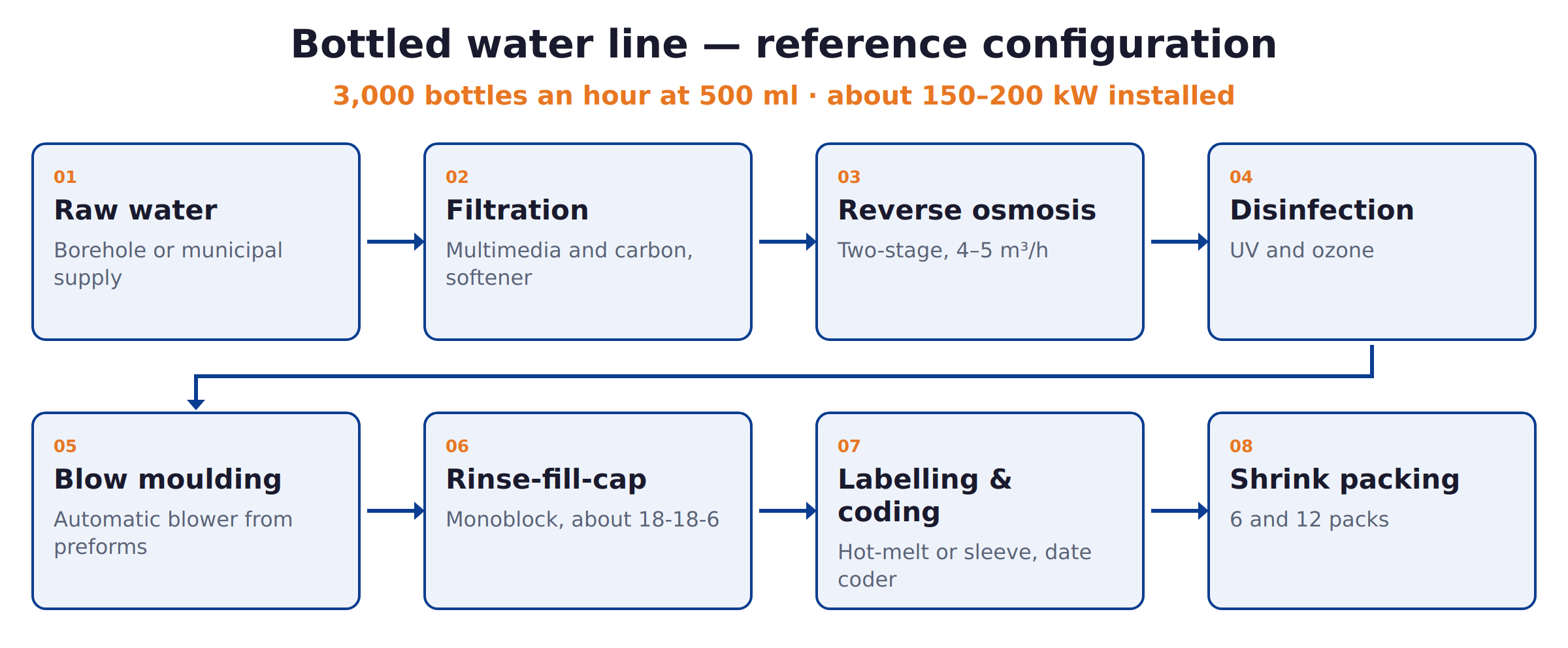
Step 2: Secure and test the water source
Your water may come from the municipal supply, a borehole or a spring. Test it at an accredited laboratory for chemistry, including fluoride, hardness and dissolved solids, and for microbiology, before you design treatment. Borehole water in many parts of Kenya needs reverse osmosis or defluoridation. Drilling and abstracting from a borehole needs a permit from the Water Resources Authority; apply early.
Step 3: Get the approvals
| Approval | Issued by | What it covers |
|---|---|---|
| Business registration and KRA PIN | Business Registration Service, KRA | Company and tax |
| County business permit | Your county | Trading at the premises |
| Public health licence | County public health department | Food premises hygiene |
| Water permit | Water Resources Authority | Borehole abstraction |
| Environmental requirements | NEMA | Effluent and waste |
| KEBS Standardization Mark | KEBS | Product testing and plant inspection for packaged water |
Fees and timelines differ, so confirm each with the issuing body before you set an opening date.
Step 4: Plan the plant
- Treatment room: filters, softener, RO, remineralisation, ozone or UV, storage tanks.
- Filling room: enclosed, washable, with controlled access and air filtration.
- Bottle handling: washing for returnables, blowing or storage for PET.
- Packing and storage: shrink wrapping, pallets, a cool dry warehouse.
- Laboratory: daily checks of treated water and product.
- Utilities: a stable three-phase supply, compressed air for blowers, drainage.
Step 5: Equipment and costs
| Purchase | Capacity | Indicative price (2026) |
|---|---|---|
| Semi-automatic filler, capper or labeller | Small output | About US$1,000–10,000 each |
| Rinse-fill-cap monoblock | 1,000–4,000 bottles an hour | About US$13,000–60,000 |
| Complete PET line with treatment | 2,000–4,000 bottles an hour | About US$150,000–400,000 ex-works |
Our water bottling machine price guide breaks the equipment down further. Imported equipment usually enters at 0% EAC duty, with 16% VAT, the 2.5% Import Declaration Fee and the 2% Railway Development Levy, and regulated goods need KEBS pre-export verification before shipment. Budget landed and installed costs of about 1.25–1.45 times ex-works for coastal sites, more inland.
Step 6: Work out cost per bottle
Add the cost of treated water (including RO rejection and power), the bottle or preform, cap, label and shrink film, labour, electricity for blowers, compressors and pumps, distribution, rent and loan repayments. EPRA's fuel energy cost charge was about KES 3.5 per kWh in August 2026, on top of Kenya Power's base tariff, so energy is not a small item for a PET plant. For 20-litre bottles, include bottle losses and the cost of collecting empties.
Step 7: Sell and deliver
Water is bulky, so most sales are local. Refill businesses win on reliable delivery and clean bottles; PET brands win on distribution, shelf price and approvals. Supermarkets and institutions ask for the KEBS mark, consistent supply and invoices with VAT.
Worked example: a refill business adding bottles
A refill business in Kisumu sells 20-litre bottles to homes and offices. It holds the KEBS mark for its refills, a county public health licence and a water permit for its borehole. To sell 500 ml bottles to shops, it adds a clean filling room, buys preforms and a semi-automatic blower at first, then installs a monoblock and labeller. Six months later, with steady orders, it replaces the semi-automatic blower with an automatic one. The figures are illustrative.
Choosing a location
A water plant needs a reliable source, a three-phase power supply, drainage for RO reject water and wash water, road access for delivery vans, and space for empty bottles and stock. Being close to your customers saves transport on a heavy product; many refill businesses locate in residential and commercial neighbourhoods, while PET plants often sit in industrial areas with better power and access.
Staffing and hygiene
Train staff in hygiene, bottle inspection and the daily treatment checks, and keep records of filter changes, RO performance, UV or ozone operation and laboratory tests. Inspectors and customers will ask for them.
Growing the business
Start with the product your source, approvals and delivery can support, and grow in steps: more 20-litre bottles and a second delivery van, then PET bottles with bought-in bottles, then your own blower and a faster monoblock. Each step should be paid for by steady orders, not expected ones.
Common mistakes
- Buying equipment before testing the water.
- Filling in an open room.
- Selling before KEBS approval.
- No water permit for a borehole.
- Ignoring electricity costs in the price per bottle.
- Too few delivery vehicles for the plant's output.
What we see in Kenya
- Refill water is a large, competitive market.
- PET bottles serve shops, events and supermarkets.
- KEBS approval is expected for packaged water.
- Borehole water often needs RO or defluoridation.
- Capital goods usually enter duty-free under the EAC CET, but VAT, the IDF and the RDL apply.
- PVoC comes before shipment for regulated goods.
- Electricity includes a fuel energy cost charge of about KES 3.5 per kWh in August 2026.
- County permits differ, so check locally.
Where CISH fits
We supply complete water bottling plants, treatment, bottle handling, filling, capping, labelling and packing, from audited factories in China, sized to your packs and volumes. CISH ships to Mombasa, clears, installs and commissions the plant on your water, and trains your team. Permits and KEBS approval are applied for by the business owner.