Either way it needs a tested borehole or other source, treatment that makes safe water every day, a clean filling room, a local authority health permit, and certification against the Zimbabwean standard for packaged water through the Standards Association of Zimbabwe, which supermarkets expect. Imported lines come from Durban through Beitbridge, landed at about 1.45–1.60 times ex-works; regulated goods need a CBCA certificate before loading, and import VAT is 15.5% from January 2026. Power has been steadier in 2026, but blowers and compressors still need backup. CISH supplies, installs and commissions complete water bottling plants in Zimbabwe.
Step 1: choose your product
| 20-litre refills | PET bottles | |
|---|---|---|
| Packs | 18.9 or 20-litre returnable bottles, dispensers | 500 ml, 750 ml, 1 L, 1.5 L |
| Customers | Homes, offices, clinics, schools | Shops, supermarkets, filling stations, events |
| Equipment | Treatment, bottle washer, filler, capper | Treatment, blower or bought bottles, monoblock, labeller, coder, shrink wrapper |
| Investment | Lower | Higher |
| Logistics | Delivery routes and bottle returns | Distributors and retail listings |
Step 2: the borehole and treatment
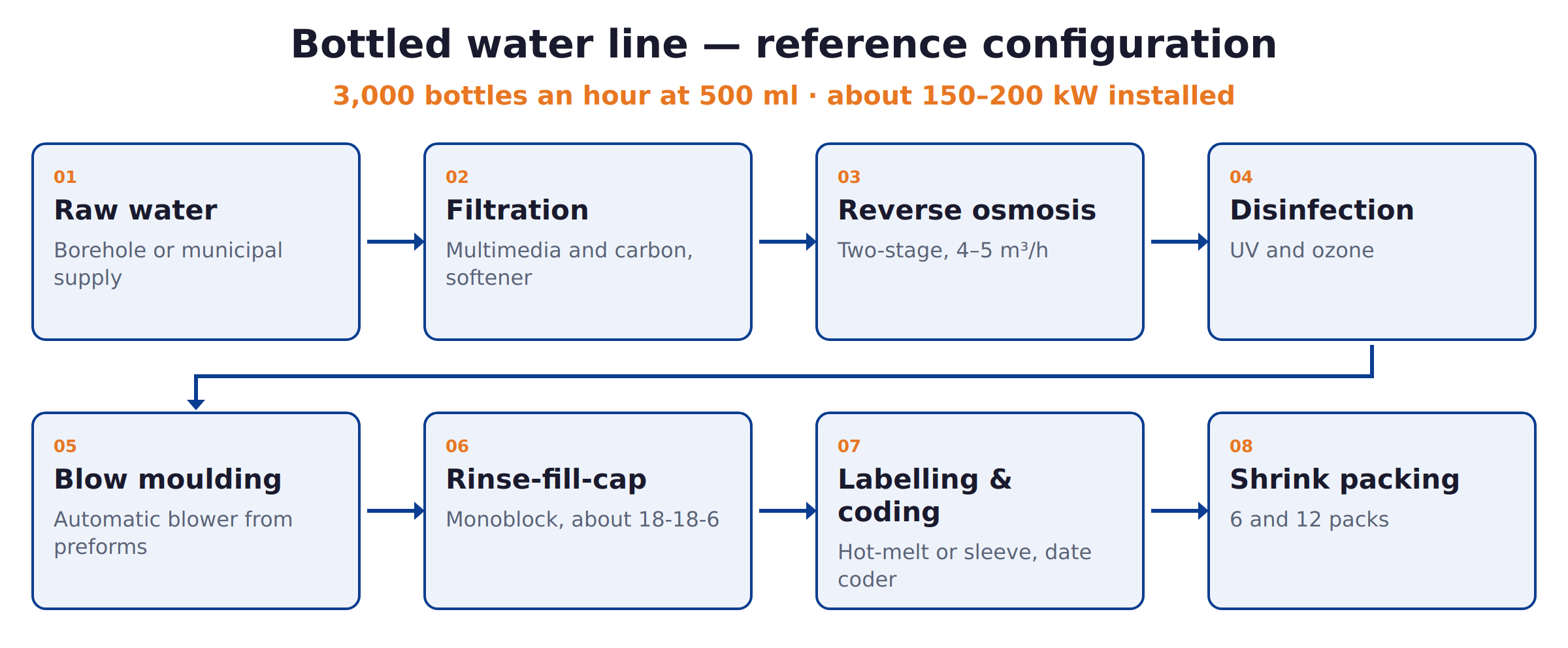
Most bottlers drill a borehole. Test the water at an accredited laboratory before designing treatment; hardness, iron, nitrate and microbiology vary by area. Check what water permit applies with the Zimbabwe National Water Authority. A typical system includes sand and carbon filters, softening or reverse osmosis where needed, micron filters, and ozone or UV before filling, with stainless storage.
Step 3: approvals
- Company registration and tax registration with ZIMRA.
- Local authority permits and health inspection of the premises and staff.
- SAZ certification of the product against the packaged drinking water standard; supermarkets ask for it.
- Water permit for the borehole where required.
Keep records of water tests, filter changes, UV or ozone operation and cleaning.
Step 4: equipment and costs
| What you buy | Capacity | Indicative price (2026) |
|---|---|---|
| Semi-automatic filler, capper or labeller | Refills and small runs | About US$1,000–10,000 each |
| Rinse-fill-cap monoblock | 1,000–4,000 bottles an hour | About US$13,000–60,000 |
| Semi-automatic PET blower | 2 cavities | About US$3,500–15,000 |
| Automatic PET blower | 2–6 cavities | About US$20,000–95,000 |
| Complete line with treatment | 2,000–4,000 bottles an hour | About US$150,000–400,000 ex-works |
| Faster line | 6,000–12,000 bottles an hour | About US$400,000–900,000 ex-works |
Our bottling line sizing guide shows how to match speed to sales.
Step 5: power
The Herald reported that by late October 2026 Zimbabwe had gone 304 days without scheduled load-shedding. Faults and maintenance still cause outages, and blowers, high-pressure compressors and RO pumps are heavy loads. Size a generator or solar system for the treatment and filling sections at least, and include energy in your cost per bottle.
Step 6: importing into Zimbabwe
| Item | 2026 basis |
|---|---|
| Payments at import | Duty, surtax where applicable, and VAT, per the Tariff Handbook |
| VAT | 15.5% from 1 January 2026 |
| CBCA | Pre-shipment certificate for regulated goods; 12% of CIF penalty without it |
| Route | Durban, then road through Beitbridge |
| Landed factor | About 1.45–1.60 times ex-works |
Plan the CBCA inspection together with the factory test so the certificate is ready before the line is crated. Our Zimbabwe import guide explains the sequence.
Step 7: cost per bottle and selling
Add bottles or preforms, caps, labels, film, treated water including RO reject, power and fuel, labour, filters and chemicals, tests, delivery, rent and finance. For refills, add bottle losses and collection. Prices are commonly quoted in US dollars; price your packs against those on the shelf and leave room for retailer and distributor margins.
Worked example: a refill business in Harare adds PET
A business in Harare delivers 20-litre refills to homes and offices from a borehole with RO and UV. Supermarkets and filling stations ask for 500 ml bottles. The owner adds an enclosed filling room, a two-cavity automatic blower with a compressor, a monoblock of about 2,000 bottles an hour, a labeller and a shrink wrapper, with solar and a generator for the blower. She gets the bottled product certified by SAZ and arranges the CBCA certificate before the line is shipped from China. The figures are illustrative.
From a delivered project: A 12,000 bottles-an-hour PET water line combined filling, blowing and labelling from China with locally fabricated steelwork and a local water-treatment specialist under one project lead; it landed at about US$850,000, six to eight weeks faster than a fully imported line, with more than 40% local content. Read the hybrid bottling line case study.
Common mistakes
- Skipping the borehole test.
- Filling in an open room.
- Shipping without CBCA, and paying 12% of CIF.
- Selling before SAZ certification to supermarkets.
- No backup for the blower and compressor.
What we see in Zimbabwe
- Boreholes supply most bottlers.
- 20-litre refills are a large market in towns.
- PET bottles sell in shops, supermarkets and filling stations.
- SAZ certification is expected by retailers.
- Power was steadier in 2026.
- CBCA and 15.5% VAT apply to imported lines.
Water quality in Zimbabwean boreholes
Boreholes in and around Zimbabwe's towns can carry hardness, iron, nitrate or bacteria, especially where septic tanks and boreholes are close together. Test the source before designing treatment, and test again after the rainy season. Locate the borehole away from septic tanks and drains, protect the wellhead, and disinfect storage tanks regularly. A treatment system designed for the actual water, with records of every check, is the basis of SAZ certification and customer trust.
Distribution and pricing
Most bottled water reaches customers through shops, supermarkets, filling stations, delivery routes and events. Agree prices and margins with distributors, plan delivery routes, and keep stock for weekends and holidays. Refill customers value reliable delivery more than a small price difference.
Hygiene in the filling room
Keep the filling room enclosed and clean, with washable surfaces, a hand-wash point and controlled access. Staff should wear clean clothing, hairnets and gloves. Sanitise fillers, tanks and pipes on a schedule, inspect returned 20-litre bottles before washing, and keep cleaning records for inspectors and SAZ.
Records for inspectors
Keep daily records of water tests, filter changes, UV or ozone operation, cleaning and batch codes; inspectors and SAZ ask for them first.
Delivery vehicles
Plan enough vans or trucks for refill routes and retail deliveries, and keep them clean.
Where CISH fits
We supply complete water bottling plants, treatment, bottle washing or blowing, filling, capping, labelling and packing, from audited factories in China, sized to your packs and volumes. CISH arranges CBCA with our factory test, ships through Durban and Beitbridge, clears, installs and commissions the plant on your water, and trains your team. Approvals and permits are applied for by the business owner.