Both need a tested water source, often a borehole, treatment that makes safe water every day, a clean filling room, and approval of the product against Zambian standards through ZABS, plus local authority health permits and, for a borehole, the right water permit. Because Zambia is landlocked, imported lines cost about 1.45–1.60 times ex-works landed and installed, through Dar es Salaam, Durban, Walvis Bay or Beira. Most capital equipment falls in the 0–5% duty band, with 16% import VAT. Power improved in 2026, but blowers and compressors are heavy loads, so plan backup.
Step 1: choose your product
| 20-litre refills | PET bottles | |
|---|---|---|
| Packs | 18.9 or 20-litre returnable bottles, dispensers | 500 ml, 750 ml, 1 L, 1.5 L |
| Customers | Homes, offices, schools, clinics | Shops, supermarkets, filling stations, events, hotels |
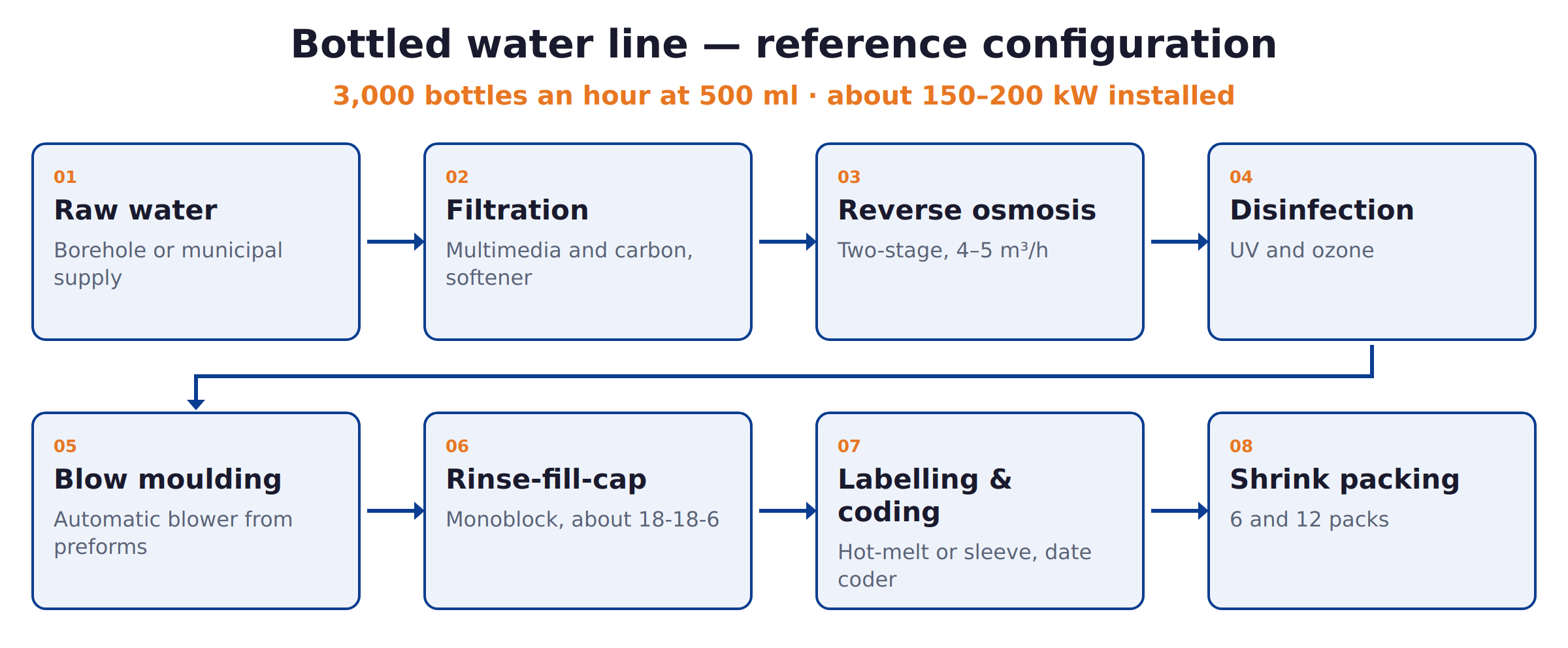
| Equipment | Treatment, bottle washer, filler, capper | Treatment, blower or bought bottles, monoblock, labeller, coder, shrink wrapper |
| Investment | Lower | Higher |
| Logistics | Delivery and bottle returns | Distributors and retail listings |
Many businesses start with refills and add PET once approvals and customers are in place.
Step 2: secure and test the water
Most bottlers in Zambia use borehole water. Test it at an accredited laboratory for chemistry and microbiology before designing treatment; hardness, iron and dissolved solids vary by area. Check what water permit applies to your borehole with the Water Resources Management Authority. Plan storage tanks so production continues when pumping stops.
Step 3: approvals
- Company registration and tax registration.
- Local authority permits for the premises, including health inspection.
- ZABS: bottled water should be tested and certified against the Zambian standard for packaged drinking water; supermarkets expect it.
- Water permit for borehole abstraction where required.
Keep records of water tests, filter changes and cleaning from day one.
Step 4: equipment and costs
| What you buy | Capacity | Indicative price (2026) |
|---|---|---|
| Semi-automatic filler, capper or labeller | Small runs and refills | About US$1,000–10,000 each |
| Rinse-fill-cap monoblock | 1,000–4,000 bottles an hour | About US$13,000–60,000 |
| Semi-automatic PET blower | 2 cavities | About US$3,500–15,000 |
| Automatic PET blower | 2–6 cavities | About US$20,000–95,000 |
| Complete line with treatment | 2,000–4,000 bottles an hour | About US$150,000–400,000 ex-works |
| Faster line | 6,000–12,000 bottles an hour | About US$400,000–900,000 ex-works |
Our bottling line sizing guide shows how to match speed to demand.
Step 5: power
Blowers, high-pressure compressors and RO pumps are the largest loads. ZESCO said in June 2026 that nationwide load management was not expected to return this year, helped by a larger 2026 Kariba allocation, but bottlers remember the long cuts of 2024. Choose efficient compressors, size a generator or solar system for critical loads, and include energy in your cost per bottle.
Step 6: importing into Zambia
| Item | 2026 basis |
|---|---|
| Duty | Mostly in the 0–5% band for capital equipment |
| VAT | 16% on customs value plus duty |
| Valuation | CIF basis |
| Standards | ZABS for regulated goods |
| Corridor | Dar es Salaam, Durban, Walvis Bay or Beira |
| Landed factor | About 1.45–1.60 times ex-works |
Our Zambia import guide explains the corridor choice.
Step 7: cost per bottle and selling
Add the preform or bottle, cap, label and film, treated water including RO reject, power and fuel, labour, filters and chemicals, tests, delivery, rent and loan repayments. For refills, add bottle losses and collection. Sell through shops, supermarkets and filling stations for PET, and through delivery routes to homes and offices for refills. Water is heavy, so most sales are local.
Worked example: a refill business in Ndola adds PET
A business in Ndola delivers 20-litre refills to offices and homes from a borehole with RO and UV. Filling stations and a supermarket ask for 500 ml bottles. The owner adds an enclosed filling room, a two-cavity automatic blower with a compressor, a monoblock of about 2,000 bottles an hour, a labeller and a shrink wrapper, with a generator for the blower, and gets the bottled product certified by ZABS before listing. The figures are illustrative.
From a delivered project: A 12,000 bottles-an-hour PET water line combined filling, blowing and labelling from China with locally fabricated steelwork and a local water-treatment specialist under one project lead; it landed at about US$850,000, six to eight weeks faster than a fully imported line, with more than 40% local content. Read the hybrid bottling line case study.
Common mistakes
- No water test before buying treatment.
- Filling in an open room.
- Selling before certification.
- A blower without enough compressor or backup power.
- Too few delivery vehicles.
What we see in Zambia
- Borehole water supplies most bottlers.
- 20-litre refills serve homes and offices.
- PET bottles sell through shops, supermarkets and filling stations.
- ZABS certification is expected by supermarkets.
- Power improved in 2026, but backup remains wise.
- Every imported line crosses at least one border, which shapes the schedule and cost.
Water quality in Zambian boreholes
Borehole water quality varies widely across Zambia. Some areas have hard water that scales equipment, some have iron or manganese that stains and tastes, and some have high nitrate near farms or pit latrines. A laboratory test of the actual borehole tells you whether you need softening, iron removal, reverse osmosis or only filtration and disinfection. Testing again after a few months, and after heavy rains, shows whether the source changes with the seasons.
Building a delivery business
For 20-litre refills, the business is in delivery: a reliable schedule, clean bottles, dispensers that work and quick replacement of empties. Offices, schools and clinics often sign monthly orders, which gives steady volume. Track bottles in the market and bottles returned, charge deposits, and inspect every returned bottle before washing and refilling.
Hygiene in the filling room
The filling room is where water is most at risk. Keep it enclosed, with washable surfaces, filtered air if possible, and a hand-wash point at the entrance. Staff should wear clean clothing, hairnets and gloves, and only people who work there should enter. Clean and sanitise fillers, tanks and pipes on a schedule, and keep the records for inspectors and ZABS.
Records for inspectors
Keep daily records of water tests, filter changes, UV or ozone operation, cleaning and batch codes; they are the first thing inspectors and buyers ask for.
Where CISH fits
We supply complete water bottling plants, treatment, bottle washing or blowing, filling, capping, labelling and packing, from audited factories in China, sized to your packs and volumes. CISH ships through the corridor that suits the season, clears, installs and commissions the plant on your water, and trains your team. Approvals and permits are applied for by the business owner.