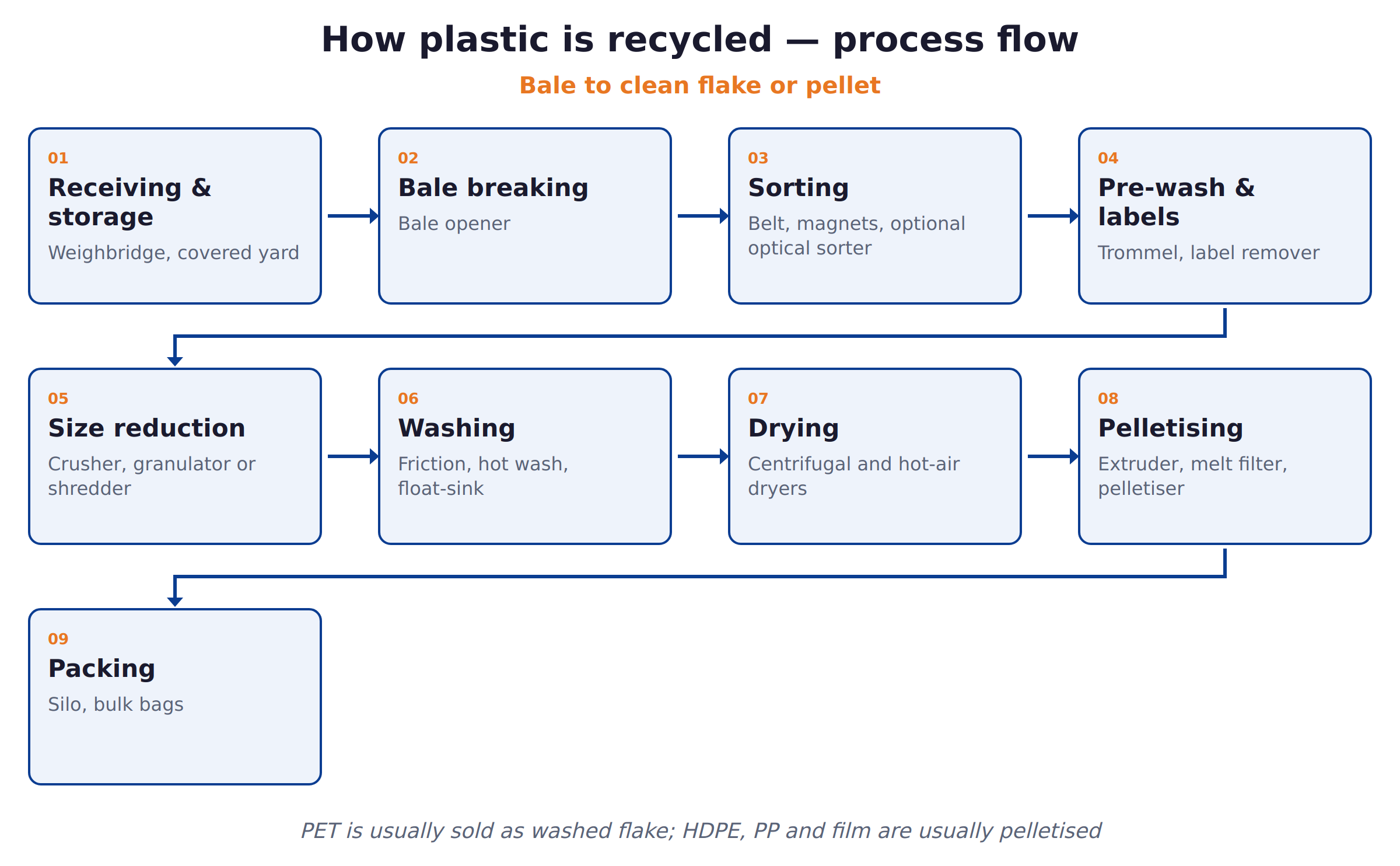
First, collection and baling: buying PET bottles, HDPE containers and other plastics from collectors and households, sorting them by type and colour and baling them for sale to recyclers in Zimbabwe or South Africa. Second, washing: shredding, washing, separating and drying plastic into clean flakes, on a washing line of about 300–1,000 kg an hour costing about US$120,000–350,000 ex-works, or a PET line of about 500 kg an hour at about US$150,000–200,000, as an indication for 2026. Third, pelletising: melting flakes or film into pellets for bag, film and moulding factories, for about US$80,000–120,000 more. Clean sorted bottle bales often yield in the region of 70–85% clean flakes. Waste handling and recycling are overseen by the Environmental Management Agency, so check which licence your site needs before you start. Imported lines come from Durban through Beitbridge, landed at about 1.45–1.60 times ex-works; regulated goods need a CBCA certificate before loading, and import VAT is 15.5% from January 2026.
The three stages
| Stage | What you do | Equipment | Indicative investment (2026) | Who buys |
|---|---|---|---|---|
| 1. Collection and baling | Buy, sort, bale | Yard, scales, baler | Mostly working capital | Recyclers in Zimbabwe and South Africa |
| 2. Washing | Shred, wash, separate, dry | Washing line | About US$120,000–350,000 for 300–1,000 kg/h; PET about US$150,000–200,000 for 500 kg/h | Converters, exporters |
| 3. Pelletising | Melt and filter into pellets | Pelletiser | About US$80,000–120,000 more | Bag, film, pipe and moulding factories |
Stage 1: collection
Collection depends on informal collectors, households, schools, businesses and landfill pickers. Set up buy-back points, pay fairly and quickly on honest scales, and sort by polymer and colour: clear PET, coloured PET, natural HDPE, coloured HDPE, PP and film. Clean, dry, well-sorted bales earn more. Transport is a large cost, so bale tightly and fill trucks.
Stage 2: washing
A washing line removes labels, caps, glue and dirt: shredding, pre-washing, hot or friction washing, float-sink separation and drying. Washing needs a reliable water supply and effluent treatment so water can be reused. Clean sorted bottle bales often yield in the region of 70–85% clean flakes, depending on contamination.
Stage 3: pelletising
Pellets are easier to sell to local converters than flakes, and travel better if you export. Pelletising uses more power and needs skilled operators. Our recycling and bag machine guide shows how recycled pellets become bags and film.
Licences and the environment
The Environmental Management Agency oversees waste management and environmental licensing in Zimbabwe. Before you lease a site, check with EMA which licence your collection, storage, washing or pelletising activity needs, and what is required for wash water, storage of bales and fire safety. Local authority permits also apply.
Power
Shredders, friction washers, dryers and extruders are heavy loads. The Herald reported 304 days without scheduled load-shedding by late October 2026, but faults still cause outages; plan a generator for the line and include energy in your cost per tonne.
Importing a line into Zimbabwe
| Item | 2026 basis |
|---|---|
| Payments at import | Duty, surtax where applicable, and VAT, per the Tariff Handbook |
| VAT | 15.5% from 1 January 2026 |
| CBCA | Pre-shipment certificate for regulated goods; 12% of CIF penalty without it |
| Route | Durban, then road through Beitbridge |
| Landed factor | About 1.45–1.60 times ex-works |
Our Zimbabwe import guide explains CBCA sequencing.
Who buys
- Recyclers and exporters buy bales, including buyers across the border in South Africa.
- Local converters buy flakes and pellets for bags, film, pipes and household goods.
- Your own products: some recyclers add a bag or film line to use their pellets.
Agree specifications and prices in writing: polymer, colour, moisture, contamination and packing.
The numbers
At each stage: price of what you sell minus material, losses, labour, power, water, transport and finance. Transport to buyers is significant in a landlocked country, so washing and pelletising locally can save freight by selling a lighter, more valuable product.
Worked example: a buy-back centre in Bulawayo
A buy-back centre in Bulawayo collects about 80 tonnes a month of plastics and sells PET bales to a recycler in South Africa, paying trucking through Beitbridge. It sorts clear PET and natural HDPE, checks its licence requirements with EMA, and installs a 500 kg/h washing line with water treatment and a generator, arranging the CBCA certificate before the line ships. It sells HDPE flakes to a local moulder and PET flakes for export. The figures are illustrative.
Common mistakes
- Mixed, dirty bales nobody wants.
- A washing line before collection is steady.
- No water treatment.
- Ignoring licence requirements.
- No signed buyer for flakes or pellets.
What we see in Zimbabwe
- Collectors and buy-back points drive collection.
- Many bales go to South Africa for recycling.
- Local washing and pelletising can save freight.
- EMA oversees waste and environmental licensing.
- Power was steadier in 2026, with occasional faults.
- CBCA and 15.5% VAT apply to imported lines.
Working with collectors and communities
Informal collectors, often among the poorest people in a town, collect much of Zimbabwe's recyclable plastic. A recycler that pays fairly and promptly, keeps the buy-back point safe, and explains what earns a better price will receive more and cleaner material. Partnerships with schools, businesses, churches and residents' associations can add steady volumes of sorted bottles and containers.
Safety and fire
Plastic bales and flakes burn fiercely. Store bales in rows with space between them, keep the yard clean, keep fire extinguishers and water on site, and keep fuel and the generator away from stock. Guard shredders and conveyors, and give workers gloves, boots and eye protection.
Selling across the border
When bales or flakes go to buyers in South Africa, plan documents, transport and border time, and agree who pays which costs. Prices are usually per tonne delivered, with deductions for moisture and contamination, so weigh and inspect before dispatch.
Choosing a site
A recycling yard needs space for bales and sorting, a covered area for washing and pelletising, water and drainage, three-phase power, and road access for trucks. Check zoning with the local authority and licence requirements with EMA before you sign a lease, because a site that cannot be licensed is a costly mistake.
Records and pricing
Record weights bought from each collector, weights sold, losses in washing and prices, so you know your real margin per tonne and which streams pay.
Staff
Train sorters to recognise polymers and colours, and machine operators to run shredders and washers safely.
Where CISH fits
We supply complete washing and pelletising lines, shredding, washing, separation, drying, water treatment and extrusion, from audited factories in China, sized to your stream. CISH arranges CBCA with our factory test, ships through Durban and Beitbridge, clears, installs and commissions the line on your material, and trains your team. For a baler or single shredder, a local supplier is usually the better buy.