Palm oil in Ghana is produced at every scale, from women's processing groups boiling and pounding fruit in villages, to small mills with a thresher, digester and screw press, to industrial mills beside plantations. Oil comes to roughly a fifth of bunch weight, depending on fruit and mill, and kernels are a second product. Quality earns the price: fresh fruit, clean processing, no added colouring and dry, clean storage. Bottled palm oil sold in shops must be registered with the Food and Drugs Authority. Imported mills pay the ECOWAS CET, mostly 5%, plus the combined 20% VAT, NHIL and GETFund from January 2026. CISH supplies, installs and commissions complete palm oil mills.
Three scales of palm oil business
| Scale | Equipment | Output | Who buys |
|---|---|---|---|
| Village processing | Boiling drums, pounding or a small digester, hand pressing | Small batches | Local markets, neighbours |
| Small mill | Thresher, steriliser, digester, screw press, clarification tanks | About 1–5 t of bunches an hour | Market traders, soap makers, food vendors, bottled oil for shops |
| Industrial mill | Full mill with boilers, kernel plant, effluent treatment | 10 t/h and up | Refiners, food manufacturers, exporters |
Step 1: fruit supply
A mill lives on fresh fruit bunches delivered the same or next day after harvest. Fruit that waits bruises and develops free fatty acids, which lowers oil quality and price. Build relationships with farmers and farmer groups, agree prices and collection days, weigh fairly and pay quickly. In the peak season fruit is plentiful and cheap; in the lean months mills compete for it, so plan for lower throughput.
Step 2: choose your equipment
| What you buy | Capacity | Indicative price (2026) |
|---|---|---|
| Single machines | Small | About US$950–29,000 each; small machines around US$1,500 |
| Complete small mill | About 1–5 t of bunches an hour | About US$100,000–390,000 |
| Industrial mill | 10 t/h and up | From about US$1.7 million |
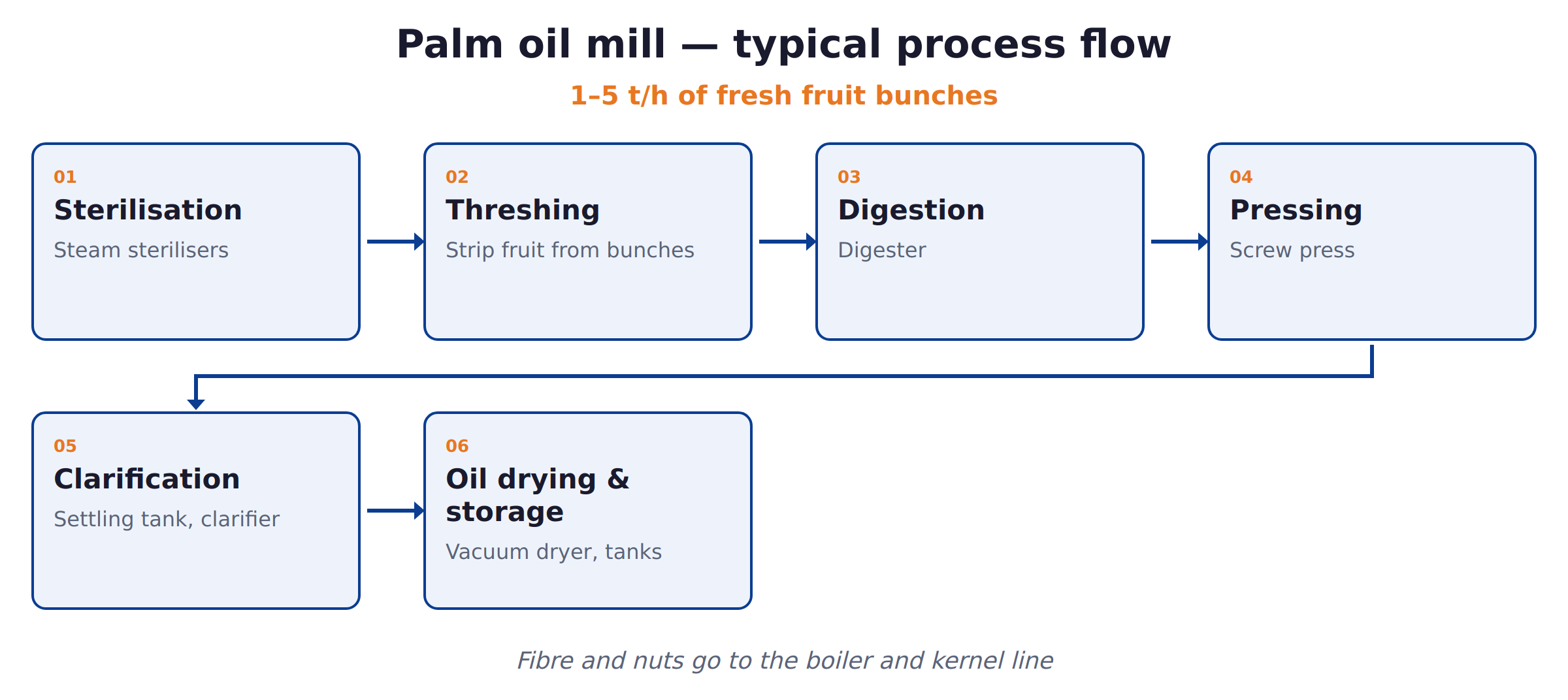
A complete small mill typically includes bunch reception, sterilisation with steam, a thresher, a digester, a screw press, clarification and settling tanks, a nut and fibre separator, a boiler fired with fibre and shells, and a nut cracker for kernels. Our palm oil machine price guide covers each stage. Ghanaian workshops make many small machines and handle repairs; our guide to machinery suppliers in Ghana explains where local and imported equipment fit.
Step 3: quality earns the price
- Process fruit fresh to keep free fatty acids low.
- Sterilise properly to stop enzymes that sour the oil.
- Clarify well so the oil is free of water and sludge.
- Never add dyes or colourants. Adulterated palm oil is a health risk, and buyers and regulators test for it.
- Store clean and dry in sealed drums or tanks out of the sun.
Buyers, especially food manufacturers, refiners and exporters, pay more for oil that meets their specification and comes with simple test records.
Step 4: register and package
Bulk oil sold in drums to traders is a commodity trade. Bottled red palm oil sold in shops and for export is a packaged food: register each product with the Food and Drugs Authority, label it with the product name, net volume, batch, dates and your address, and prepare for a premises inspection. Export buyers may ask for additional certificates and tests.
Step 5: kernels and by-products
Kernels from the nut cracker sell to kernel oil processors, or can be pressed into palm kernel oil for soap and cosmetics if you add a kernel press. Fibre and shells fire the boiler, and empty bunches can be composted or used as mulch.
Step 6: power, steam and effluent
The boiler that makes steam for sterilisation can burn fibre and shells. Presses, digesters and pumps need electricity or diesel engines; ECG reported in April 2026 that much of its distribution network was overloaded, so plan a generator. Mills produce effluent from sterilisation and clarification; build settling ponds or treatment well away from streams and homes.
Step 7: importing a mill
| Charge | 2026 basis |
|---|---|
| Import duty | ECOWAS CET; most machinery at 5% |
| VAT, NHIL and GETFund | Combined 20% from 1 January 2026 under Act 1151 |
| ECOWAS and AU levies | Small percentages on CIF value |
| Clearing | ICUMS at Tema |
Step 8: the numbers
Oil and kernel income minus fruit, transport, labour, fuel, maintenance, packaging and finance gives the margin. Throughput matters most: a mill that runs half-empty in the lean months still pays its staff and loans. Size the mill to the fruit you can secure across the year, not only in the peak.
Worked example: a processing group becomes a mill
A women's processing group in the Eastern Region produces red palm oil by hand for local markets. With a farmer co-operative supplying fruit, it installs a small mill of about 1.5 tonnes of bunches an hour with a steriliser, a thresher, a digester, a screw press, clarification tanks and a fibre-fired boiler. Oil quality improves and output rises; the group registers bottled red palm oil with the FDA for shops and sells kernels to a kernel oil processor. The figures are illustrative.
Common mistakes
- Fruit left too long before processing.
- Poor sterilisation that sours the oil.
- Added colouring.
- No effluent plan.
- A mill sized for the peak season only.
What we see in Ghana
- Village processors produce much of the oil.
- Small mills are the step up for groups and entrepreneurs.
- Red palm oil sells locally and to the diaspora abroad.
- Local workshops make many small machines.
- FDA registration is needed for bottled oil.
- Machinery mostly pays 5% duty plus the combined 20% VAT and levies.
Packaging for shops and export
Red palm oil for shops and the diaspora market sells best in clean, food-grade bottles and jerrycans with tamper-evident caps and clear labels. Choose containers that do not leak in transport, store filled bottles out of the sun, and keep batch numbers on every label. Export buyers often ask for product specifications and test results, so keep them ready.
Working with farmer groups
Agreements with farmer groups and co-operatives give a mill steady fruit. Agree collection days, weighing, quality standards for bunches and prompt payment, and consider support such as transport or harvesting tools. Farmers who are paid fairly and on time keep selling to the same mill.
Where CISH fits
We supply complete palm oil mills, sterilisation, threshing, digesting, pressing, clarification, kernel recovery and boilers, from audited factories in China, sized to your fruit supply. CISH ships to Tema or Takoradi, clears, installs and commissions the mill on your fruit, and trains your team. For single small machines, a local workshop is usually the better buy.