Bar soap is made by saponifying oils and fats with caustic soda or by finishing ready-made soap noodles; liquids are mixed from surfactants in tanks and filled into bottles and containers. Much of the raw material, oils, noodles and surfactants, is imported. Imported machines come overland from Durban through Beitbridge, so landed costs run at about 1.45–1.60 times ex-works; regulated goods need a CBCA certificate before loading to avoid a 12% of CIF penalty, and import VAT is 15.5% from January 2026. Products sold in supermarkets are expected to meet SAZ standards. CISH supplies, installs and commissions complete soap and detergent lines in Zimbabwe.
Soap making machine prices in Zimbabwe, 2026
| What you buy | Capacity | Indicative price (2026) | Fits |
|---|---|---|---|
| Washing-powder blending set | 50–500 kg per batch | About US$3,000–45,000 | Powder packers |
| Liquid detergent mixing and filling set | Batch tanks, small filler | About US$20,000–60,000 | Dishwashing liquid, hand wash, cleaners |
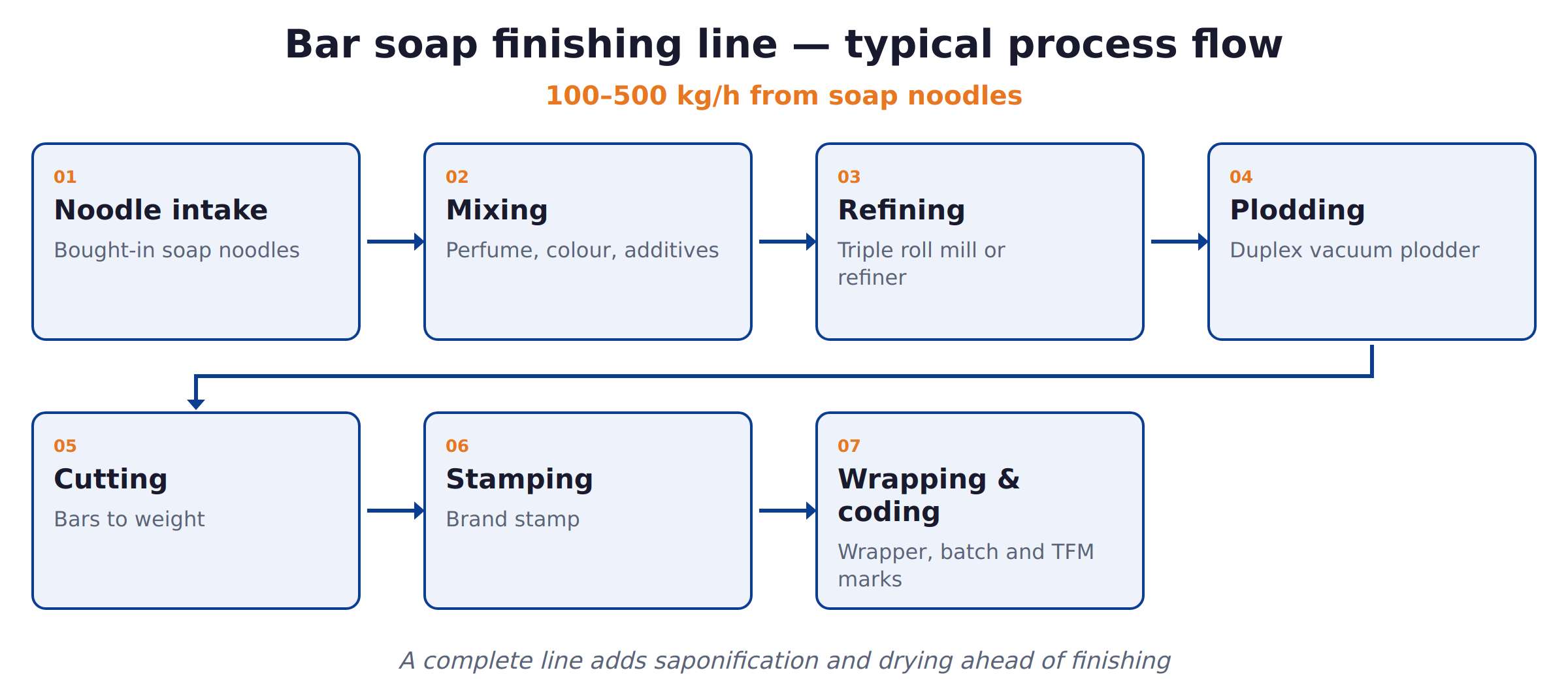
| Noodle finishing line | 100–500 kg an hour | About US$20,000–100,000 | Green bar and toilet soap from noodles |
| Complete bar soap line | 300–1,000 kg an hour | About US$150,000–400,000 | Bar soap from oils |
| Spray-dried powder tower | Tonnes an hour | Quoted per configuration | Large detergent makers |
Bars or liquids?
| Green bar and toilet soap | Liquid detergents | |
|---|---|---|
| Raw materials | Noodles, or oils, tallow and caustic soda | Surfactants, salt, thickener, preservative, fragrance |
| Equipment | Mixer, refiner, plodder, cutter, stamper, wrapper | Mixing tanks, filler, capper, labeller |
| Investment | Higher | Lower |
| Market | Every household, rural and urban | Towns, supermarkets, institutions |
Many businesses start with liquids and add bars, or restore an existing soap plant.
Raw materials
Soap oils, noodles, caustic soda and surfactants are largely imported, so prices follow world markets and transport costs through Beitbridge. Buy from reliable suppliers, test deliveries, store caustic soda safely and keep enough stock for several weeks, because border delays can stop production.
Recover an idle line first
Some Zimbabwean soap plants stand idle or run below capacity. Restoring a plodder, refiner or saponification section with new parts and recommissioning can be cheaper than buying new. Our guide new, used or recover explains the decision.
Power
Plodders, mixers and pumps need a reliable three-phase supply, and saponification needs steam. The Herald reported that by late October 2026 Zimbabwe had gone 304 days without scheduled load-shedding; faults still cause outages, so keep backup for critical motors.
Importing a soap line into Zimbabwe
| Item | 2026 basis |
|---|---|
| Payments at import | Duty, surtax where applicable, and VAT, per the Tariff Handbook |
| VAT | 15.5% from 1 January 2026 |
| CBCA | Pre-shipment certificate for regulated goods; 12% of CIF penalty without it |
| Route | Durban, then Beitbridge |
| Landed factor | About 1.45–1.60 times ex-works |
Our Zimbabwe import guide explains how to sequence CBCA with the factory test.
Standards and labels
Supermarkets expect soaps and detergents to meet SAZ standards. Label each product with its name, net quantity, directions, batch and your details, and test bar soaps for fatty matter and free alkali.
Worked example: a Bulawayo detergent maker adds green bar
A business in Bulawayo makes dishwashing liquid and hand wash for shops and institutions with mixing tanks and a semi-automatic filler. Wholesalers ask for green bar soap. The owner installs a noodle finishing line of about 300 kg an hour with a mixer, refiner, plodder, cutter and stamper, buys imported laundry noodles, and arranges a CBCA certificate before the line is loaded in China. Bars are cut, stamped and sold in cartons to wholesalers. The figures are illustrative.
How to compare quotes
- Kilograms per hour of finished product.
- Refiner and plodder sizes.
- Cutting and stamping for your bar sizes.
- Mixing tanks and filler type for liquids.
- Steam and power needs.
- Installation, commissioning and training.
- Spares: screws, dies, seals.
- References in southern Africa.
Choose by situation
- Liquid soap starter: a mixing and filling set.
- Green bar from noodles: a finishing line.
- Bar soap from oils: a complete saponification line.
- Idle plant owner: recovery of the existing line.
What we see in Zimbabwe
- Green bar soap is a household staple.
- Liquid detergents are growing in towns.
- Raw materials are largely imported.
- Some plants are idle, and recovery can pay first.
- CBCA certificates come before shipment.
- VAT is 15.5% from January 2026.
Getting green bar right
Green bar soap is judged by how hard it is, how long it lasts in the wash, how well it lathers in hard water, and whether it cracks or goes soft in storage. These depend on the oil blend or noodle quality, moisture, fillers and how long bars are left to set. Test bars in use as well as in the laboratory, keep the formula consistent, and record batch numbers so you can trace complaints.
Packing and distribution
Long bars are cut into pieces at the shop, packed in cartons for wholesalers, or wrapped individually for supermarkets. Cartons must protect bars in trucks on rough roads. Many producers sell through wholesalers who reach rural shops, so build relationships with a few reliable wholesalers and agree delivery and payment terms.
Raw material stock
Because many raw materials come through Beitbridge, keep enough stock of noodles, oils, caustic soda and fragrance to cover border delays.
Space and utilities
A soap plant needs a dry store for noodles or oils and packaging, a safe store for caustic soda and fragrances, three-phase power, water, drainage and, for saponification, steam. Plan the layout so raw materials enter at one end and finished cartons leave at the other.
Safety with caustic soda
Caustic soda causes serious burns. Store it locked and labelled, give staff gloves, goggles and aprons, keep water and an eyewash close to mixing areas, and train everyone before they handle it.
Liquid detergent quality
Check active content, thickness, pH and fragrance on every batch of liquid products, use clean, leak-free bottles, and keep retained samples so you can answer complaints.
Delivery
Plan transport to wholesalers and shops, pack cartons so bars do not break on rough roads, and agree payment terms before the first delivery.
Where CISH fits
We supply complete soap and detergent lines, noodle finishing, saponification, liquid mixing and filling, and we recover idle plants. CISH sources from audited factories in China, arranges CBCA with our factory test, ships through Durban and Beitbridge, clears, installs and commissions the line on your materials, and trains your team. For simple tanks, a local fabricator is usually the better buy.