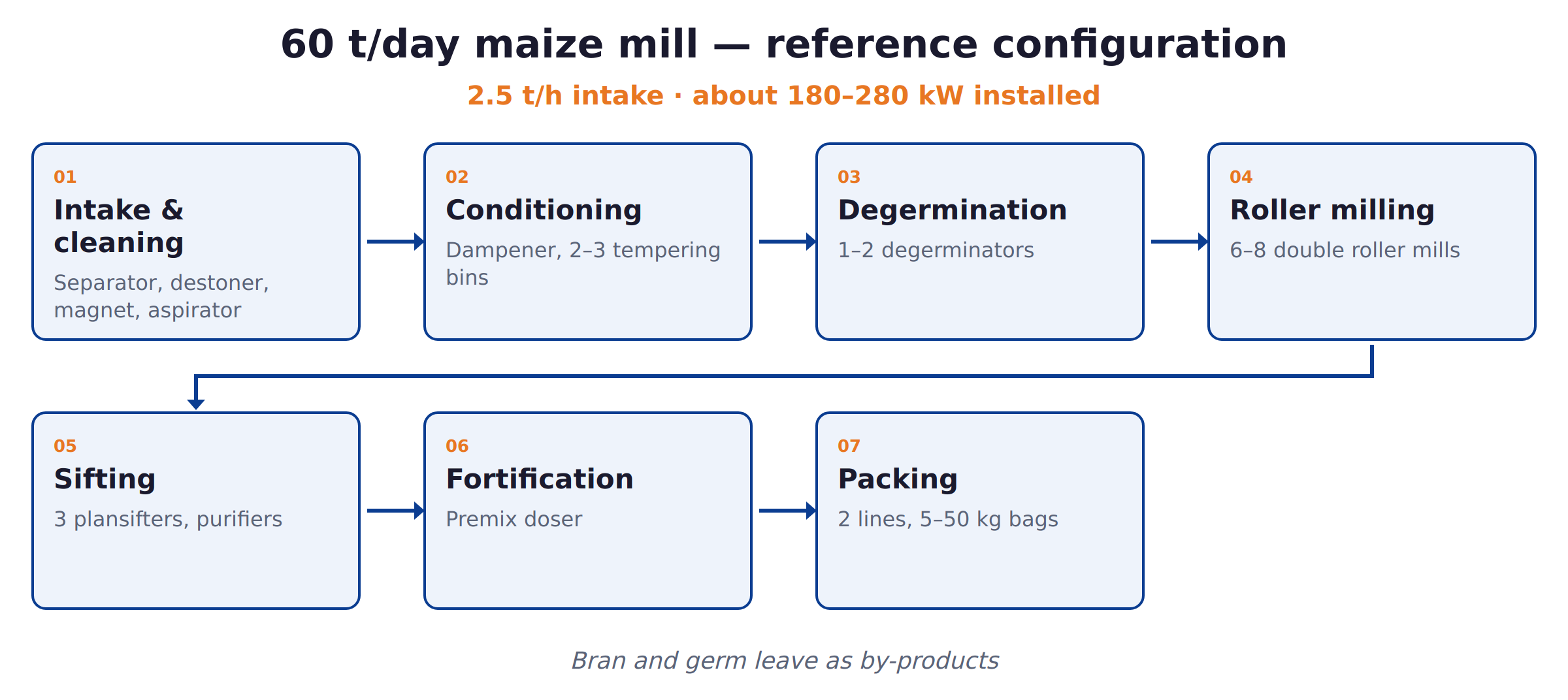
Most single posho mills of 7.5–15 HP are made and sold locally, often by jua kali workshops, and cost well under US$3,000. Electricity is the main running cost: EPRA's fuel energy cost charge was about KES 3.5 per kWh in August 2026, on top of Kenya Power's base tariff, so motor efficiency and good screens matter. Location decides volume: near homes, markets and maize farmers. When the business grows into branded grade 1 or sifted flour for supermarkets, the next step is a roller mill plant, about US$250,000–400,000 for 30 tonnes a day. CISH supplies, installs and commissions complete maize milling plants.
Two ways to make money
| Milling fee (service milling) | Selling your own unga | |
|---|---|---|
| How it works | Customers bring maize; you mill it for a fee | You buy maize, mill, pack and sell |
| Main costs | Power, labour, hammers and screens, rent | Maize, power, labour, packing, transport |
| Working capital | Very little | Maize stock |
| Income | Fee per kilogram or per tin | Margin per bag |
| Risk | Quiet months after harvest stock runs out | Maize price swings, competition |
Many mills combine the two: service milling every day, and their own unga when maize is cheap.
What a posho mill costs
| Item | Indicative cost |
|---|---|
| Single posho mill, 7.5–15 HP, electric or diesel | Well under US$3,000 for most locally made mills |
| Combined grade 1 and grade 2 machine | Higher, still mostly sold locally |
| Shed, wiring, three-phase connection | Varies by site |
| Small roller mill plant for branded flour | Priced per configuration below 30 t/day; about US$250,000–400,000 for 30 t/day |
Our posho mill price guide covers local machines and the step up to a plant.
Electricity: the cost to watch
Posho mills are run by electric motors or diesel engines. On grid power, your bill includes Kenya Power's base tariff plus pass-through charges; the fuel energy cost charge set by EPRA was about KES 3.5 per kWh in August 2026. Ways to keep the bill down:
- Correct motor size for the mill; an oversized motor wastes power.
- Sharp hammers and the right screen: worn hammers take longer and use more power per bag.
- Good belts and alignment.
- Mill in full loads, not small amounts that leave the motor running empty.
- Three-phase supply where available, for efficient motors.
Location
- Near customers: residential areas, markets and trading centres.
- Near maize: farming areas give steady service-milling business after harvest.
- Power available: a three-phase supply or a reliable diesel engine.
- Visibility and access: customers carry maize in bags and on motorbikes.
- Competition: count the mills nearby and how busy they are.
Working out payback (example)
- Investment: mill, motor, shed and wiring.
- Bags milled per day and fee per bag, or flour sold and margin per bag.
- Monthly costs: electricity, labour, hammers, screens, rent, licences.
- Monthly profit = income − costs.
- Payback (months) = investment ÷ monthly profit.
As an example, a single mill that grinds forty bags a day for a fee typically covers its power, labour and rent and pays back its machine in months rather than years, if the location is busy. A mill that sells its own unga earns more per bag but ties up money in maize. Use your own fees, volumes and power bill; the figures here are illustrative.
Licences and standards
Register the business, get a county business permit, and follow county public health rules for food premises if you pack and sell flour. Packed maize flour sold in shops is expected to carry the KEBS mark and meet standards for fortified maize flour; check what applies before selling branded unga.
When to grow into a plant
Signs it is time for a roller mill: supermarkets and schools ask for branded grade 1 or sifted flour; you sell more packed unga than service milling; you need consistent quality and fortification. A roller plant with degerming, sifting, fortification dosing and packing is a different investment. Imported capital goods usually enter at 0% under the EAC CET, but VAT of 16%, the 2.5% Import Declaration Fee and the 2% Railway Development Levy apply, and regulated goods go through KEBS pre-export verification. Our maize mill sizing guide shows what each size needs.
Worked example: two mills in Kakamega
A miller in Kakamega runs one electric posho mill for service milling at a market centre. After harvest the mill is busy; in the lean months queues shrink. He adds a second mill for grade 2 flour, buys maize at harvest and stores it, and packs 2 kg bags of his own unga for local shops through the lean months. Electricity bills fall after he replaces worn hammers and fits a correctly sized motor. The figures are illustrative.
Common mistakes
- A busy location ignored: a good mill in a quiet place earns little.
- Worn hammers and screens that waste power.
- Buying maize on credit without storage.
- Packing flour without permits or standards.
- Moving to a roller plant before having buyers.
What we see in Kenya
- Posho mills are everywhere, most made by local workshops.
- Service milling is the entry point.
- Electricity bills include pass-through charges, about KES 3.5 per kWh for fuel energy cost in August 2026.
- Branded unga needs KEBS approval.
- Roller plants suit supermarket and school supply.
Maintenance that pays
A posho mill earns only when it runs. Check hammers and screens every week, turn or replace worn hammers, keep belts tight and aligned, grease bearings, and clean the mill and the room daily so flour dust does not build up. Keep a spare set of hammers, a screen and a belt on the shelf. A local jua kali workshop can usually re-hard-face or replace hammers quickly and cheaply.
Customers and service
Service milling customers value short queues, honest weighing, a clean mill and fine, even unga. Use a calibrated scale, keep the mill area clean and dry, and set fair fees displayed on a board. Many mills also sell maize, bags and other small items to customers who wait, which adds income from the same visit.
Records
Write down bags milled, fees collected and units of power used each day. After a month you will know your cost per bag and your busiest days, and you can see quickly when worn hammers start pushing up the power bill.
Where CISH fits
For single posho mills, a local jua kali workshop is usually the better buy, and we will say so. When the business grows into branded flour, CISH supplies complete maize milling plants, cleaning, degerming, roller milling, sifting, fortification and packing, from audited factories in China, ships them to Mombasa, clears, installs and commissions them, and trains your miller.