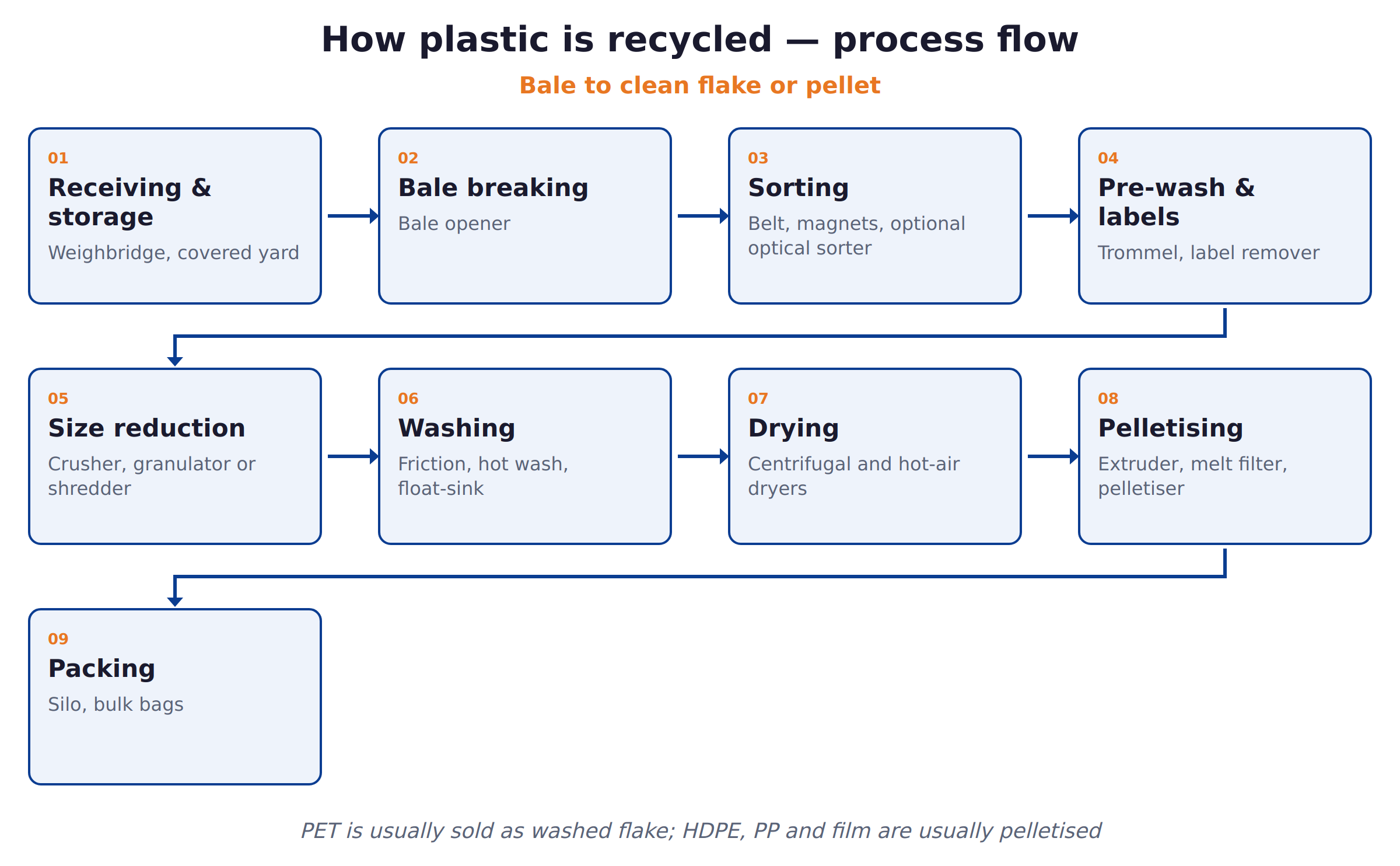
Kenya banned plastic carrier bags in 2017, and much of today's recycling centres on bottles and rigid plastics. A plant sorts bales, shreds or crushes the plastic, washes and dries it, and sells flakes or pelletises them for local moulders and pipe makers. Capital goods usually enter at 0% EAC duty, with 16% VAT, the 2.5% IDF and the 2% RDL. Electricity, with a fuel energy cost charge of about KES 3.5 per kWh in August 2026, is a major running cost. CISH supplies, installs and commissions complete recycling lines.
Plastic recycling machine prices in Kenya, 2026
| What you buy | Capacity | Indicative price (2026) |
|---|---|---|
| Single shredder or crusher | Per machine | Low tens of thousands of US dollars |
| Complete washing line | 300–1,000 kg/h | About US$120,000–350,000 ex-works |
| PET bottle flake line | About 500 kg/h | About US$150,000–200,000 ex-works |
| Pelletising line added | Per line | About US$80,000–120,000 more |
| Landed and installed | Any of the above | Typically 25–45% more than ex-works, more inland |
Which plastics, which product
| Plastic | Common sources in Kenya | Usual product |
|---|---|---|
| PET | Water and soda bottles | Washed flake for fibre, strapping or export |
| HDPE | Milk and juice bottles, jerrycans, containers | Pellets for moulding and pipes |
| PP | Crates, buckets, chairs, caps | Pellets for moulded goods |
| LDPE film | Packaging film, agricultural film | Pellets, if washed and dried well |
Yield decides profit
The yield is the clean product you sell divided by the bales you buy. Clean, sorted bottle bales often yield in the region of 70–85% clean flake; mixed or dirty material yields less. Pay suppliers on clear quality grades, sort carefully, and test a few tonnes before signing supply contracts.
Water and electricity
Washing lines use water continuously, so a borehole or reliable municipal supply with settling and filtration for recirculation is usual. Hot washing, dryers and pelletising extruders are heavy power users. EPRA's fuel energy cost charge was about KES 3.5 per kWh in August 2026, on top of Kenya Power's base tariff, so choose efficient motors and heaters and run the extruder at steady output. Size the connection for starting current.
Importing into Kenya
| Item | 2026 basis |
|---|---|
| Duty | 0% EAC CET on most capital goods |
| VAT | 16% |
| Import Declaration Fee | 2.5% of customs value |
| Railway Development Levy | 2% of customs value |
| KEBS PVoC | For regulated products, before shipment |
| Port and inland | Mombasa, then road or SGR to Nairobi and beyond |
Rules to check
Kenya banned plastic carrier bags in 2017, and has moved towards extended producer responsibility for packaging. A recycling plant also needs environmental approvals and must handle waste water and residues properly. Check the current requirements for your site and activity with NEMA and your county before you buy equipment.
Worked example: an HDPE and PP pellet plant
A recycler near Nairobi buys sorted HDPE and PP from aggregators and sells it crushed. Local moulders want pellets. The recycler installs a washing line of about 500 kg an hour with a crusher, friction washer, float-sink tank and dryer, followed by a pelletising extruder with a melt filter. It builds settling tanks to recycle water and upgrades its power connection. Pellets sell at a better price than crushed regrind, and colour sorting by hand before crushing lifts the price further. The figures are illustrative.
How to compare quotes
- Output in kg/h of clean flake or pellets.
- Yield on your bales.
- Sorting and label removal.
- Hot wash for PET.
- Melt filter and degassing on the pelletiser.
- Water use and recirculation.
- Power: connected load and efficiency.
- Installation, commissioning on your material, and training.
- Spares: blades, screens, filters.
- References of plants in East Africa.
Choose by situation
- Aggregator adding value: a crusher and simple washing.
- PET flake producer: a PET washing line with hot wash.
- Pellet supplier to moulders: washing plus pelletising for HDPE and PP.
- Large recycler: several lines with optical sorting.
Setting up the site
A recycling plant needs more yard than building. Plan covered storage for bales, a sorting area with good light, the washing line under a roof, settling tanks or ponds for water, a dry store for finished flakes or pellets, and space for trucks. Keep bales in stacks with fire breaks, away from the extruder and any fuel, and keep fire extinguishers and hoses ready. Crushers are loud, so locate them away from neighbours and provide hearing protection.
Paying suppliers
Collectors and aggregators sell to whoever pays promptly and fairly. Publish clear prices by grade, weigh in front of suppliers, and pay on time; reliable payment secures steadier, cleaner supply than chasing the lowest price per kilogram.
Cost per tonne
Work out the cost of a tonne of clean flake or pellets before you buy: the price paid for bales divided by the yield, plus electricity, water, labour, consumables such as caustic and screens, transport and overheads. Compare it with what buyers pay for the grade you can make. Electricity is often the second-largest cost after the bales, so meter the line and watch kWh per tonne. A small improvement in yield or sorting quality usually does more for profit than a faster machine, because every kilogram lost in washing was paid for at the bale price.
Buyers and specifications
Agree specifications with buyers before installing a line: flake size, moisture, colour and PVC content for PET, or melt flow and contamination for pellets. Send samples, and keep a sample from every batch you sell.
Mistakes we see
- Buying before testing bales.
- No melt filter on pellets.
- Discharging untreated wash water.
- Underestimating electricity.
- No agreed buyer specification.
What we see in Kenya
- Carrier bags were banned in 2017; bottles and rigid plastics are the main streams.
- Collection is mostly informal, through pickers and aggregators.
- Local moulders and pipe makers buy HDPE and PP pellets.
- Capital goods are usually duty-free under the EAC CET.
- VAT, the IDF and the RDL apply to imports.
- PVoC comes before shipment for regulated goods.
- Electricity includes a fuel energy cost charge of about KES 3.5 per kWh in August 2026.
- Environmental approvals come from NEMA and counties.
Where CISH fits
We supply complete recycling lines, sorting, washing, drying and pelletising, from audited factories in China, sized to your plastics and output. CISH ships to Mombasa, clears, installs and commissions the line on your material with yield measured, and trains your team. For a single shredder, a local dealer is usually the better buy.