Small producers do most of this by hand with a local slicer and a frying pot, sold in naira. Fully automatic lines with continuous frying, oil filtration and nitrogen-flush packing are priced per configuration. Landed through Lagos, budget roughly 1.25–1.45 times ex-works. Imports pay the ECOWAS tariff plus a 7% surcharge on the duty, the 1% CISS, 0.5% ETLS and 7.5% VAT, after Form M on B'Odogwu. Chips must be registered with NAFDAC, and plantain supply, oil cost and packaging decide the margin. CISH supplies, installs and commissions complete plantain chips lines.
Plantain chips machine prices in Nigeria, 2026
| What you buy | Capacity | Indicative price (2026) | Fits |
|---|---|---|---|
| Local slicer and frying pot | Small batches | Sold locally in naira | Home and market producers |
| Single imported machines (slicer, fryer, de-oiler, seasoner) | Small output | Priced machine by machine | Small factories filling gaps |
| Semi-automatic chips line | About 100–300 kg of chips an hour | About US$15,000–80,000 ex-works | Brands supplying shops and distributors |
| Automatic line with continuous fryer and nitrogen packing | Higher output | Quoted per configuration | Regional and national brands |
Indicative ex-works prices, not quotes. Freight, duties, clearing, installation and a generator come on top.
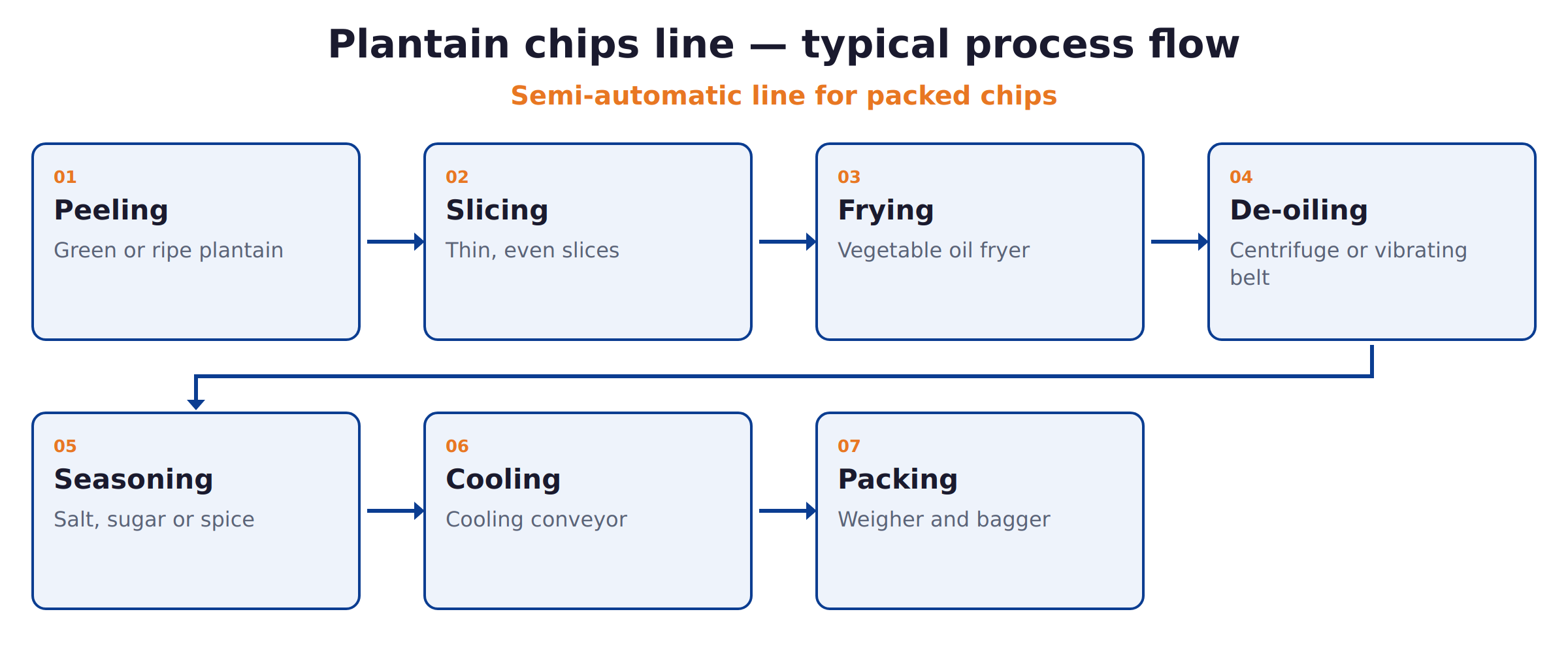
How the line works
- Washing and peeling: plantain is washed and peeled by hand or with a peeling machine; green plantain peels better by hand at small scale.
- Slicing: a slicer cuts round or long slices of even thickness; even thickness means even frying.
- Frying: batch fryers suit small runs; continuous fryers keep oil temperature steady at volume.
- De-oiling: a centrifuge spins off surface oil so chips are less greasy and keep longer.
- Seasoning: a drum coats chips with salt, pepper, sugar or spice blends.
- Cooling and packing: chips cool before packing; a vertical packing machine fills and seals bags, with nitrogen flushing for longer shelf life.
Oil is the biggest running cost after plantain
Fryers use and absorb oil. Keep oil at the right temperature, filter it during the day, top it up and change it on a schedule. Continuous fryers with oil filtration and heat exchangers use oil more efficiently. Diesel or gas heating is common where grid power is unreliable.
Plantain supply
Plantain is grown widely in southern Nigeria, and prices change with the season. Buy from farmers and markets close to the factory, agree volumes with aggregators for steady supply, and store plantain so it does not ripen too fast if you make green-plantain chips. The yield of chips from raw plantain depends on ripeness, peel losses and how thin you slice, so measure it on your own fruit.
Power
NERC's third-quarter 2025 report put available grid capacity at about 5.4 GW nationally, and the Manufacturers Association estimated factories spent around ₦1.4 trillion on their own power in 2025. A chips line needs power for slicers, centrifuges, conveyors, seasoning and packing, and heat for frying; plan a generator and gas or diesel for the fryer.
Importing into Nigeria
| Charge | 2026 basis |
|---|---|
| Import duty | ECOWAS CET band for each HS code |
| Surcharge | 7% of the duty |
| CISS | 1% of FOB value |
| ETLS | 0.5% of CIF value |
| VAT | 7.5% |
| Form M | Before shipment, on the B'Odogwu portal |
NAFDAC and packaging
Packaged snacks fall under NAFDAC's mandate over food. Register each product and pack size, label it with ingredients, net weight, batch, dates and your address, and prepare for a factory inspection: washable surfaces, clean water, pest control and staff hygiene. Use bags with a good moisture barrier; nitrogen flushing slows the chips going stale and soft.
Worked example: a Lagos snack brand scales up
A snack business in Lagos fries plantain chips by hand for supermarkets and schools, about 300 kg a week. A distributor offers national listings for 2 tonnes a month. The business installs a semi-automatic line with a slicer, a batch fryer with oil filtration, a de-oiling centrifuge, a seasoning drum and a vertical packing machine with nitrogen flushing, in a cleaned and tiled production room, with a generator and gas for frying. It registers its new pack sizes with NAFDAC and contracts plantain aggregators in Ogun. The figures are illustrative.
Cost per pack
Add plantain, oil, seasoning, packaging film, nitrogen, gas or diesel, labour, NAFDAC and testing costs, rent, distribution and loan repayments. With the maximum lending rate around 33% in mid-2026, finance cost per pack matters; size the line to orders you have and keep stock low. Compare your cost per pack with shelf prices and leave room for distributor and retailer margins.
How to compare quotes
- Kilograms of finished chips per hour, not raw plantain.
- Slicer type and slice thickness range.
- Fryer: batch or continuous, heating type, oil capacity, filtration.
- De-oiling centrifuge capacity.
- Seasoning drum and dosing.
- Packing machine: bag sizes, speed, nitrogen flushing.
- Connected load and fuel use.
- Installation, commissioning on your plantain, and training.
- Spares: blades, belts, filters, heating elements.
- References of snack lines in West Africa.
Choose by situation
- Market producer: a local slicer and fryer.
- Brand supplying shops: a semi-automatic line with a packing machine.
- National distribution: an automatic line with continuous frying and nitrogen packing.
What we see in Nigeria
- Plantain chips are a popular snack in shops, schools and on the street.
- Most producers start by hand and add machines as orders grow.
- Oil and packaging are large costs after plantain.
- Generators and gas power most lines.
- NAFDAC registration is required for packaged snacks.
- Credit is costly, so size the line to real orders.
Quality buyers check
Supermarkets and distributors judge plantain chips on colour, crispness, oil content, seasoning and breakage in the bag. Fry at a steady temperature so chips do not darken or stay soft, de-oil every batch, and cool chips before packing so steam does not soften them. Check a sample from every batch for taste and texture, weigh packs, and keep retained samples with the batch number. Rancid oil is the fastest way to lose a listing, so change oil on schedule and record it.
Staff and hygiene
A semi-automatic line needs people for peeling, feeding the slicer, frying, seasoning and packing. Train them in hand hygiene, protective clothing and safe work around hot oil, and keep raw plantain, frying and packing areas apart so peel and dirt do not reach finished chips.
Where CISH fits
We supply complete plantain chips lines, washing, slicing, frying, de-oiling, seasoning and packing, from audited factories in China, sized to your output. CISH ships to Lagos, clears, installs and commissions the line on your plantain, and trains your team. For a single slicer or frying pot, a local supplier is usually the better buy.