In villages and town neighbourhoods, small mills offer two services: kukoboa, dehulling maize to remove the bran and germ, and kusaga, grinding it into flour on a hammer mill, usually for customers who bring their own maize. Those machines are made and sold locally for a small part of a plant budget. Commercial millers make packed flour for shops and supermarkets: sembe, the fine white flour from dehulled maize, and dona, whole-grain flour with more bran. A commercial plant cleans, conditions, degerms, mills, sifts and packs, and as an indication for 2026 a complete plant of about 30 tonnes of maize a day costs about US$250,000–400,000, 60 tonnes a day about US$700,000–1.1 million, and 240 tonnes a day about US$2.0–3.5 million, landed and commissioned for the mill and packaging scope. Electric mills cost less to run where power is reliable; diesel suits sites without grid supply. Packed flour sold in Tanzania must meet TBS standards and labelling rules. Capital goods generally pay 0% duty under the EAC Common External Tariff, and VAT may be deferred for qualifying capital goods. CISH supplies, installs and commissions complete maize milling plants for sembe and dona.
Kukoboa and kusaga: the village mill
| Service | What it does | Machine | Output |
|---|---|---|---|
| Kukoboa | Removes bran and germ from the kernel | Dehuller (huller) | Dehulled maize for sembe |
| Kusaga | Grinds maize into flour | Hammer mill with screen | Flour; dona if not dehulled |
Village mills charge customers per bucket or kilogram. The machines are robust, made by local workshops or imported, and run on electricity or diesel. They suit service milling, but they do not make consistent packed flour for retail.
Sembe and dona: what retail flour needs
- Sembe: fine white flour from dehulled and degermed maize; the most popular packed flour in towns.
- Dona: whole-grain flour with bran, valued for nutrition and price.
Commercial plants control particle size, moisture and extraction rate, pack accurately and label to TBS standards, which village mills cannot.
Complete plant prices, 2026
| Plant | Maize per day | Indicative price, landed and commissioned (2026) |
|---|---|---|
| Small commercial plant | About 30 t | About US$250,000–400,000 |
| Medium plant | About 60 t | About US$700,000–1.1 million |
| Large plant | About 240 t | About US$2.0–3.5 million |
| Building, civils, grain storage, working capital | All | Extra; inland sites also cost more to reach than the coast |
Our maize mill sizing guide sets out what each plant includes.
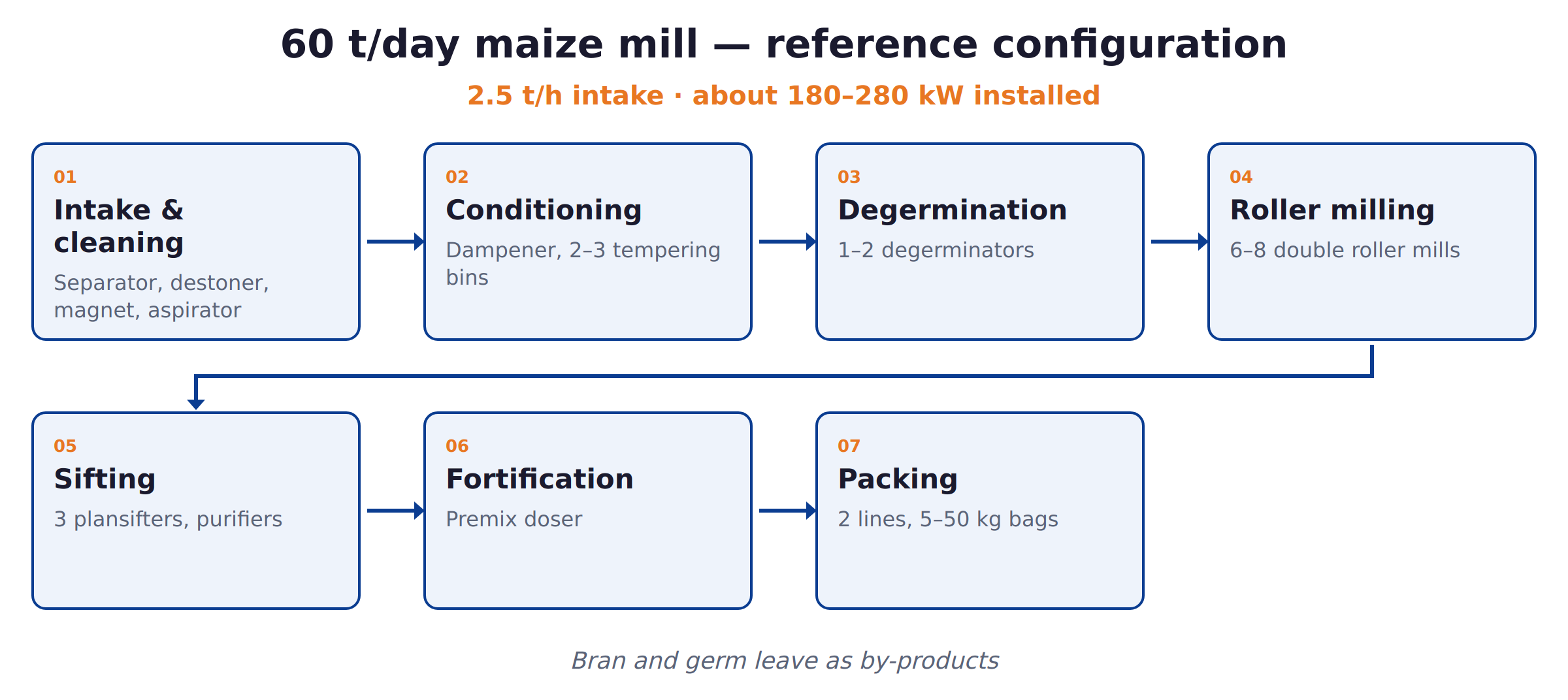
What is in a complete plant
- Intake and cleaning: sieves, de-stoners and magnets.
- Conditioning: adding water and resting maize for better degermination.
- Degermination: removing bran and germ for sembe.
- Milling: roller mills or hammer mills, depending on the plant.
- Sifting: plansifters to separate flour grades.
- Fortification (where required): dosing vitamins and minerals.
- Packing: weighing and bagging in retail and bulk packs.
- By-products: bran and germ for animal feed.
Electric or diesel
Electric mills have lower running costs and less maintenance where the grid is reliable. Diesel engines suit remote sites and backup, but fuel and servicing cost more. Many commercial plants run on grid power with a generator for critical sections. Check your connection capacity with the utility before choosing plant size.
What drives the price
- Capacity in tonnes a day.
- Roller mills or hammer mills: roller mills give finer, more consistent sembe at higher cost.
- Degermination quality and extraction rate.
- Automation, controls and packing.
- Storage: silos or warehouses for maize and flour.
- Building and civils.
Landed cost in Tanzania
Flour milling machinery, cleaners, sifters and packing machines are capital goods that generally enter duty-free under the EAC tariff, subject to their codes; the steel structure, silos and spare parts may be classified differently. VAT of 18% applies at import unless the plant qualifies for deferment through TRA. Electrical panels and some items may be on TBS's PVoC list and need a Certificate of Conformity before shipping. A complete mill also needs a building tall enough for the milling tower, maize storage, foundations, power connection, installation and training, which come on top of the plant price. Our guide to importing a production line into Tanzania explains the route.
Maize supply and working capital
Maize is harvested seasonally; prices are often lowest after harvest. Commercial millers buy and store maize to run all year, which needs dry storage and working capital. Test maize for moisture and aflatoxins: contaminated maize can make flour unsafe and fail standards.
How to compare quotes
Ask each supplier for maize per day, flour extraction rate and grades, power and steam needs, roller or hammer milling, degermination performance on your maize, packing accuracy, installation, commissioning, training and spares. Visit a running plant if you can.
From a delivered project: On a delivered 60 t/day super-fine maize mill more than six hours from the nearest engineering hub, the mill itself was the easy part: extra pre-cleaning for maize at 11–16% moisture, an on-site critical-spares buffer and a year of support took the plant to about 85% of nameplate by month four. Read the maize mill case study.
Common mistakes
- Buying a village mill to make retail flour.
- No cleaning or degermination, giving poor sembe.
- No maize storage or cash for the harvest season.
- No aflatoxin testing.
- Power supply too small for the plant.
Who buys packed flour
Packed sembe and dona sell through wholesalers and distributors to shops, supermarkets and kiosks, and directly to schools, hospitals, prisons, the army and other institutions that buy in bulk. Supermarkets want consistent quality, accurate weights, attractive packs and certification; institutions often buy through tenders that specify standards and require certification and delivery capacity. Many commercial millers also sell bran and germ to livestock farmers and feed millers, which adds revenue. Plan your packs, from 1 kg and 2 kg retail bags to 25 kg and 50 kg bulk bags, around these buyers.
Fortification
Packed maize flour in Tanzania may need to be fortified with vitamins and minerals under national standards and regulations; check the current requirement with TBS and the food authorities before you design the plant, and include a micro-dosing feeder if it applies. Fortification needs accurate dosing, mixing and records, and buyers increasingly ask for it.
From village mill to commercial mill
Many commercial millers began with kukoboa and kusaga service mills. The jump to packed flour is not just a bigger machine: it means buying maize, storing it, controlling quality, packing to weight, branding and selling. Start with a plant size you can keep supplied with maize and sell all year, and grow from there.
Quality control in a commercial mill
A commercial mill tests incoming maize for moisture, foreign matter and aflatoxins, checks flour moisture and particle size during production, and checks pack weights at the packing machine. A small laboratory with a moisture meter, sieves, a balance and an aflatoxin test kit covers most of these. Keep results in batch records; TBS and large buyers will ask for them, and they protect you if a customer complains.
Power and running costs
Milling is power-hungry. Roller mills, hammer mills, fans and conveyors all draw current, so power is one of the largest running costs after maize. Ask suppliers for kWh per tonne of flour, compare it between quotes, and use it in your price.
Where CISH fits
We supply complete maize milling plants, cleaning, conditioning, degermination, milling, sifting, fortification and packing, from audited factories in China, sized to your maize and flour. CISH ships the plant, installs and commissions it on your maize, and trains your team. For kukoboa and kusaga service milling, a local workshop is usually the better buy.