These machines are made and sold locally in naira and cost a small fraction of a mill project. Imported mills pay ECOWAS CET duty plus surcharge, CISS, ETLS and 7.5% VAT, Form M runs on the B'Odogwu portal, and power is your own problem: grid capacity was about 5.4 GW nationally in 2025.
Maize grinding and milling prices in Nigeria, 2026
| What you buy | Typical scale | Indicative price (2026) | Fits |
|---|---|---|---|
| Local hammer mill (dry or wet) | Service grinding in markets | Priced locally in naira; a small part of any mill project | Grinding customers' maize, ogi |
| Local dehuller and grinder set | Small flour sales | Priced locally | Neighbourhood flour sellers |
| Complete maize mill | About 30 t/day | About US$250,000–400,000 | Packed flour and grits brands |
| Larger mill | About 60 t/day | About US$700,000–1.1 million | Regional brands, food makers |
| Industrial mill | About 240 t/day | About US$2.0–3.5 million | Large processors |
Complete mills are priced in US dollars, including packing; landed and installed costs on a coastal route are typically 1.25–1.45 times the equipment price.
Grinding or milling: what is the difference?
A grinding machine smashes the whole grain through a screen. It is cheap and simple, and suits ogi, tuwo masara flour and animal feed. Everything goes into the flour: germ, bran and endosperm, so the flour is darker, higher in fat and has a shorter shelf life.
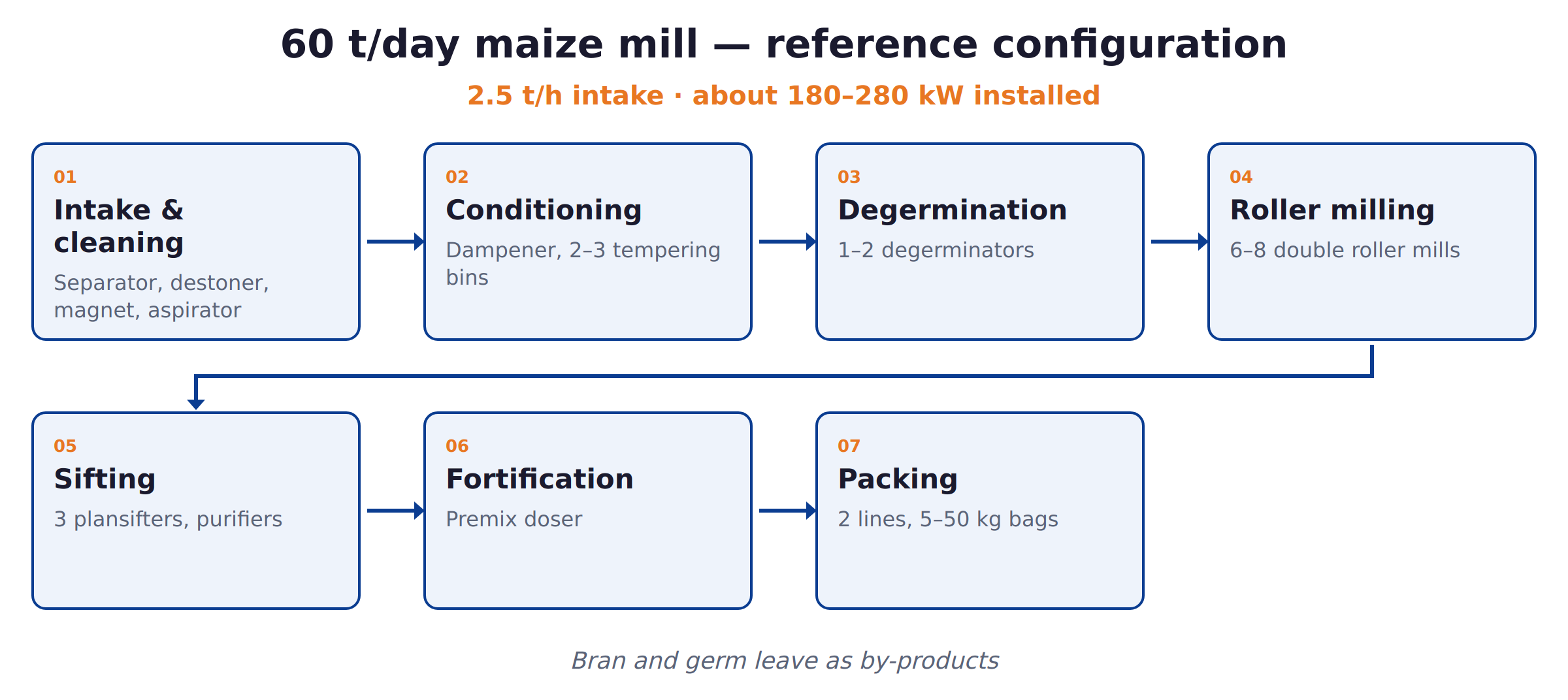
A maize mill cleans the grain, removes germ and bran in a degerminator, mills the endosperm on rollers and sifts it into products: fine flour, grits for breweries and snack makers, semolina, and bran and germ for feed. The products are whiter, store longer and suit packed retail sale and industrial buyers.
Who buys milled maize products in Nigeria
- Households buying packed maize flour for tuwo, pap and baking.
- Breweries and beverage makers buying maize grits.
- Snack and cereal makers buying grits and flour.
- Feed millers buying bran and germ.
- Bakers using maize flour in blends.
A mill that has supply contracts with one or two industrial buyers before it starts is far safer than one selling only to the open market.
Power: plan for self-generation
NERC's third-quarter 2025 report put available grid capacity at about 5.4 GW for the whole country, and the Manufacturers Association estimated factories spent around ₦1.4 trillion generating their own power in 2025. A 30 tonne a day mill needs a substantial three-phase supply for roller mills, sifters, fans and conveyors. Plan a generator or a dedicated supply, and include diesel or gas in your cost per tonne.
Landed cost in Nigeria
| Item | How it applies |
|---|---|
| Duty | ECOWAS CET band for each item's HS code |
| Surcharge | 7% of the duty |
| CISS | 1% of FOB |
| ETLS | 0.5% of CIF |
| VAT | 7.5% on value plus duties |
| Form M | Opened on the B'Odogwu portal before shipment |
| 4% FOB charge | Suspended; confirm the position before importing |
Our Nigeria import guide explains the sequence.
Finance
The Central Bank's money market indicators put the maximum lending rate at around 33.16% in mid-2026. At that cost of credit, size the mill to confirmed demand, start with one shift, and add capacity as contracts grow.
Worked example: from service grinding to a 30 tonne mill
A grain trader in Kaduna runs several hammer mills for customers and sells maize. A brewery buyer offers a contract for grits, and supermarkets want packed white maize flour. A 30 tonne a day mill with cleaning, degerming, roller milling, sifting and bagging lets the trader sell grits, flour and bran. The project needs a building with height for elevators and sifters, silos or a warehouse for maize, a generator, and working capital to buy maize at harvest. The hammer mills keep serving walk-in customers. The figures are illustrative.
How to compare quotes
- Tonnes of maize per day and the products each quote delivers.
- Degermination method and fat content of the flour.
- Roller mills and sifters: number and size.
- Cleaning and destoning included.
- Packing: bag sizes and weighing accuracy.
- Power: connected load and generator size.
- Installation, commissioning on your maize, and training.
- Spares: rolls, screens, sieves.
- Building drawings and heights.
- References of mills in West Africa.
Choose by situation
- Grinding for customers: a local hammer mill.
- Small flour sales: a local dehuller and grinder set.
- Packed flour and grits brand: a complete 30 tonne a day mill.
- Industrial supplier: a 60 tonne a day mill or larger, with storage.
Wet milling for ogi and pap
Ogi, also called pap or akamu, is made by soaking maize, wet-grinding it, sieving out the chaff and letting the slurry ferment and settle. In markets this is done on wet hammer or disc mills for customers. A commercial ogi or custard-style product needs stainless soaking tanks, a wet mill, a sieving system, settling or pressing, and drying if you sell powder, plus strict hygiene because the wet product spoils quickly. It is a different line from dry maize milling, so decide which products you will sell before you choose equipment, and register packaged products with NAFDAC.
Mistakes we see
- Selling hammer-milled flour as premium flour. It spoils sooner.
- No destoner. Stones in flour lose customers.
- No plan for bran and germ. They are income, not waste.
- Ignoring power cost in the price per tonne.
- No maize storage for the months after harvest.
What we see in Nigeria
- Hammer mills are everywhere for service grinding and ogi.
- Industrial buyers want grits of consistent size and low fat.
- Grid capacity is limited: about 5.4 GW nationally in 2025.
- Self-generation is a major cost: about ₦1.4 trillion across manufacturers in 2025.
- Credit is expensive, with the maximum lending rate around 33% in mid-2026.
- Imports pay CET duty plus surcharge, CISS, ETLS and VAT.
- Form M runs on the B'Odogwu portal.
- Packed foods need NAFDAC registration before sale.
Where CISH fits
We supply complete maize mills, cleaning, degerming, milling, sifting and packing, from audited factories in China, sized to your maize and market. CISH ships and clears the mill, installs and commissions it with output demonstrated on your maize, and trains your miller. For a single grinding machine, a local fabricator is the better buy.